Common Bolt Shear Failures Engineers Should Consider in Design
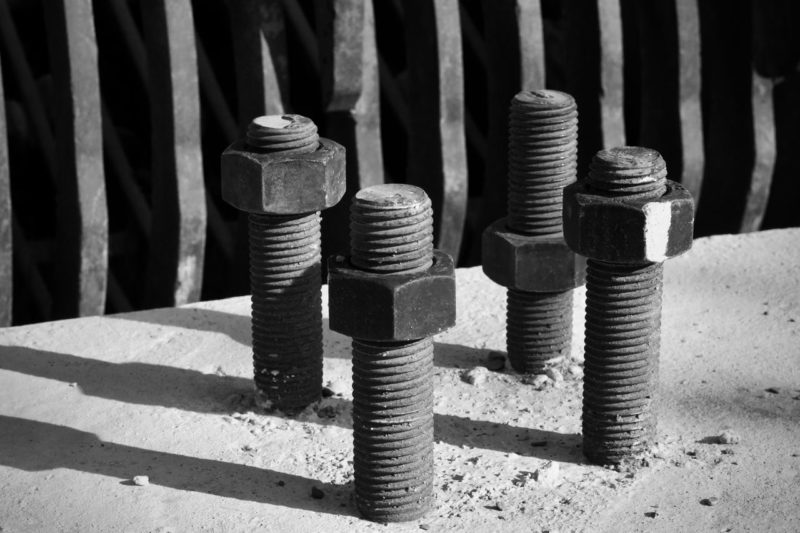
A bolted connection is never designed against a single failure mode. The bolt shank can shear, but the plate around the hole can crush first, the edge can tear out, or a whole block of steel can rip away from the joint. Each mechanism has its own formula and its own limit state, and the weakest one sets the capacity of the connection.
This article walks through the common shear failure modes in bolted connections: shank shear, hole bearing, edge tearout, net section rupture, block shear, and slip in preloaded bolts. For each one, it covers the governing standard, the geometric or material parameter that controls it, and why it cannot be skipped during a check.
A Bolt Rarely Fails in Just One Way
A bolted shear connection carries load through at least two parts: the bolt itself and the plates it clamps together. The capacity of the joint is always the minimum of several independent checks. A class 10.9 bolt can have a wide margin on shear, and the connection can still fail, simply because the plate edge sits too close to the hole.
Design codes require every mode to be checked. EN 1993-1-8 collects them in Table 3.4: shear resistance, bearing resistance, and slip resistance for preloaded bolts. AISC 360 sets up the checks in a similar way, but since 2022, it separates bearing and tearout into distinct limit states. Miss any one of these modes, and the stated safety margin exists only on paper.
Shank Shear: Where the Check Starts
Shank shear is the most direct mechanism. The bolt acts as a pin, and under enough transverse force, its body is cut through along the plane where the plates meet.
The check starts with a simple comparison. The acting bolt shear stress is measured against the design shear resistance. Under EN 1993-1-8, that resistance is F_v, Rd = αv · f_ub · A / γ_M2, where f_ub is the ultimate tensile strength of the bolt material and γ_M2 = 1.25. The αv coefficient depends on where the shear plane falls. For classes 4.6, 5.6, and 8.8, it equals 0.6. For class 10.9, when the shear plane passes through the threads, αv drops to 0.5, and the calculation uses the threaded stress area As instead of the gross shank area.
This distinction is easy to lose. A high-grade bolt with threads in the shear plane gives up roughly 17% of its resistance compared to the smooth shank. AISC captures the same physics with its N and X designations: threads included in the shear plane (N) means lower nominal resistance, threads excluded (X) means about a quarter more.
Then there is the geometry of the joint itself. A bolt that passes through three members and works across two shear planes (double shear) has twice the resistance it would have on a single plane (single shear). The same bolt carries a different load in a lap splice than in a clevis.
Hole Bearing and Edge Tearout
The bolt can survive shear, and the connection can still fail. When the pressure from the shank exceeds the strength of the plate, the steel around the hole begins to yield, and the hole stretches into an oval. This is bearing. Its resistance scales with the plate: F_b, Rd = k₁ · αb · f_u · d · t / γ_M2, where f_u is the ultimate strength of the plate, not the bolt.
The dominant parameter here is end distance, the gap from the hole center to the plate edge measured along the line of force. The αb coefficient is directly proportional to it. At the minimum permitted end distance of 1.2 d₀, αb drops to 0.4, so the connection carries only 40% of its maximum bearing capacity.
At very short end distances, the mechanism changes. Instead of ductile bearing, the connection fails by tearout: the material between the hole and the edge shears off along shear paths toward the free edge, and the bolt breaks free. AISC 360-22 split tearout into a separate check precisely because the failure behaves differently. Bearing is ductile: the plate deforms visibly before it lets go. Tearout is brittle and sudden.
Net Section and Block Shear
The next two mechanisms break the plate while the bolt stays intact.
Net section rupture applies to tension members. A row of holes reduces the cross-section, and under enough tension, the plate tears along the line of holes. The net area is always smaller than the gross area, and it is the net area that governs rupture strength.
Block shear is more involved. A whole block of steel tears out of the plate: one face fails in shear along the bolt line, the perpendicular face fails in tension. It shows up in gusset plates, coped beams, and angle connections. AISC 360-22 handles it through Equation J4-5, adding the shear resistance on one plane to the tension resistance on the other. One detail matters: block shear initiates at the end bolt nearest the edge. That makes a short end distance doubly dangerous, since it weakens both bearing and block shear.
Slip and Prying Action
Not every connection is allowed to bear directly on the bolts. In slip-critical connections, the load travels through friction between the plates, generated by bolt preload. As long as that friction holds, the bolt shank barely sees any shear. Under RCSC (2020), the minimum preload is 70% of the bolt’s ultimate tensile strength, and only classes 8.8 and 10.9 are permitted as preloaded bolts.
Slip occurs when the shear force exceeds the available friction. The connection jumps into contact with the hole walls, and the bolt switches at once to shear and bearing. For dynamically loaded and fatigue-sensitive joints, that is an unacceptable limit state.
Prying action is a separate case. It has nothing to do with shear directly, but in tension connections, a thin plate bends and adds axial force to the bolt, sometimes 15 to 30% above the applied load. That extra force reduces the tension margin, and through the combined shear-and-tension check, it lowers the allowable shear as well.
Long Joints: Group Strength Falls Below the Sum
A common mistake is to treat the strength of a bolt group as simple multiplication: number of bolts times the resistance of one. In long rows, that does not hold.
Once the distance between the end bolts along the line of force exceeds 15d, elastic redistribution sets in. The end bolts in the row take a disproportionate share of the load while the middle bolts stay underused. EN 1993-1-8 accounts for this with a reduction factor, β_Lf = 1 – (Lj – 15d) / (200d), which never falls below 0.75. For the longest joints, group strength drops to about three quarters of the nominal sum.
Why Manual Checking Does Not Scale
Each of these mechanisms has its own formula, and each depends on its own parameter: bolt class, plate strength, end distance, element thickness, and row length. For a single joint, the check fits on half a page. On a real structure with hundreds of connections, running every mode by hand for every bolt becomes a source of error. It is easy to pick the wrong area, miss threads in the shear plane, or apply the long-joint factor where it does not belong.
This is where automated code checking inside the FEA model helps. The design force in each bolt is taken straight from the finite element model, and the resistances for every limit state are computed for all connections at once, against the chosen standard, whether that is Eurocode 3, AISC 360, or another. The engineer sees the full picture: which mechanism governs at each joint, and where the margin sits close to the limit. That frees engineering time for design decisions and takes the routine recalculation off the desk.
Would you like to receive similar articles by email?

Paul Tomaszewski
Paul Tomaszewski is a science & tech writer as well as a programmer and entrepreneur. He is the founder and editor-in-chief of CosmoBC. He has a degree in computer science from John Abbott College, a bachelor's degree in technology from the Memorial University of Newfoundland, and completed some business and economics classes at Concordia University in Montreal. While in college he was the vice-president of the Astronomy Club. In his spare time he is an amateur astronomer and enjoys reading or watching science-fiction. You can follow him on LinkedIn and Twitter.


You May Also Like

The Importance of Road Construction in Society

5 Reliable Ways To Make a City More Inclusive