How Comet Nucleus Ice Sublimates Into Coma And Tails
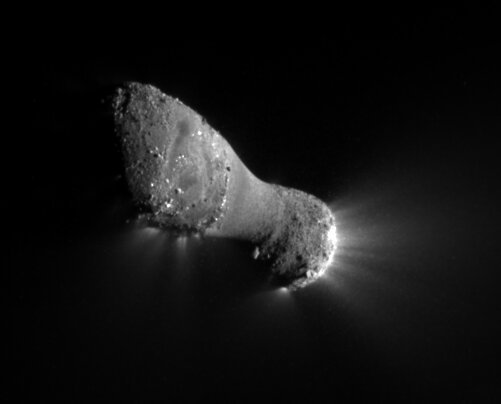
A comet grows a coma and tails when sunlight warms volatile ice in the nucleus, the ice sublimates straight from solid to gas, that gas escapes through the surface, drags dust with it, and the Sun then sorts the outflow into a dust tail and an ion tail. That whole sequence sounds tidy on paper. In space, it’s a rougher, more physical thing. Pressure is almost nonexistent, surfaces are dark and crusty, vents open and choke, jets fire from odd spots, and a tiny solid body a few km wide can suddenly wear a fuzzy atmosphere hundreds of thousands of km across.
That is why a comet can look dead in the outer solar system and then become unruly once it drops inward. The nucleus is ancient, icy, dusty, porous, usually dark as charcoal, and badly insulated in places. Warm it enough, and the surface starts breathing.
What starts ice loss near the Sun
Solar heat
The trigger is simple. The mechanism is not. Sunlight falls on the cometary nucleus, some gets reflected, much of it gets absorbed, and the absorbed energy has to go somewhere. On a low-albedo surface, it goes into heating crust, pores, fractures, and shallow subsurface layers. The old dirty snowball picture of comet nuclei still holds up as a decent shortcut, even if real nuclei are patchier and meaner-looking than the phrase suggests.
A few things decide when activity begins:
- darker ground absorbs more sunlight
- slower heat loss lets subsurface ice survive until a warm pass inward
- rotation creates local noon hot spots, so one patch can vent while another stays quiet
Volatile ices
Not all ice waits for the same temperature. Water ice usually needs the comet to come closer to the Sun. Carbon dioxide and carbon monoxide are more volatile, so they can sublimate much farther out. That matters. A detailed study of C/2017 K2 developing a coma beyond Saturn is a good reminder that some Oort Cloud comets wake up long before water ice should dominate.
So when people say “the ice melts,” that misses the interesting part. Different frozen materials switch on at different heliocentric distances, and the early drivers are often CO or CO2, not plain H2O ice.
Direct phase change
The phase change is sublimation, not ordinary melting. In the vacuum around a comet, pressure is far too low for a neat liquid-water stage on the surface. The solid becomes gas. Energy goes into breaking molecular bonds rather than forming puddles. That gas then threads through pores and cracks, carrying momentum with it.
How the nucleus vents gas and dust
Active regions
A nucleus rarely vents evenly. Sun-facing cliffs, pits, fractured terrain, and spots where fresh ice sits near the surface become active regions. Rosetta’s detections of exposed water ice on comet 67P helped confirm what many astronomers suspected: the surface is dynamic enough to expose fresher icy material from time to time.
Dust drag
Gas alone would make a ghostly coma. The dramatic part comes when that gas flow entrains dust grains. If the upward drag force beats the weak gravity of the nucleus, and beats the grain’s cohesion with neighboring material, the grain lifts off. Fine particles go first. Bigger chunks need stronger outflow.
That’s why comet activity is not just chemistry. It’s gas dynamics, surface mechanics, and grain physics all jammed together.
Jets and bursts
Jets happen when vents focus the flow. Bursts happen when heat reaches a volatile-rich pocket, or when crust fails and fresh ice gets exposed. Rotation keeps changing the illumination pattern, so jets can pulse with the comet’s day. Messy, asymmetric, sometimes spectacular.
How the coma forms
Gas expansion
Once gas escapes, it expands rapidly around the nucleus. Near the surface, molecules still collide often enough to behave like a very thin flowing gas. Farther out, the coma gets more rarefied and collisions fade. Ultraviolet light from the Sun starts breaking molecules apart and ionizing some of them.
Dust halo
Dust does not move exactly like gas. It spreads more slowly, lingers longer, and reflects sunlight efficiently, which is why the coma often looks bright and diffuse in a telescope. The glowing “head” of a comet is mostly this dust-and-gas envelope, not the solid object itself.
Size and density
The scale fools people. A nucleus may be only a few km across. The coma can swell to tens of thousands or even millions of km. Density, though, is tiny. If Earth somehow sat in a coma, you would not experience it as a fog bank. You’d barely call it an atmosphere.
Why two tails appear
Ion tail
Some coma gases get ionized by solar ultraviolet radiation. Those charged particles interact with the solar wind, which is a stream of plasma flowing outward from the Sun and threaded with magnetic field lines. The result is a straight ion tail, often blue because of emission from ionized carbon monoxide and related species.
Dust tail
Dust grains stay electrically neutral most of the time. They respond mainly to sunlight and their own orbital motion. Radiation pressure pushes them away from the Sun, but not all equally. Small grains get shoved harder than large ones, so the dust tail fans out and curves.
Color and shape
| Feature | Ion tail | Dust tail |
|---|---|---|
| Main material | ionized gas | solid dust grains |
| Main driver | solar wind and magnetic field | radiation pressure |
| Typical look | straighter, bluish | broader, curved, white to yellowish |
| Direction | almost directly away from Sun | trails along a curved path away from Sun |
What shapes each tail
Radiation pressure
Photons carry momentum. Tiny, but relentless. On dust grains, that adds up. A small grain can be pushed strongly enough that its path bends away from the comet’s orbit, which is why the dust tail often looks swept back rather than laser-straight.
Solar wind
For ions, the solar wind is the sculptor. A useful Europlanet summary of ion tails as tracers of space weather shows why these tails can kink, disconnect, or suddenly change shape when solar conditions shift.
Sunward direction
A comet’s tails point away from the Sun, not simply behind the comet like exhaust behind a car. That is the geometry that confuses beginners.
Why tails grow near perihelion
Near perihelion, solar heating spikes because sunlight intensity rises fast as distance drops. More surface area becomes active. Water ice joins the show if it had been quiet earlier. Gas production increases, dust lifting gets easier, and the coma thickens. Sometimes the biggest visual jump happens just before or after perihelion because thermal lag matters. A crust can soak up heat, then fail a little later.
That extra dust does not just vanish into aesthetics, either. Old comet debris can spread along the orbit and later feed meteor showers such as the Orionids from comet Halley.
What observations reveal about these processes
Spacecraft changed the game. Giotto at Halley, Stardust, and Rosetta turned comet work from fuzzy-light interpretation into surface geology, grain sampling, and in situ plasma physics. Spectra reveal water, carbon-bearing molecules, radicals, and emission features. Images show jets, shadowed pits, and collapsing terrain.
And then there is the modern surprise factor. Hubble’s work on a very large comet from the Oort Cloud was a reminder that the outer solar system still keeps oversized fossils in storage. I suspect that matters more than the headline bragging rights. Large comet nuclei are data gold for formation models.
Amateurs matter too. New telescope images from skilled observers often catch outbursts, tail disconnection events, and brightness changes early. Citizen science in astronomy is no longer a cute side note. It’s part of the surveillance network.
FAQ
Why do comets have tails only near the Sun?
Because sublimation needs enough heating. Far out in the solar system, the nucleus stays too cold for strong gas release, so little or no tail forms.
Does the coma mean the nucleus is melting?
Usually no. The dominant surface process is sublimation, a direct solid-to-gas transition in low pressure.
Why is the ion tail straighter than the dust tail?
Ionized gas is tied to the solar wind and magnetic field, which pull it almost directly anti-sunward. Dust grains keep more of their original orbital motion, so their tail curves.
Can a comet have more than two tails?
Yes. A comet can show multiple dust structures, anti-tails caused by viewing geometry, and complex plasma features. “Two tails” is the standard pattern, not a hard limit.
Conclusion
So that fuzzy comet shape comes from a very specific chain of events. Sunlight heats the nucleus. Volatile ice sublimates. Escaping gas drags dust free. The coma swells around the solid core. Then radiation pressure and the solar wind take over, separating the outflow into distinct tails. Ancient object, very active behavior. Which is probably why comets still feel less like leftovers and more like live experiments drifting through the sky.
Would you like to receive similar articles by email?

Paul Tomaszewski
Paul Tomaszewski is a science & tech writer as well as a programmer and entrepreneur. He is the founder and editor-in-chief of CosmoBC. He has a degree in computer science from John Abbott College, a bachelor's degree in technology from the Memorial University of Newfoundland, and completed some business and economics classes at Concordia University in Montreal. While in college he was the vice-president of the Astronomy Club. In his spare time he is an amateur astronomer and enjoys reading or watching science-fiction. You can follow him on LinkedIn and Twitter.


You May Also Like

Why Scientists Need Clear Imaging to Solve Medical Mysteries
Perseid Meteor Shower Guide