Comet Hartley 2: Orbit, Earth Approaches, and Missions
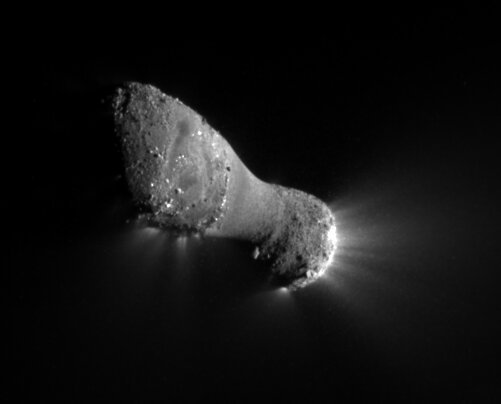
Every few years, a small comet swings past Earth and reminds us that the solar system is far messier and stranger than the tidy diagrams suggest. Comet Hartley 2, formally cataloged as 103P/Hartley, is one of those oddballs. It’s a small, peanut-shaped comet that spews out far more water and gas than a body its size has any business releasing, which is why astronomers slapped the label “hyperactive” on it. This guide walks through its discovery, its physical quirks, its orbit around the Sun, and the two Earth encounters (2010 and 2023) that turned it into one of the most closely studied comets we’ve ever visited.
What Is Comet Hartley 2?
If you picture a comet as a dirty snowball, Hartley 2 is closer to a dirty snowball that someone shook violently and then set on fire. It belongs to the Jupiter family of short-period comets, and its behavior is genuinely weird for something so tiny.
Nucleus size
The nucleus stretches only about 1.2 to 1.6 kilometers long, roughly a mile end to end. That’s a fraction of Mount Everest laid on its side. According to NASA’s profile of the comet, it’s one of the smaller cometary nuclei ever imaged up close.
Hyperactive behavior
Here’s the thing that puzzled planetary scientists. A rock this size shouldn’t lose so much water. Yet Hartley 2 ejects a disproportionate amount, and that mismatch earned it its reputation. Researchers studying the comet’s hyperactivity and dust composition found that icy grains flung off the nucleus account for a huge share of the water we detect in the coma.
Snow globe halo
When the Deep Impact spacecraft flew by, it revealed something almost whimsical. The comet sits inside a dense cloud of ice particles, some fine as dust, others as big as a basketball. National Geographic described it as a cosmic snow globe, and honestly, no better metaphor exists.
Who Discovered the Comet and When?
Malcolm Hartley
The comet carries the name of Malcolm Hartley, a British-Australian astronomer working with the UK Schmidt Telescope Unit at Siding Spring Observatory. He wasn’t hunting for anything glamorous. He was scanning photographic plates, the tedious backbone of comet discovery in the era before CCD sensors took over.
Discovery year
Hartley spotted it in 1986. The Minor Planet Center logged it, and the object slid into the catalog as another faint smudge that would eventually become one of the most photographed comets in history.
Name origin
The “2” in Hartley 2 simply distinguishes it from other comets he found. Malcolm Hartley discovered several, so the numbering keeps the record tidy. Nothing mysterious there, just bookkeeping.
How Does Its Orbit Work?
Hartley 2 loops the Sun on a short, low-inclination path shaped and reshaped by Jupiter’s gravity. Three details define its journey:
- Orbital period of roughly 6.5 years, meaning it returns to the inner solar system about once per Earth-decade-and-a-half’s worth of visits.
- Perihelion distance near 1.05 astronomical units, bringing it just outside Earth’s orbit at its closest approach to the Sun.
- Jupiter family membership, which ties its future entirely to the giant planet’s gravitational effects.
That Jupiter connection matters. The planet nudges the orbit over centuries, and any long-term prediction of the comet’s fate hinges on those slow gravitational tugs.
What Powers Its Jets and Ice Grains?
Carbon dioxide sublimation
Most comets are driven by water ice turning to vapor. Hartley 2 runs on something different. Frozen carbon dioxide, dry ice, sublimates and powers the jet streams that tear dust and ice grains off the surface. That CO2 engine is the real reason this comet behaves so aggressively.
Water ejection
The jets don’t just release gas. They drag chunks of water ice along, and those grains sublimate later, out in the coma. Studies of the icy grain composition found these chunks survive only a few hours before vanishing, which explains the constantly shifting halo.
Dust and chunks
Some of the ejected material is startlingly large. The Planetary Society’s post-flyby analysis described a genuine “split-personality” comet, with smooth waist regions and rough, bumpy ends behaving almost like separate objects.
Earth Approach in 2010
Closest distance
In October 2010, Hartley 2 passed within about 11 million miles of Earth, one of the closest approaches of any comet in recent memory.
Naked-eye visibility
Under dark skies it flirted with naked-eye brightness, hovering around magnitude 5. Most casual observers needed binoculars, but experienced stargazers under truly dark conditions caught it as a faint fuzzy patch.
EPOXI flyby
Days later, on November 4, the Deep Impact spacecraft’s EPOXI mission screamed past the nucleus, gathering imagery that rewrote what we thought we knew about small comets.
Earth Approach in 2023
Viewing conditions
The 2023 apparition brought Hartley 2 back within telescope range, though it never reached the brightness of 2010. Backyard observers with a small reflector and a CCD camera could still track it across several nights.
Fading brightness
Something had changed. Citizen scientists working with the SETI Institute helped confirm that the comet was noticeably fading, suggesting its hyperactive phase may be winding down. A 2025 pre-print modeling the ongoing decline in activity even predicts it could go inactive by 2112.
Observation tips
To catch it on future returns, use a red flashlight to protect your night vision, shoot stacked one-minute exposures with a DSLR like a Canon T2i, and let a planetarium app pinpoint the coma. Patience beats aperture every time.
Images and Observations From the EPOXI Mission
The EPOXI flyby fact sheet documented a nucleus tumbling chaotically, with a rotation period stretching near 18 hours. Later analysis of the comet’s complex spin state showed the rotation was actually slowing and wobbling, a rare glimpse of a comet physically evolving before our instruments. The raw imaging archive remains public for anyone who wants to inspect the pictures themselves.
How Hartley 2 Compares to Tempel 1
Both comets were visited by the same Deep Impact spacecraft, which makes them natural rivals for comparison.
| Feature | Hartley 2 | Tempel 1 |
|---|---|---|
| Nucleus length | ~1.2–1.6 km | ~7.6 km |
| Activity level | Hyperactive | Typical |
| Primary driver | Carbon dioxide | Water ice |
| Orbital period | ~6.5 years | ~5.5 years |
The size gap tells the story. Tempel 1 is several times larger yet far calmer, which sharpens the mystery of why the little comet works so hard.
FAQ
Is Hartley 2 dangerous to Earth?
No. There’s no imminent likelihood of a future collision. Its orbit stays comfortably outside our path.
When will it return?
Roughly every 6.5 years, though its fading activity may make future returns harder to spot.
Could water like this have filled our oceans?
Possibly. Herschel measurements found its water resembled Earth’s oceans, fueling that long-running debate.
Conclusion
Hartley 2 punches well above its weight. A comet barely a mile long, driven by dry ice, wrapped in a shimmering halo of frozen chunks, slowly fading as it exhausts itself over the coming century. It’s a reminder that the small stuff out there still has plenty left to teach us, and that sometimes the tiniest bodies ask the biggest questions.
Would you like to receive similar articles by email?

Paul Tomaszewski
Paul Tomaszewski is a science & tech writer as well as a programmer and entrepreneur. He is the founder and editor-in-chief of CosmoBC. He has a degree in computer science from John Abbott College, a bachelor's degree in technology from the Memorial University of Newfoundland, and completed some business and economics classes at Concordia University in Montreal. While in college he was the vice-president of the Astronomy Club. In his spare time he is an amateur astronomer and enjoys reading or watching science-fiction. You can follow him on LinkedIn and Twitter.


You May Also Like
Gamma Normid Meteor Shower Guide

Living with CRPS: Coping Strategies and Treatment Advances