Coma Berenices Constellation Guide
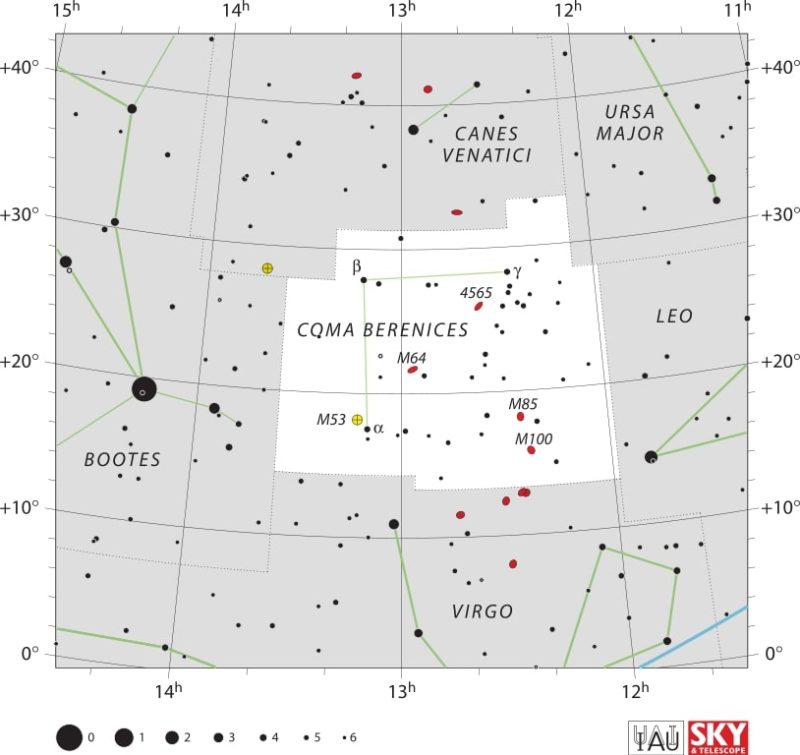
Coma Berenices is a faint northern constellation with an unusually rich identity: its name refers to the hair of Queen Berenice II of Egypt, its star pattern is anchored by the loose Melotte 111 cluster, and its borders contain some of the finest galaxy fields visible to amateur astronomers. It may look modest to the naked eye, yet the region opens toward the north galactic pole, offering a relatively clear view beyond the Milky Way’s dust.
This is a constellation for patient observers. Its brightest stars are not dazzling, and many of its deep-sky objects appear as pale smudges rather than dramatic pinpoints. The reward comes slowly, especially under a dark sky.
What Does Coma Berenices Represent?
Name And Meaning
The Latin name Coma Berenices means “Berenice’s hair.” In older astronomical writing, the genitive form Comae Berenices often appears in star names and catalog entries. The subject is Queen Berenice II, a third-century BCE ruler of Ptolemaic Egypt.
The constellation’s shape is not really a lock of hair in the modern sense. It is a broad scattering of stars, with no single bright star dominating the pattern. That looseness can make it difficult to recognize, although it also gives the region a natural, almost cloudlike appearance.
Greek Mythology
According to the familiar myth, Berenice vowed to sacrifice her long hair if her husband, Ptolemy III Euergetes, returned safely from war. After his return, she placed the hair in the temple of Aphrodite. It disappeared overnight.
The court astronomer Conon of Samos reportedly claimed that the gods had placed the offering among the stars. The story later became attached to the tail of Leo, the lion, before Coma Berenices developed into a distinct constellation. This connection between Leo and Berenice’s hair is explained in a useful historical account from EarthSky’s mythology guide.
Cultural Interpretations
The constellation reflects a broader pattern in western astronomy, where political history, religion, and naked-eye observation became tangled together. Berenice’s hair was both a royal offering and a celestial memorial.
Some traditions have interpreted the stars as a woman’s hair, a sheaf of grain, or a loose celestial cloud. These readings make sense when viewed from a dark site, where Melotte 111 spreads across the sky like a faint spray of silver.
How Did Coma Berenices Become A Constellation?
Ancient Origins
The star group was known before its boundaries were standardized, but it was not always treated as an independent constellation. Ancient observers often associated it with Leo, particularly the lion’s tail.
Its royal story helped preserve the pattern in star maps, while its position near Virgo and Leo made it useful for regional sky lore. Coma Berenices gradually gained independence during the Renaissance, when European astronomers and mapmakers began separating the hair from Leo.
Ptolemy’s Catalog
Claudius Ptolemy’s Almagest, compiled in the second century CE, did not list Coma Berenices among the original 48 constellations as an independent figure. This is an important distinction. The stars were known, but the constellation’s later identity had not yet become standard.
Renaissance celestial globes and star atlases helped establish the modern interpretation. Astronomers such as Gerardus Mercator and Tycho Brahe played roles in giving the group a more permanent place in western star catalogues.
Modern Boundaries
Today, the International Astronomical Union recognizes Coma Berenices as one of the 88 official constellations. Its area covers about 386 square degrees, according to NOIRLab’s constellation reference.
The boundaries matter because famous objects such as Messier 64, Messier 53, and the Coma Galaxy Cluster are assigned to this region even when the visible star pattern offers little guidance.
Where Is It Located In The Night Sky?
Neighboring Constellations
Coma Berenices lies between Leo, Boötes, Canes Venatici, and Virgo. It sits close to the Virgo Cluster and is also positioned near the north galactic pole, where the Milky Way’s dense star fields thin considerably.
That geography explains the constellation’s galactic richness. With less foreground dust and fewer Milky Way stars in the way, distant galaxies become easier to study.
Best Viewing Season
The best time to observe Coma Berenices from the Northern Hemisphere is spring, especially from April through June. It rises prominently in the evening during that period. Observers in the Southern Hemisphere can also see it, although it remains relatively low in northern parts of the sky.
A dark location makes a major difference. Urban light pollution can erase Melotte 111 almost completely, leaving only a few unrelated stars.
Finding The Star Pattern
Start with the Big Dipper. Follow the curve of its handle toward Arcturus, then look westward and slightly north toward the region between Leo and Boötes. Coma Berenices appears as a loose triangular or wedge-shaped grouping.
A phone planetarium app can help, but binoculars often reveal the pattern more naturally.
Which Stars Define Its Shape?
Beta Comae Berenices
Beta Comae Berenices is a yellow-white main-sequence star roughly 30 light-years away, shining at about magnitude 4.2. It is one of the constellation’s brighter anchor points, though it still lacks the visual punch of stars such as Regulus or Arcturus.
Alpha Comae Berenices
Alpha Comae Berenices, also called Diadem, is a close binary star. The proper name refers to a crown or ornament, fitting the constellation’s royal association. Its components are difficult to separate without suitable magnification and steady observing conditions.
Melotte 111
Melotte 111 is the true visual centerpiece. This open star cluster contains dozens of related stars spread across roughly five degrees, making it too large for many telescopes at low power. Binoculars are ideal.
The cluster is not the same thing as the Coma Galaxy Cluster. One is a nearby group of stars in the Milky Way; the other is a vast collection of galaxies hundreds of millions of light-years away.
Which Deep-Sky Objects Are Worth Observing?
Coma Berenices is packed with targets. Messier 53 is a bright globular cluster, while Messier 64, the Black Eye Galaxy, is a spiral galaxy marked by a conspicuous dark dust lane. NGC 4565, an edge-on spiral galaxy, is another favorite because its narrow profile resembles a needle cutting through space.
Messier 85, M88, M91, M98, M99, and M100 belong to the larger Virgo-Coma galaxy region. Most require a telescope and a dark site. A 6-inch to 8-inch telescope can provide satisfying views, although larger 10-inch to 12-inch instruments make faint galaxy structure easier to detect.
The face-on spiral NGC 4689 lies about 54 million light-years away, and NASA’s Hubble observation shows its delicate structure in remarkable detail. Deep exposures reveal what visual observers usually see only as a dim oval.
What Makes The Coma Galaxy Cluster Important?
The Coma Cluster, also known as Abell 1656, contains thousands of galaxies bound together by gravity. It spans more than 20 million light-years, as illustrated by Hubble’s sweeping view.
Its population includes giant elliptical galaxies, lenticular galaxies, and spirals. The cluster is valuable to astrophysicists because galaxy motion, hot intracluster gas, dark matter, and gravitational interactions can all be studied within one enormous system. The region is spread across several degrees, so observers should expect a galaxy field rather than one compact target.
How Should You Observe This Region?
Begin with binoculars and Melotte 111. Let your eyes adapt for at least 20 minutes, then scan slowly instead of making quick glances. Relaxed viewing matters here; faint star clouds often emerge only after the first impression has faded.
For galaxies, use averted vision and moderate magnification. Do not expect photographs. A gray patch, a brighter core, or a thin spindle can represent an entire galaxy, and that slightness is part of the experience.
FAQ
Is Coma Berenices easy to see?
Its general star pattern is visible under dark skies, but city light pollution can make it difficult. Binoculars improve the view considerably.
What is the brightest star in Coma Berenices?
Beta Comae Berenices is among its brightest stars, with an apparent magnitude near 4.2. The constellation has no first-magnitude star.
Is the Coma Cluster the same as Melotte 111?
No. Melotte 111 is a nearby open star cluster. The Coma Cluster is a distant cluster of galaxies.
Conclusion
The Coma Berenices constellation rewards curiosity more than spectacle. Its royal mythology, Renaissance history, loose star cluster, and immense galaxy fields occupy the same patch of sky, linking human storytelling with modern observational science. Find it in spring, start with binoculars, and give the region time to disclose itself.
Would you like to receive similar articles by email?

Paul Tomaszewski
Paul Tomaszewski is a science & tech writer as well as a programmer and entrepreneur. He is the founder and editor-in-chief of CosmoBC. He has a degree in computer science from John Abbott College, a bachelor's degree in technology from the Memorial University of Newfoundland, and completed some business and economics classes at Concordia University in Montreal. While in college he was the vice-president of the Astronomy Club. In his spare time he is an amateur astronomer and enjoys reading or watching science-fiction. You can follow him on LinkedIn and Twitter.


You May Also Like
How Did Jupiter’s Moon Europa Get Its Name
How Did the Milky Way Galaxy Get Its Name