Columba Constellation Guide
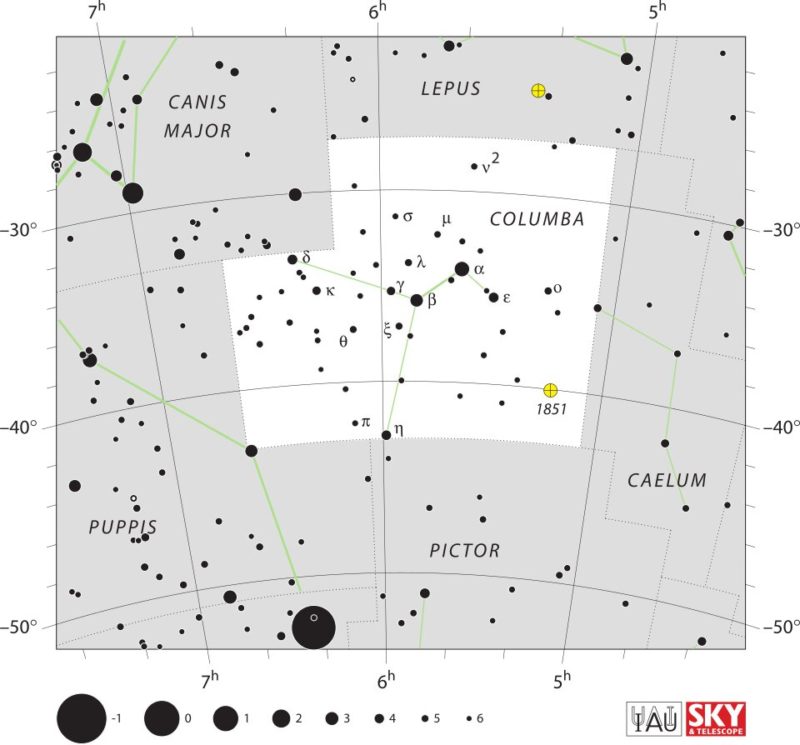
Columba is a small, faint southern constellation whose name means “dove” in Latin. It represents the biblical dove associated with Noah, although it has no classical Greek or Roman myth behind it. For modern stargazers, its real appeal lies in the contrast between an understated outline and remarkable targets such as the globular cluster NGC 1851 and the starburst galaxy NGC 1808.
What Is Columba?
Meaning and pronunciation
The name Columba is pronounced kuh-LUM-buh. In Latin, it means dove or pigeon. Older sources sometimes call it Columba Noachi, meaning Noah’s dove, while modern astronomy uses the shorter official name.
This is a constellation, not a single celestial object or a recognized zodiac sign. It belongs to the 88 constellations standardized by the International Astronomical Union, or IAU.
IAU boundaries
The IAU defines Columba as a specific region of the sky with fixed borders, much like a county drawn on a celestial globe. It covers about 270 square degrees, making it a small constellation by modern standards. Its boundaries contain several cataloged stars and deep-sky objects, even though most of its visible stars are dim.
The constellation’s approximate position is documented through its technical sky coordinates, centered near right ascension 5 hours and declination -35 degrees.
Southern-sky status
Columba lies in the southern celestial hemisphere, below the celestial equator. It is not a permanently visible southern circumpolar constellation for most observers, yet it can still be seen from much of the Northern Hemisphere during winter, especially at lower and middle latitudes.
From the northern United States, Columba stays low above the southern horizon. Atmospheric haze can erase its fainter stars quickly, so location matters.
Where Is Columba Located?
Coordinates and area
The constellation sits roughly between declinations -27 and -43 degrees. Its brightest star, Alpha Columbae, is the easiest entry point, while the rest of the pattern spreads south and west of Canis Major.
The NOIRLab guide to Columba places the constellation in useful observational context, including the distances to Alpha and Beta Columbae.
Neighboring constellations
Columba is bordered by Canis Major to the north, Lepus toward the northwest, Caelum to the west, Pictor to the south, and Puppis toward the east. It also sits near the former constellation Argo Navis, the enormous ship later divided into Carina, Puppis, and Vela.
That neighborhood makes Columba easier to locate than its faintness suggests. Sirius, the brightest star in the night sky, acts as a prominent signpost.
Seasonal visibility
The best time to observe Columba is during the Northern Hemisphere’s winter months, from December through February. In the Southern Hemisphere, it rises higher and remains visible for longer periods, making its star pattern considerably easier to recognize.
Observers north of roughly 50 degrees latitude may struggle with the constellation’s southern stars. At lower latitudes, the view improves dramatically.
How Does Columba Appear?
Dove-shaped pattern
Traditional charts portray Columba as a flying dove, sometimes with its head directed northward and its wings stretched across the sky. The interpretation is imaginative rather than obvious. Without a chart, most people will see a loose chain of stars, not a bird.
The brightest star, Phact, marks part of the dove’s body. Other stars suggest the wings, tail, and hind leg in older illustrations.
Brightness and scale
Columba is a faint constellation. Alpha Columbae shines at approximately magnitude 2.65, while many of its other principal stars are third or fourth magnitude. The pattern is compact enough to fit comfortably within a modest binocular field, but its weak outline disappears under urban light pollution.
Its visual map and neighboring boundaries are useful for understanding why the constellation can feel visually scattered.
Best viewing conditions
Choose a clear night with minimal moonlight and an unobstructed southern horizon. Binoculars help separate the surrounding star fields, though the main outline is best learned with unaided vision first. A telescope is unnecessary for identifying Columba, but it becomes valuable once you begin hunting NGC 1851.
What Is Columba’s Origin?
Petrus Plancius
Dutch astronomer and cartographer Petrus Plancius introduced Columba in the late 16th century. It appeared on celestial globes around 1592, during the period when European mapmakers were adding new patterns to the southern sky.
The historical trail is explained in Ian Ridpath’s account of Columba, which also addresses the constellation’s relationship to older star catalogs.
Canis Major stars
Plancius formed Columba from previously unformed stars near Canis Major. These stars had been recorded in the broader region associated with Ptolemy’s Almagest, but they were not assigned to a separate constellation.
That detail matters. Columba is a modern European creation, not a surviving constellation from ancient Greek astronomy.
Biblical dove imagery
The dove represents the bird Noah sent from the ark, returning with an olive branch to signal that the floodwaters had receded. The symbol appears in Christian-era celestial cartography, where the bird was placed near Canis Major. This origin is cultural and religious rather than classical mythological.
Which Stars Form Columba?
Alpha Columbae
Alpha Columbae, also called Phact, is a hot blue-white giant or subgiant star roughly 270 light-years from Earth. The Arabic name Phact is linked to the phrase describing a dove’s ring or neck.
It is the constellation’s most conspicuous star and the best starting point for navigation.
Beta and Gamma
Beta Columbae, known as Wazn, is an orange giant about 86 light-years away. Its warmer color contrasts with the blue-white appearance of Phact, especially through binoculars or a small telescope.
Gamma Columbae and several stars labeled with Greek letters complete the central pattern, although none rivals Alpha Columbae in apparent brightness.
Mu Columbae
Mu Columbae is an unusual runaway star. Astronomers think it was expelled from the Orion region during a stellar interaction, possibly involving a disrupted multiple-star system. Traveling at high velocity, it offers a striking reminder that stars are not fixed decorations pasted onto the sky.
Which Deep-Sky Objects Exist Inside?
NGC 1851
NGC 1851 is a dense globular cluster roughly 39,000 light-years away. Through binoculars it may resemble a small, hazy star, but a telescope begins to resolve its compact swarm of old stars.
Its unusual internal structure has made it an important target for studies of globular-cluster formation and stellar populations. The observing guide to NGC 1851 compares it with Columba’s other major deep-sky prize.
NGC 1808
NGC 1808 is a barred spiral galaxy and an active star-forming system about 46 million light-years away. Its central region shows evidence of intense star formation, giving it a more restless character than the ancient globular cluster NGC 1851.
Southern targets
Columba contains other faint galaxies and cataloged objects, but most require a telescope, dark skies, and patience. The deep-sky object index for Columba is useful when planning a more serious observing session.
How Can You Find Columba?
Start with Orion
Find Orion first. Its bright belt is hard to miss during winter. From there, look southeast toward Sirius, the dominant star of Canis Major.
Trace Canis Major
Canis Major forms a recognizable shape around Sirius. Columba lies below and slightly west of this constellation, close to the southern horizon for many northern observers.
Use Phact
Search for Phact, Alpha Columbae, as the brightest star in the area. Once you identify it, the dimmer dove-shaped arrangement becomes easier to trace. A printed chart or planetarium app can help, since light pollution often removes the pattern’s weaker stars.
FAQ
Is Columba visible from the Northern Hemisphere?
Yes. It is visible during winter, though it remains low in the southern sky from many northern locations.
Is Columba part of ancient mythology?
No. Its dove imagery comes from biblical and early modern European tradition, not Greek or Roman mythology.
What is the brightest star in Columba?
Alpha Columbae, or Phact, is the brightest star in the constellation.
Conclusion
The Columba constellation rewards observers who look past spectacle. Its outline is faint, its mythology is relatively recent, and its stars can be swallowed by haze or city lights. Yet within this modest patch of sky are a runaway star, an ancient globular cluster, and a turbulent distant galaxy. That is the charm of astronomy: even an overlooked constellation can open a door into stellar history, human storytelling, and the wider universe.
Would you like to receive similar articles by email?

Paul Tomaszewski
Paul Tomaszewski is a science & tech writer as well as a programmer and entrepreneur. He is the founder and editor-in-chief of CosmoBC. He has a degree in computer science from John Abbott College, a bachelor's degree in technology from the Memorial University of Newfoundland, and completed some business and economics classes at Concordia University in Montreal. While in college he was the vice-president of the Astronomy Club. In his spare time he is an amateur astronomer and enjoys reading or watching science-fiction. You can follow him on LinkedIn and Twitter.


You May Also Like
Monocerotid Meteor Shower Guide

How to Reduce Mental Overload While Balancing Work and Family