Circumgalactic Medium: Its Role In Galaxy Evolution
The circumgalactic medium affects galaxy evolution by controlling the traffic of gas around a galaxy. It feeds star formation, catches and reshapes galactic outflows, stores a large share of missing baryons, and returns chemically enriched material back to the disk over long timescales. If you want the short version, the CGM is the throttle, shock absorber, pantry, and recycling loop all at once.
That sounds almost too tidy, and the real picture is messier. The halo around galaxies is thin, turbulent, multiphase, and hard to see directly. Even so, modern astronomy keeps finding the same pattern. A galaxy’s stars and gas disk make sense only when you include the much larger circumgalactic medium around them. Recent review work on the CGM as a multiscale gas reservoir leans hard in that direction, and the figures suggest the field is no longer treating the halo as background scenery.
What is the halo around a galaxy?
Size and extent
A galaxy sits inside a much larger halo of diffuse gas that can stretch roughly to the virial radius, often hundreds of thousands of light-years from the central galaxy. For spiral galaxies like the Milky Way, that means the visible disk is only the bright inner part of a much bigger baryonic system. The circumgalactic medium bridges the interstellar medium inside the galaxy and the intergalactic medium beyond it.
People sometimes picture a neat shell. It is not neat. The density drops with radius, the shape is lopsided, galaxy mergers stir it up, and nearby galaxy pairs or dense regions can distort it badly.
Gas phases
The circumgalactic medium is famous for being multiphase, which is a clinical word for a very unruly atmosphere.
| Phase | Typical state | What it tells us |
|---|---|---|
| Cool gas | about 10,000 K | fresh accretion, condensed clouds, metal-line absorptions |
| Warm-hot gas | about 100,000 to 1,000,000 K | shock heating, mixing, galactic winds |
| Hot gas | above 1,000,000 K | massive halos, virialized plasma, quenching pressure |
Those phases do not sit in polite layers. They overlap. Cool gas clouds move through hot gas, interfaces mix, and ionization changes with local radiation and gas density.
Core properties
A few properties matter more than the rest:
- Mass: the CGM may hold a huge fraction of a galaxy’s baryons that are missing from the stars and disk gas.
- Metallicity: heavy elements from supernovae and stellar winds leave fingerprints in absorption lines.
- Ionization and kinematics: line widths, shifted wavelength patterns, and column densities reveal whether material is falling in, blowing out, or stalling.
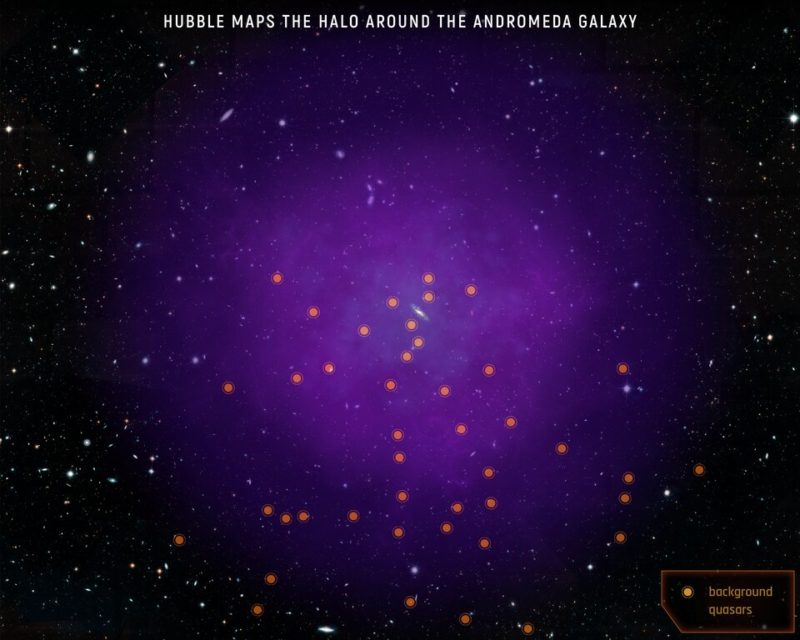
That is why background quasars are gold. Their light passes through foreground galaxies and turns the invisible halo into readable absorption features in galaxy spectra and background galaxy spectra.
Why does it matter for galaxy evolution?
Gas reservoir
Star formation ends when fuel supply fails. Simple as that. The CGM is the main buffer between a galaxy and the cosmic web, so it sets how much cool gas can accrete, condense, and reach the galaxy disc plane. A star formation rate that looks modest in the disk may depend on a much larger halo reservoir staying available for billions of years.
Feedback regulator
Galactic nuclei, massive stars, and supernovae drive energy outward. That gas does not always escape into the wider universe. Often it piles into the halo, shocks, mixes, cools, and later returns. The CGM turns feedback from a one-way blast into a cycle. In FIRE simulations tracing metal flows in halos, feedback does a lot more than eject matter. It reorganizes the timing of return flows.
Baryon budget
One of the persistent headaches in galaxy formation is that galaxies seem to contain fewer ordinary baryons than cosmology predicts from the cosmic microwave background radiation. Some of those “missing” baryons are in the CGM, especially in warm-hot and hot gas. That matters because dark matter sets the deep gravitational well, but baryons decide whether a galaxy actually lights up with stellar populations.
How do inflows and outflows shape a galaxy?
Cold accretion
Cold accretion is a favored channel in lower-mass systems and at higher redshift. Gas can stream in without being fully shock-heated to the halo temperature, especially when the halo mass is modest. A recent study of cold gas inflows driving galaxy evolution argues that this supply route still deserves more respect than it sometimes gets.
Galactic winds
Outflows from starbursts or active galactic nuclei can remove dense gas from star-forming regions and push metals far into the halo. That slows future star formation, at least temporarily. Dwarf galaxies feel this especially hard because their gravitational grip is weaker, which fits results from CUBS work on the highly ionized CGM of dwarf galaxies.
Fountain cycles
Some gas goes out, cools, and falls back. The old galactic fountain picture survives because nature keeps refusing cleaner diagrams. In a galactic fountain scenario, material launched by supernovae rises into the circumgalactic gas, mixes with lower-metallicity gas, then returns in denser gas parcels. That is chemical evolution with weather.
What sets star formation or quenching?
Fuel supply
A galaxy with access to cool gas keeps making stars. A galaxy cut off from fresh accretion drifts toward quenching. The surprise is not that this happens. The surprise is how strongly it tracks halo conditions rather than just what is happening in the visible disk.
Cooling balance
Cooling, heating, turbulence, cosmic rays, and mixing layers all compete. If hot gas cools efficiently, clouds can condense and feed stellar formation. If heating wins, the halo stays too stable and diffuse to rain back in. The comparison of warm-hot CGM models shows how sensitive the answer is to the assumed physics.
Halo mass
Halo mass changes almost everything. Massive galaxies and elliptical galaxies often sustain hotter, more stable halos, which helps suppress star formation rates. Lower-mass galaxies can keep a more porous, bursty exchange with their surroundings. In galaxy clusters and dense clusters, the environment strips or compresses halo gas, adding another layer of chaos.
How do gas and metals recycle?
Metal transport
Heavy elements forged in massive stars do not stay put. They are carried outward by stellar winds and supernovae, then dispersed through the halo. Classic COS-Dwarfs observations of carbon around sub-L* galaxies made this painfully clear: the metal reservoir outside galaxies can be enormous.
Mixing paths
Mixing is where the field gets delightfully ugly. Cool clouds get shredded, hot gas entrains colder clumps, and interfaces create intermediate ions like O VI. That is why absorption-line work needs strong spectral resolution and why one sightline can mislead you.
Return flows
Returned gas is rarely pristine. It comes back chemically enriched, often slower, and sometimes after long delays. So future star formation is built partly from processed ejecta, not only fresh infall. That loop shapes galaxy properties from metallicity gradients to star formation history.
How do scientists study this invisible gas?
Mostly by cheating, in the noble scientific sense. They look through it rather than at it.
- Ultraviolet absorption spectroscopy with background quasars or background galaxies tracks ions such as H I, O VI, and C IV across redshift.
- Emission mapping in X-ray, radio, and optical nebular lines catches hotter or denser components, though the signal is faint.
- Simulations test whether the observed column densities, velocities, and phase structure emerge from realistic feedback recipes.
| Method | Best for | Limitation |
|---|---|---|
| UV absorption | low-density halo gas | depends on chance sightlines |
| X-ray emission | hot gas in massive halos | weak signal, hard calibration |
| Cosmological simulations | causal interpretation | subgrid physics can bias outcomes |
What do new data and simulations reveal?
They reveal that resolution matters, sometimes embarrassingly so. Better halo resolution and enhanced halo resolution in simulations produce more fragmented cool gas, richer mixing layers, and less cartoonish outflows. Observationally, surveys such as CUBS mapping diffuse baryonic structures and recent work on Andromeda’s ionized baryon halo keep reinforcing the same point: the CGM gas content is large, structured, and tied to stellar mass, environment, and star formation activity.
Which open questions could change galaxy theory?
The big one is still how baryons and dark matter choreograph galaxy growth across cosmic time. I suspect circumgalactic medium physics is one of the least glamorous, most decisive parts of that story. Dark energy, the cosmological constant, and Hubble-scale tensions may be the wider universe’s main quest, yes, but galaxy evolution lives or dies on the local bookkeeping of gas, energy, and metals. If feedback models are even slightly wrong, inferred galaxy parameter trends can shift fast.
Another live issue is whether different galaxy properties are being set by the same underlying halo cycle or by several separate channels that only look similar in coarse data. That would change how we interpret everything from spiral galaxies to quenched satellites in dense regions.
FAQ
Is the CGM the same as dark matter?
No. Dark matter dominates the halo mass gravitationally, but the CGM is ordinary baryonic gas.
Can the CGM form stars by itself?
Usually no. Its gas is too diffuse, though dense clouds can cool and eventually feed star-forming regions inside the host galaxy.
Why is it so hard to observe?
Because the gas has low density and emits weakly. Absorption against bright background sources is often the cleanest route.
Conclusion
The circumgalactic medium shapes galaxy evolution by deciding what gets in, what gets out, and what comes back altered. That sounds almost bureaucratic, but it is the living exchange layer of a galaxy, a universal engine for growth, quenching, and chemical memory. If you want real insights into why galaxies look the way they do, this is the halo to explore. The flashy part of astronomy gets the headlines. The CGM does the quiet work.
Would you like to receive similar articles by email?

Paul Tomaszewski
Paul Tomaszewski is a science & tech writer as well as a programmer and entrepreneur. He is the founder and editor-in-chief of CosmoBC. He has a degree in computer science from John Abbott College, a bachelor's degree in technology from the Memorial University of Newfoundland, and completed some business and economics classes at Concordia University in Montreal. While in college he was the vice-president of the Astronomy Club. In his spare time he is an amateur astronomer and enjoys reading or watching science-fiction. You can follow him on LinkedIn and Twitter.


You May Also Like

Alpha Monocerotid Meteor Shower Guide

Draconid Meteor Shower Guide