Circinus Constellation Guide
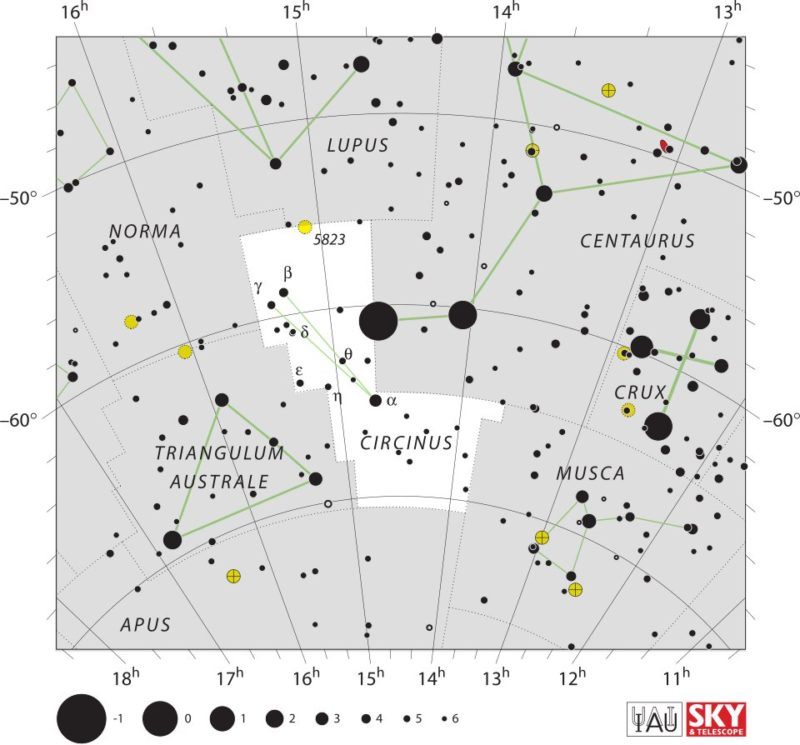
Circinus is a small, faint constellation of the far southern sky that represents a draftsman’s compasses, the hinged instrument used to draw circles on paper. It sits tucked beside Alpha Centauri, covers just 93 square degrees, and holds no star brighter than magnitude 3.2. Most beginners skip right over it. That’s a mistake, because this unremarkable patch of the southern skies happens to host one of the nearest active Seyfert galaxies and one of the strangest X-ray binaries on record.
What Does Circinus Represent in the Southern Sky?
Name meaning
The Latin word circinus means a pair of compasses, the drafting tool, not the magnetic compass you’d carry on a hike. Worth stating plainly, since the mix-up happens constantly. That navigational instrument belongs to Pyxis, a different constellation entirely, and both were invented by the same man.
Lacaille’s 1750s origin
French astronomer Nicolas Louis de Lacaille catalogued nearly 10,000 southern stars from the Cape of Good Hope between 1751 and 1752, and along the way he carved 14 new constellations out of the leftovers. Circinus was one of them. NOIRLab’s constellation reference credits Lacaille with the 1750s introduction and lists Alpha Circini at magnitude 3.19 with Beta Circini trailing at 4.07. Enlightenment tools, promoted to the heavens. Telescopium, Caelum, and the rest of that engineering-shop family came from the same survey.
Absence of mythology
No Greek heroes here. No transformation stories, no gods hurling anyone skyward. Circinus is an 18th-century invention, and its blank mythological record is precisely why so many popular star chart books give it a single sentence and move on.
Size, Shape, and Neighboring Constellations
Fourth smallest of the 88 modern constellations, which pegs the area at 93 square degrees. Only Crux, Sagitta, and Equuleus are tighter.
The shape is a narrow, lopsided triangle. Alpha at the eastern point, Beta and Gamma forming the short opposite side, roughly the outline of compasses half-opened on a drafting table.
Its neighbors do most of the heavy lifting for finding it:
- Centaurus, wrapping around the north and west, home of Alpha and Beta Centauri
- Triangulum Australe, the brighter triangle immediately east
- Musca, Apus, Norma, and Lupus filling out the remaining borders
Which Stars Define the Compass Outline?
Alpha Circini is the headline act. A white main sequence star about 54 light-years out, it is the brightest rapidly oscillating Ap star known, pulsating in periods of a few minutes with a chemically peculiar, magnetically braided atmosphere. It also carries a red dwarf companion, making it a workable double star in a modest amateur telescope.
Beta Circini is a hotter A-type star roughly 91 light-years distant. Gamma Circini is the interesting one for splitting: a tight binary star of blue and yellow components, separation under a single arcsecond at times, demanding steady seeing and real aperture.
Theta Circini is an eruptive variable star, and the constellation carries a scattering of faint variables that reward patient photometry more than casual glancing.
| Star | Magnitude | Type | Distance (light-years) |
|---|---|---|---|
| Alpha Circini | 3.19 | Rapidly oscillating Ap | ~54 |
| Beta Circini | 4.07 | A-type main sequence | ~91 |
| Gamma Circini | 4.51 | Binary (B + G) | ~450 |
Deep Sky Objects Worth Tracking
Here’s where the faintness stops mattering. The Circinus Galaxy, ESO 97-G13, lies about 13 million light-years away behind the dust of the Milky Way’s plane, and is one of twelve large galaxies in the “Council of Giants” surrounding the Local Group. The Hubble imagery of its Seyfert core showed ionized gas rings streaming from an active galactic nucleus. Joint Hubble and Webb observations of the same galaxy have since peeled back the obscuring dust to examine the accretion torus feeding the central supermassive black hole.
Then there’s Circinus X-1. A neutron star in a wildly eccentric orbit with a companion, and in 2013 Chandra used X-ray light echoes bouncing off intervening dust clouds to fix its distance at 30,700 light-years. The same system appears to be under 4,600 years old, making it the youngest known X-ray binary. Astonishingly young by cosmic accounting.
Smaller game: the open cluster NGC 5823 straddling the Lupus border, and NGC 5315, a compact planetary nebula shed by a dying star.
When and Where Can You See Circinus?
Southern Hemisphere, overwhelmingly. Observers in Australia, Chile, South Africa, and New Zealand get it high overhead. Equatorial regions catch it low. From the Northern Hemisphere the whole constellation stays hidden above about 30 degrees north latitude, with the visible window running between +30 and -90.
Peak months are May through July, when it culminates around local midnight.
Locate the Compasses Step by Step
- Find Alpha Centauri, the brilliant pointer star.
- Hop about 4 degrees southwest to Alpha Circini.
- Trace east toward the bright triangle of Triangulum Australe.
- Cross-check with Musca and the Coalsack to confirm you’re in the right neighborhood.
Observation Tips for Binoculars and Telescopes
Binoculars sweep the rich Milky Way background here beautifully, though they won’t resolve much. Split Gamma Circini with 150 mm of aperture minimum, and expect to wait for a still night. The galaxy needs dark skies and 250 mm plus, plus honest expectations, since heavy galactic extinction dims it considerably.
FAQ
Is Circinus a zodiac constellation?
No. It sits far south of the ecliptic.
Can I see it from Europe or the United States?
Not from the continental US or most of Europe. Southern Florida barely misses it.
Conclusion
The Circinus constellation is small, dim, mythologically empty, and still one of the more scientifically productive squares of sky Lacaille ever drew a line around.
Would you like to receive similar articles by email?

Paul Tomaszewski
Paul Tomaszewski is a science & tech writer as well as a programmer and entrepreneur. He is the founder and editor-in-chief of CosmoBC. He has a degree in computer science from John Abbott College, a bachelor's degree in technology from the Memorial University of Newfoundland, and completed some business and economics classes at Concordia University in Montreal. While in college he was the vice-president of the Astronomy Club. In his spare time he is an amateur astronomer and enjoys reading or watching science-fiction. You can follow him on LinkedIn and Twitter.


You May Also Like
What Causes Dips in Exoplanet Reflected Light Curves
Draco Constellation Guide