Chamaeleon Constellation Guide
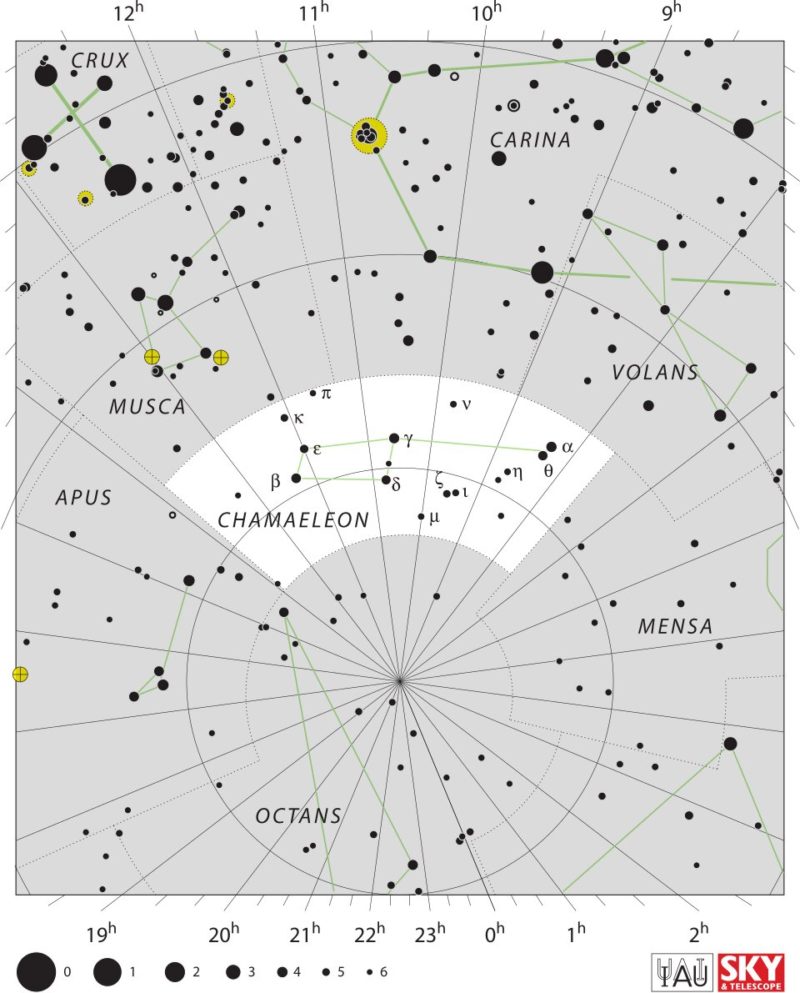
Chamaeleon is a small, faint constellation in the deep southern sky, wedged between the Southern Cross and the south celestial pole, and it takes its name from the color-shifting lizard that Dutch navigators saw on their voyages through the East Indies. It has no bright stars worth bragging about. What it does have, tucked behind its dim outline, is one of the nearest active stellar nurseries to our solar system.
What Is Chamaeleon and Where Did Its Name Come From?
Name meaning
The Latin name simply means chameleon. Sailors on those late 16th-century Dutch voyages encountered these lizards across Madagascar and the islands of the Indian Ocean, and the animal made a neat pairing with the neighboring constellation Musca, the fly. The chameleon sticks out its tongue at the bee-fly forever. Old star charts really do draw it that way.
Petrus Plancius origin
Credit for the constellation goes to the Dutch cartographer and theologian Petrus Plancius, who plotted it on a celestial globe in 1597 or 1598 using observations brought back by Pieter Dirkszoon Keyser and Frederick de Houtman. Willem Lodewyckz kept navigational records from the same expedition. This was not folklore handed down from antiquity. It was survey work, done by men trying to fix their position at sea south of the equator where the familiar zodiac gave them nothing.
Early chart depictions
Johann Bayer printed it in his Uranometria atlas of 1603, which is how Chamaeleon entered the canon of western IAU constellations. Universe Today’s survey of that period tracks how Keyser and de Houtman’s charting fed Bayer’s atlas, and the Dutch cartography background also shows up in NOIRLab’s reference profile on the constellation.
How Do You Find Chamaeleon in the Night Sky?
Position and coordinates
Right ascension runs roughly from 7h to 14h, and declination sits between about -75 and -83 degrees. That puts it close enough to the celestial pole that it barely moves. Ranked 79th by area, it covers around 132 square degrees.
Bordering constellations
- Musca to the north, the fly it eternally chases
- Carina and Volans to the west and northwest
- Mensa to the southeast, near the Large Magellanic Cloud
- Octans to the south, the pole itself
- Apus to the east
Star-hopping route
Start at Crux. Drop south past Musca, keep going, and you land in a patch of sky where three modest stars form a lopsided triangle. That is it. Binoculars help enormously here.
Visibility by Latitude and Season
Southern Hemisphere view
From Chile, New Zealand, South Africa or southern Australia, Chamaeleon is circumpolar. It never sets.
Northern latitude limits
North of about 7 degrees north latitude, forget it. Observers in equatorial regions catch the northern edge grazing the horizon in poor seeing.
Best months
March and April, when it rides highest after dark. EarthSky’s field notes on tracking Chamaeleon relative to the Southern Cross explain the seasonal geometry better than most star atlases do.
Main Stars and Their Characteristics
| Star | Magnitude | Spectral type | Distance |
|---|---|---|---|
| Alpha Chamaeleontis | 4.06 | F5 III | ~63 light years |
| Gamma Chamaeleontis | 4.11 | M0 III | ~418 light years |
| Beta Chamaeleontis | 4.24 | B5 Vn | ~298 light years |
| Delta-1 Chamaeleontis | 5.46 | K0 III | ~354 light years |
Alpha Chamaeleontis
A yellow-white subgiant, hotter than the Sun, and the constellation’s brightest star. Its binary main-sequence status has been examined in a structural entry on the star’s galactic coordinates, though the evidence there is worth reading skeptically.
Gamma Chamaeleontis
A red-hued star, a cool giant with a bloated radius and a low surface temperature. The most obviously colored object in the group.
Beta and Delta pairs
Beta is a hot blue main sequence star. Delta is an optical double, not gravitationally bound, and Theta Chamaeleontis rounds out the fainter designations.
Deep Sky Objects Worth Tracking
Chamaeleon I cloud
Cha I is the closest active star-forming dark cloud to Earth. Hubble’s 315-million-pixel mosaic of this 65-light-year-wide nursery came from 23 separate Advanced Camera observations, catalogued in Goddard’s visualization data repository. Webb went further, taking a spectral inventory of deep embedded ices locked inside the same cloud. Roughly 200 to 300 young stars live there, averaging around 2 million years old.
Chamaeleon II and III
Sparser, quieter siblings. Dark Energy Camera work on scattered pockets of star formation across the wider Chamaeleon Complex showed how uneven the gravitational contraction really is, and Space.com’s coverage of the June 2025 optical capture put numbers on it. IC 2631, a reflection nebula, showed up handsomely in ESO’s VISTA infrared survey. NGC 3195 is the constellation’s planetary nebula, small and tough.
Eta Chamaeleontis cluster
A tight, young star cluster of about 18 members, roughly 316 light years away, and unusually poor in low-mass objects.
What Readers Usually Ask Next
Mostly whether they can see any of this without a telescope. Honestly, no. The dark clouds are dark. Bring a camera.
FAQ
Is Chamaeleon a zodiac constellation?
No. It sits far south of the ecliptic.
How many stars does it have?
Only three above magnitude 4.5, which is why it is easy to miss.
Why is it near Musca?
Plancius paired the chameleon with the bee-fly deliberately.
Conclusion
Chamaeleon is a faint constellation, with extraordinary contents. Go find it tonight!
Would you like to receive similar articles by email?

Paul Tomaszewski
Paul Tomaszewski is a science & tech writer as well as a programmer and entrepreneur. He is the founder and editor-in-chief of CosmoBC. He has a degree in computer science from John Abbott College, a bachelor's degree in technology from the Memorial University of Newfoundland, and completed some business and economics classes at Concordia University in Montreal. While in college he was the vice-president of the Astronomy Club. In his spare time he is an amateur astronomer and enjoys reading or watching science-fiction. You can follow him on LinkedIn and Twitter.


You May Also Like

What Causes Stretch Marks and How to Support Skin Health?

How To Choose the Right Lab Equipment for Your Next Experiment