Cetus Constellation Guide
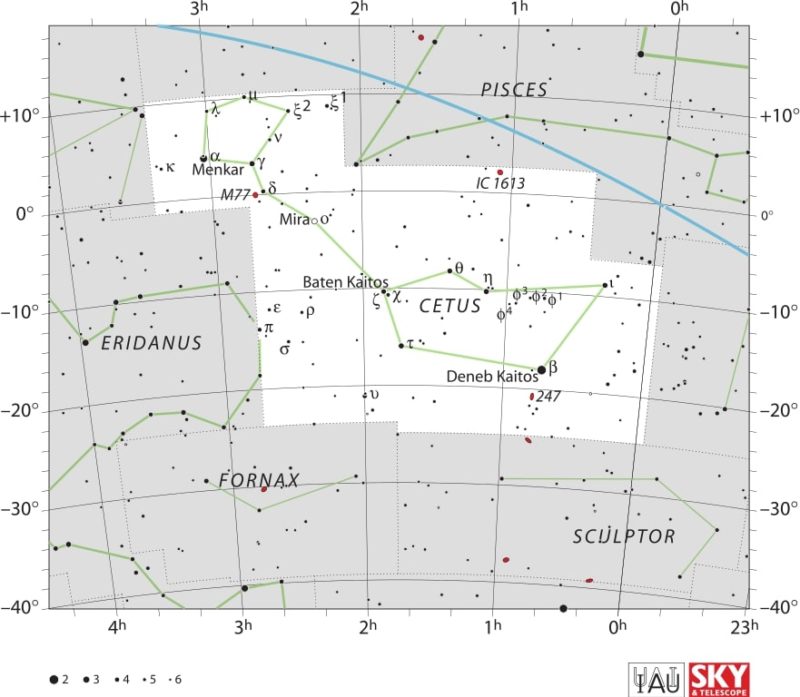
Cetus is the fourth-largest constellation in the sky, sprawling across 1,231 square degrees of the southern celestial hemisphere, and it represents the sea monster of Greek mythology sent to devour Princess Andromeda. It is best seen in autumn evenings, peaks around November, and holds two objects that matter enormously to astronomy: the variable star Mira and the Seyfert galaxy Messier 77. What it does not hold is a single first-magnitude star, which is exactly why most people have never traced it.
That absence is the whole story. Cetus is big, faint, and quietly important.
Where Does the Sea Monster Sit in the Night Sky?
Size and boundaries
Only Hydra, Virgo, and Ursa Major cover more sky. Cetus straddles the celestial equator, with its head poking north into the ecliptic zone and its tail dipping well south, so the declination range runs from roughly +10 degrees down past -24 degrees. The official International Astronomical Union boundary is a jagged polygon, not a whale shape, and the stick figures you see on charts vary wildly from atlas to atlas.
Neighboring constellations
Aries and Pisces sit above the head. Taurus and Eridanus flank the western side, Aquarius and Sculptor crowd the tail. Perseus, Cassiopeia, Cepheus, and Andromeda all hover further north, the surviving cast of the same myth.
Celestial waters region
Astronomers call this whole patch the celestial waters, a watery neighborhood of Aquarius, Pisces, Capricornus, and Eridanus. There is almost no Milky Way glare here. Which means the faint external galaxies come through cleanly.
How Do You Find Cetus Step by Step?
Start from Orion
Orion’s Belt points down and west toward Sirius, but flip the line the other way, past Aldebaran, and you drift into Cetus territory. The Guardian’s stargazing column suggests using Taurus and Orion as pointers toward the monster, and honestly, that remains the fastest route.
Trace the monster’s head
Alpha Ceti, Menkar, is a ruddy giant at magnitude 2.5 that anchors a loose pentagon of stars forming the head. It sits near the Aries border. Gamma Ceti, a tight double, is a step west.
Anchor on Diphda
Beta Ceti, also called Diphda or Deneb Kaitos, marks the tail and is the brightest star in the constellation at magnitude 2.04. Odd quirk: the brightest star got the beta designation. Head and tail located, everything between is the body.
Best Season and Latitudes for Viewing
- Peak evening window: late October through December, culminating near local midnight in early November.
- Northern hemisphere: visible from latitudes above +70 degrees south, riding low in the south for observers in Canada, the UK, and northern Europe.
- Southern hemisphere: far better placed, passing high overhead from Australia, Chile, and South Africa.
Skywatching guides note that Cetus clears the horizon comfortably once autumn haze settles.
Myth Behind the Whale
Perseus and Andromeda
Queen Cassiopeia of ancient Aethiopia bragged that her beauty rivaled the sea nymphs. Poseidon was not amused. He sent Cetus against the coasts, and an oracle told King Cepheus the only fix was sacrificing his daughter Andromeda on an ocean cliff. Perseus arrived, Medusa’s head in hand. Monster petrified, princess saved.
Sea-serpent depictions
Ptolemy and the medieval cartographers who followed him drew a scaly hybrid with forepaws and a piscine body, not a whale. Ian Ridpath’s research on classical star lore traces this ambiguity clean back to the Greek word ketos, which simply meant any huge sea creature.
Name origins
Some historians suspect ancient Mediterranean travelers found fossilized whale bones in coastal waters and built the legend around them. I find that plausible and slightly hilarious.
Cross-Cultural Star Lore
Babylonian sources tied this star field to Ea, the sea god of the deep, an emblem of primordial chaos. Arabic astronomers called it Al Hut, the fish or whale, and named its members accordingly: Menkar means nostril, Baten Kaitos means the whale’s belly. NOIRLab’s educational overview of the constellation preserves those Arabic roots. Chinese astronomy carved the region up entirely differently, distributing the stars among mansions that had nothing to do with monsters.
Mira and the Variable Stars
Omicron Ceti, Mira, is the prototype long-period variable. Over a 332-day cycle it swings from around magnitude 3.5 to a barely-there 10, and Phocylides Holwarda documented its repeating disappearance in 1638. That single observation broke the old assumption of an unchanging heavens.
Mira is actually a binary: a pulsating red giant shedding a 13-light-year cometary tail, plus a white dwarf companion. Other variables worth logging include UV Ceti, the archetypal flare star, and Zeta Ceti.
Brightest Stars Worth Knowing
| Star | Magnitude | Type | Note |
|---|---|---|---|
| Beta Ceti (Diphda) | 2.04 | K0 orange giant | Tail marker |
| Alpha Ceti (Menkar) | 2.53 | M-type red giant | Head of the monster |
| Eta Ceti | 3.45 | K giant | Deneb Algenubi |
| Tau Ceti | 3.50 | G8 dwarf | Sun-like, 11.9 light-years away |
| Omicron Ceti (Mira) | 3.5 to 10 | Variable red giant | Prototype LPV |
Tau Ceti deserves its own paragraph, frankly. A nearby single star with a candidate planetary system, it has been a SETI target since Project Ozma in 1960.
Galaxies, Nebulae, and Deep-Sky Targets
- Messier 77 (NGC 1068) – the only Messier object here, a barred spiral with an active galactic nucleus about 47 million light-years out. Bright core, easy in a 4-inch scope.
- NGC 246, the Skull Nebula – a planetary nebula with a white dwarf and a genuinely eerie face.
- NGC 1087 – a barred spiral roughly 80 million light-years distant, imaged beautifully by Hubble for its star-forming knots.
What Equipment Do You Need to Observe Cetus?
Naked eye gets you Diphda, Menkar, and Mira at maximum. Binoculars in the 10×50 range pull out the head pentagon and Mira’s color shift. For M77 and NGC 246, you want a 6-inch aperture minimum and genuinely dark skies, since surface brightness matters more than magnitude here. Celestron’s seasonal notes on tracking this fall constellation recommend low-power wide fields first, then magnify.
FAQ
Is Cetus a zodiac constellation? No. It brushes the ecliptic near Pisces but never officially hosts the Sun’s path, so it carries no canonical glyph.
Why is Mira sometimes invisible? At minimum it drops to tenth magnitude, roughly 250 times fainter than at peak, requiring a telescope.
Is Cetus a whale or a monster? Both, depending on the century. The historical record on the constellation shows the whale reading is a later softening of a much stranger beast.
Conclusion
The Cetus constellation rewards patience rather than dazzle. Trace it once from Menkar to Diphda, catch Mira mid-cycle, and the sprawling emptiness starts feeling less like a gap and more like an ocean.
Would you like to receive similar articles by email?

Paul Tomaszewski
Paul Tomaszewski is a science & tech writer as well as a programmer and entrepreneur. He is the founder and editor-in-chief of CosmoBC. He has a degree in computer science from John Abbott College, a bachelor's degree in technology from the Memorial University of Newfoundland, and completed some business and economics classes at Concordia University in Montreal. While in college he was the vice-president of the Astronomy Club. In his spare time he is an amateur astronomer and enjoys reading or watching science-fiction. You can follow him on LinkedIn and Twitter.


You May Also Like
How to Participate in Galaxy Zoo: A Volunteer Guide
Gamma Ursae Minorid Meteor Shower Guide