Cepheus Constellation Guide
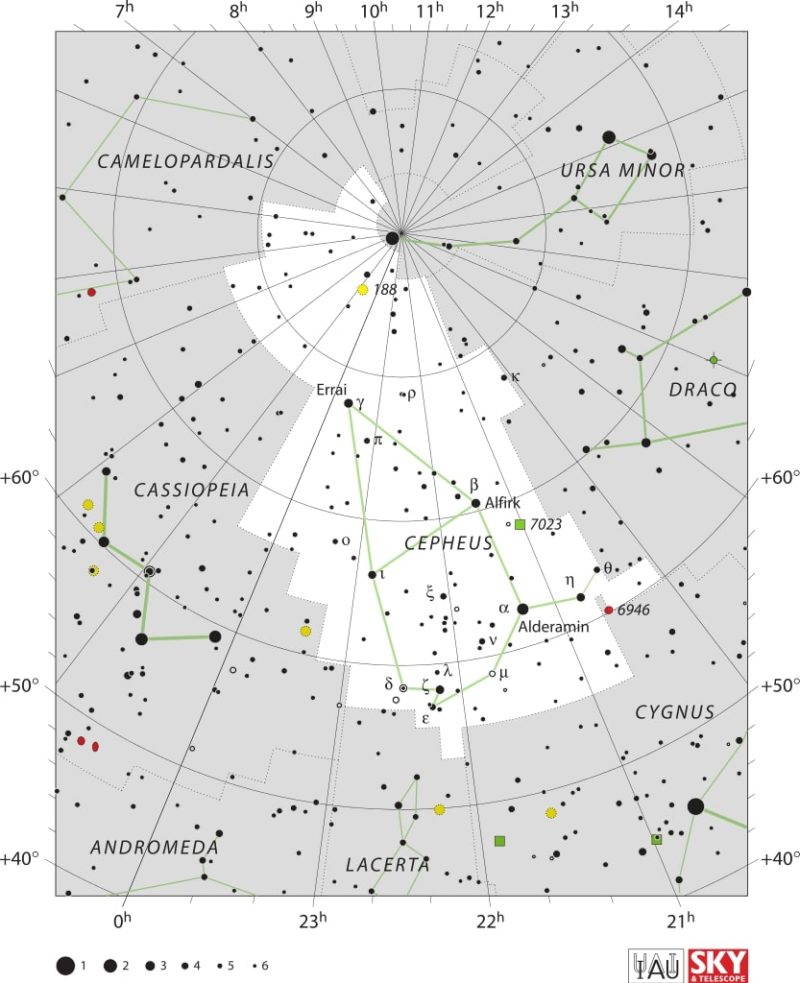
Cepheus is a large, faint constellation of the northern sky, named for the mythological king of Ethiopia, and it sits high above the horizon for most observers visible between +90° and −1° (IAU 1930 boundaries). It covers roughly 588 square degrees, ranking 27th in size among the 88 western IAU constellations, and it holds two things every serious observer eventually cares about: the prototype Cepheid variable star, and some of the largest red supergiants known. This guide walks through where it sits, what it looks like, and what’s worth chasing inside it.
What Makes Cepheus Stand Out Among Northern Constellations?
No dazzling stars. That’s the first thing people notice, usually with mild disappointment. The brightest member, Alderamin, only reaches magnitude 2.5, so from a light-polluted suburb the whole shape collapses into nothing.
But the constellation Cepheus sits right on the Milky Way’s northern edge, which means it’s stuffed with molecular clouds, star clusters, and emission complexes. Astronomers use it as a laboratory. Amateurs use it as a proving ground.
Where to Find the King in the Night Sky
Circumpolar position
From mid-northern latitudes, Cepheus never sets. It wheels around the celestial pole all year, sometimes upside down, sometimes standing upright like a proper house. Observers in equatorial regions catch it low; in the southern hemisphere, it’s essentially gone.
Neighboring constellations
Cassiopeia sits on one side, that unmistakable W. Draco curls beneath. Cygnus flies past the southern edge, and the sparse, forgettable Camelopardalis fills the space toward Ursa Minor and the north star. Lacerta borders the western edge.
Best viewing months
September through November puts Cepheus near the zenith after dark. That’s when the seeing is best for it.
The House-Shaped Pattern Stargazers Look For
Forget the robed king. What you actually see is a child’s drawing of a house, peaked roof and all.
- Alderamin corner (Alpha Cephei) anchors the bottom right of the box, a white magnitude 2.5 star spinning so fast it’s noticeably flattened.
- Alfirk (Beta Cephei) marks the roofline’s left side and lends its name to an entire class of pulsating variable stars.
- Errai (Gamma Cephei) tops the peak, and here’s a fun detail: it hosts a confirmed exoplanet (Tadmor / Gamma Cephei Ab) and will replace Polaris as the polar star around 3000 AD.
Common star-hop mistakes? Plenty. People confuse the roof apex with a nearby magnitude star in Cassiopeia’s direction, or they lose the triangle entirely when Zeta Cephei fades below their eyepiece limit. EarthSky’s guide to spotting the house shape relative to Polaris fixes most of that confusion in about thirty seconds.
Who Was Cepheus in Mythology?
The Ethiopian king. Husband to Cassiopeia, father to Andromeda, the man who chained his own daughter to a rock because Poseidon sent a sea monster after his wife bragged too loudly. Perseus showed up, killed the monster, and married the girl. Phineus, her original betrothed, objected and got turned to stone for his trouble.
Ian Ridpath’s star-atlas history of King Cepheus traces how the figure was charted across centuries of atlases, and the Cassiopeia and Cetus story shows how tightly this family cluster of nearby constellations hangs together. Ptolemy catalogued Cepheus in the Almagest.
Brightest Stars and Stellar Giants
| Star | Magnitude | Type | Note |
|---|---|---|---|
| Alpha Cephei | 2.46 | A8Vn (rapid rotator, oblate) | Subgiant / main-sequence boundary |
| Mu Cephei | 3.4–5.1 var | Red supergiant | Herschel’s Garnet Star |
| Delta Cephei | 3.48–4.37 var | Cepheid prototype | Also a binary star; discovered variable by John Goodricke (1784) |
| VV Cephei | 4.91 | Eclipsing binary (Algol + semiregular) | Red supergiant primary; ~660–1,050 R☉ |
Why Delta Cephei Matters to Modern Astronomy
This is the important one. Delta Cephei pulsates on a 5.37-day cycle, and its period ties directly to its absolute brightness. Measure the period, get the luminosity, compare to apparent magnitude, and you have distance. Cepheid variables became the cosmic yardsticks that let Hubble prove other galaxies exist and that the universe expands.
Deep-Sky Objects Worth Chasing
NGC 7380, the Wizard Nebula, needs narrowband filters to show its shape. The Iris Nebula (NGC 7023) is a reflection nebula, dusty and blue, and rewards long integrations. The Fireworks Galaxy, NGC 6946, straddles the Cygnus border and has produced more observed supernovae than nearly any other spiral galaxy.
Chandra’s work on the Cepheus B molecular cloud and Spitzer’s infrared survey of infant stars in Cepheus C both show what’s happening under the dust.
Observe Cepheus With Binoculars or a Telescope
Start with 10×50 binoculars on Mu Cephei to nail the color. Then push to Trumpler 37, where the Cosmic Pursuits field guide to the Elephant Trunk Nebula explains the star-hop cleanly.
Practical Lessons From Imaging Cepheus
Wide field beats deep aperture here. NGC 7822 looks like a small patch in a single frame and reveals a sprawling complex only across a mosaic. Budget for dark frames, careful guiding, and more integration than you think. Faint filaments, not bright showpieces.
FAQ
Is Cepheus visible from the southern hemisphere?
Barely, and only near the equator.
Which star is the Cepheid prototype?
Delta Cephei, a binary star system with a companion.
Will Cepheus contain the north star?
Yes. Errai takes over in roughly a thousand years.
Conclusion
Cepheus is a quiet constellation that quietly underwrites how we measure the universe. Go find the house in the sky.
Would you like to receive similar articles by email?

Paul Tomaszewski
Paul Tomaszewski is a science & tech writer as well as a programmer and entrepreneur. He is the founder and editor-in-chief of CosmoBC. He has a degree in computer science from John Abbott College, a bachelor's degree in technology from the Memorial University of Newfoundland, and completed some business and economics classes at Concordia University in Montreal. While in college he was the vice-president of the Astronomy Club. In his spare time he is an amateur astronomer and enjoys reading or watching science-fiction. You can follow him on LinkedIn and Twitter.


You May Also Like

The Link Between Mental Health and Skin Health
What Are Intergalactic Stars?