Centaurus Constellation Guide
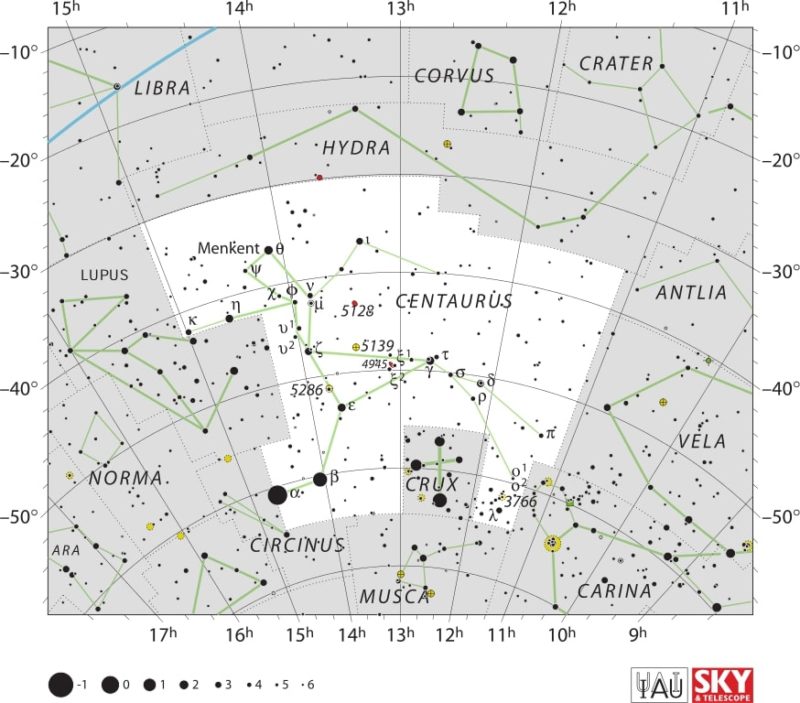
Centaurus is the ninth largest of the 88 modern constellations, sprawling across roughly 1,060 square degrees of the southern sky, and it holds more genuine astronomical wealth per square degree than almost anything else up there.
The nearest star system to the Sun sits inside it. So does the most massive globular cluster in the Milky Way, and the closest active galaxy to Earth. That combination is not luck. It is simply where our galaxy’s inner regions happen to fall from our vantage point.
What Is Centaurus and Where Does It Rank Among the Constellations?
Size and boundaries
The constellation boundaries drawn by the IAU in the 1920s give Centaurus an odd, sprawling footprint that wraps partially around Crux, the Southern Cross, like a hand cupping a coin. Right ascension runs from about 11h to 15h, declination from roughly -30 degrees down past -64. The whole constellation is a southern hemisphere coordinates affair, though its northern edge nudges close enough to the celestial equator to matter for observers up north.
Shape and asterism
Forget the horse. Nobody sees a centaur. What you actually see is a lopsided many-sided shape anchored by two very bright stars at the southeast, with a long arc of second and third magnitude stars sweeping north toward Menkent. The classical figure has the centaur spearing Lupus, the wolf, and in older charts sometimes a wild boar or bison stood in for the victim.
Neighboring constellations
Centaurus location is easiest to pin by its neighbors: Crux and Musca tucked inside its southern crook, Carina and Vela to the west, Antlia and Hydra north, Lupus and Libra to the east. Libra puts you near the ecliptic, which is a useful mental bookmark.
How Do You Find Centaurus in the Night Sky?
Star-hop from Crux
Find the Southern Cross first. It is small, tilted, and unmistakable once you stop confusing it with the False Cross. Centaurus wraps around it from the east.
Pointer stars method
Work it backwards. The two bright stars Alpha and Beta Centauri are the famous Pointers, and a line drawn through them lands on Crux. Reverse the trick and Crux points you home.
Horizon and timing checks
Three quick field checks before you commit an evening:
- Confirm your southern horizon is genuinely open, no treeline, no neighbor’s floodlight.
- Check the transit time for declination -60 at your latitude, then arrive an hour early.
- Note the Moon phase. Omega Centauri near full Moon is a waste of a drive.
Visibility by Latitude
Southern Hemisphere views
South of about 30 degrees south, the whole constellation is circumpolar or nearly so. Chile, South Africa, Australia, New Zealand: you get it all, high and steady.
Tropical and equatorial views
From equatorial regions, Centaurus climbs decently in autumn evenings and the atmospheric extinction is manageable.
Northern mid-latitude limits
Here is where the folklore breaks down, and I will get to that below.
Choose the Best Season and Hour to Observe
April to June peak
April through June is the window. Centaurus transits during convenient evening hours.
Local midnight window
Around local midnight in May, the southern stars sit lowest but have not yet set, which is exactly the sweet spot for northern observers chasing scraps.
Sky quality factors
Dry, stable air matters more than aperture at these altitudes. Humidity near the horizon eats magnitudes.
Notable Stars Inside Centaurus
| Star | Magnitude | Type | Distance |
|---|---|---|---|
| Alpha Centauri | -0.27 (combined) | Triple star system | 4.3 light-years |
| Beta Centauri (Hadar) | 0.61 | Blue giant star | ~390 light-years |
| Theta Centauri (Menkent) | 2.06 | Orange giant | ~59 light-years |
| Proxima Centauri | 11.13 | Red dwarf | 4.24 light-years |
Alpha Centauri
Rigel Kentaurus (Alpha Centauri) splits into a lovely binary pair in small telescopes. NASA’s overview of our nearest celestial neighbor lays out the exotic three-star arrangement neatly, and visualization work puts Alpha Centauri A at 1.1 solar masses. Recent Webb data hints at a giant planet candidate around the primary.
Proxima Centauri
The third star, an 11th magnitude red dwarf, is closer than the AB binary star and hosts confirmed planets.
Beta Centauri and Theta Centauri
Beta is hot, blue, and 390 light-years off. Menkent (Theta Centauri) is the northernmost bright star in the constellation, and that fact is the key to everything in the section after next.
Deep-Sky Objects Worth Targeting
Omega Centauri
Ten million stars, 16,000 light-years away, and probably the stripped core of a dwarf galaxy rather than a true globular cluster. Two decades of Hubble imaging turned up fast-moving stars circling an intermediate-mass black hole, and follow-up work with Webb has since mapped stellar-mass black holes in the same cluster.
Centaurus A
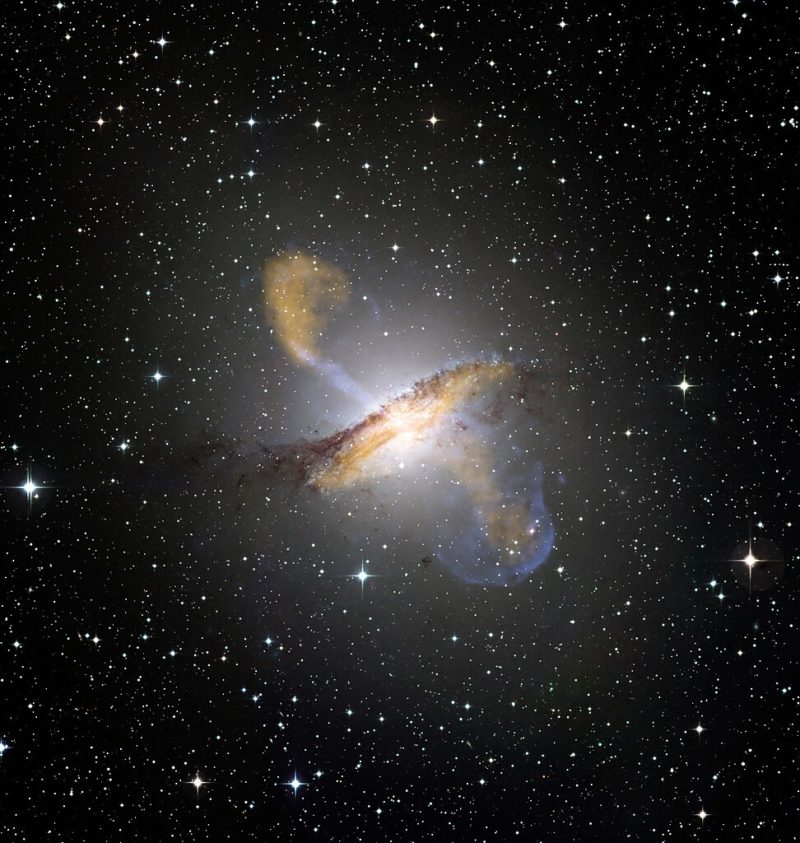
NGC 5128, the closest active galactic nucleus at 11 million light-years, with a dust lane you can glimpse in a 6-inch scope. Chandra tracks particle jets accelerated near light speed through that bright nucleus.
Running Chicken Nebula and Pearl Cluster
The Running Chicken Nebula rewards a hydrogen-beta filter. NGC 3766, the Pearl Cluster, is a binoculars object. The planetary nebula NGC 5307 sits 10,000 light-years out.
Mythology and Cultural History Behind the Name
Greek myth points to Chiron, the civilized half horse tutor raised apart from the rowdy centaurs, wounded by Heracles and placed among the stars by Zeus. Some traditions favor Pholus. The cataloging history running back to Ptolemy confirms it was already ancient by the 2nd century, and Edmond Halley later resolved Omega Centauri from Saint Helena.
Why the Claim That Centaurus Is Invisible North of 30°N Overstates the Case
Menkent sits at declination -36. From 33 degrees north latitude that star culminates around 21 degrees altitude. Visible. Gamma Centauri too. What you lose at northern latitudes is Alpha and Beta, not the constellation. Saying Centaurus is invisible from the northern hemisphere is sloppy shorthand that discourages people from trying.
Gear and Field Tactics for Low-Altitude Southern Targets
- 10×50 binoculars first, then the telescope.
- Elevation helps more than aperture; get above the haze layer.
- Plan around transit, not sunset.
FAQ
Can I see Alpha Centauri from the United States?
From Hawaii and southern Florida, yes, barely. From most of the mainland, no.
Is Centaurus on the ecliptic?
No, though it borders Libra, which is.
Conclusion
For the Centaurus constellation, chase the exact window for your latitude rather than a blanket yes or no. The sky rewards specificity.
Would you like to receive similar articles by email?

Paul Tomaszewski
Paul Tomaszewski is a science & tech writer as well as a programmer and entrepreneur. He is the founder and editor-in-chief of CosmoBC. He has a degree in computer science from John Abbott College, a bachelor's degree in technology from the Memorial University of Newfoundland, and completed some business and economics classes at Concordia University in Montreal. While in college he was the vice-president of the Astronomy Club. In his spare time he is an amateur astronomer and enjoys reading or watching science-fiction. You can follow him on LinkedIn and Twitter.


You May Also Like
Microscopium Constellation Guide
Gemini Constellation Guide