Space
Embark on an astronomical journey. Explore the cosmos, study celestial objects, and unravel the mysteries of the universe through astronomy's fascinating realm.
Monthly Stargazing Calendar for October 2013
Tonight (October 7 - 8) is the peak of the Draconids meteor shower. It is a minor meteor shower producing only about 10 meteors per hour during the peak, but some meteors can be seen one day before and after the peak. It originates from dust grains left behind by comet 21P Giacobini-Zinner, which was first discovered in 1900.
Monthly Stargazing Calendar for August 2013
Tonight (August 11 - 12) is the peak of one of the largest and perhaps one of the most famous meteor showers of the year, the Perseids meteor shower. It can produce as many as 90 meteors per hour at its peak but some meteors can be seen from July 17 to August 24. The first quarter moon will set shortly after midnight leaving dark skies for what should be an excellent show.
Monthly Stargazing Calendar for May 2013
May 2013 stargazing events: There will be a meteor shower, a solar eclipse, a conjunction of Venus and Jupiter, and a penumbral lunar eclipse.
Monthly Stargazing Calendar for April 2013
This month will be quite eventful and will have many interesting astronomical events. First of all, on April 14 we will witness the conjunction of the Moon and Jupiter. The Moon will appear to pass about two degrees of the giant planet Jupiter in the evening sky. The crescent moon will be at magnitude -10.6 and Jupiter at magnitude -2.1.
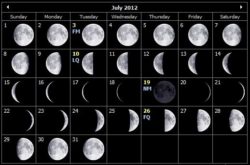
Monthly Stargazing Calendar for July 2012
Most of this month will be rather uneventful when it comes to astronomical events, but at the end of the month, on July 28 and 29 we will witness the Southern Delta Aquarids Meteor Shower. The Delta Aquarids can produce about 20 meteors per hour at their peak.
Monthly Stargazing Calendar for June 2012
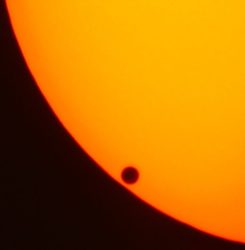
Today on June 5 we will have the chance to witness the transit of Venus across the Sun. This extremely rare event will be entirely visible throughout most of eastern Asia, eastern Australia, and Alaska.
Monthly Stargazing Calendar for May 2012
On May 5, 6 we witnessed the Eta Aquarids Meteor Shower. It is a a light shower, usually producing about 10 meteors per hour at the peak. The full moon ruined the show this year, washing out all but the brightest meteors with its glare.
Earth’s First Trojan Asteroid discovered by NASA’s WISE
NASA's WISE mission discovered asteroid 2010 TK7, an Earth Trojan, in a stable orbit around a Lagrangian point, possibly a future space destination.
Ara Constellation
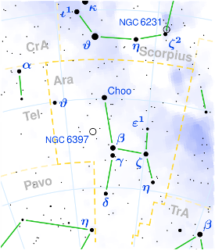
Explore the Ara constellation with its mythological roots, notable stars like Beta Arae, a star with planets, and fascinating deep-sky objects.
Aquila Constellation
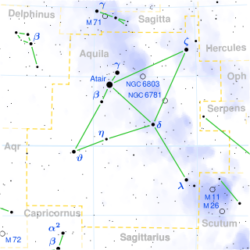
Discover Aquila, the eagle, in Greek mythology. Explore its notable stars like Altair and Alshain, as well as intriguing deep-sky objects.
Aquarius Constellation
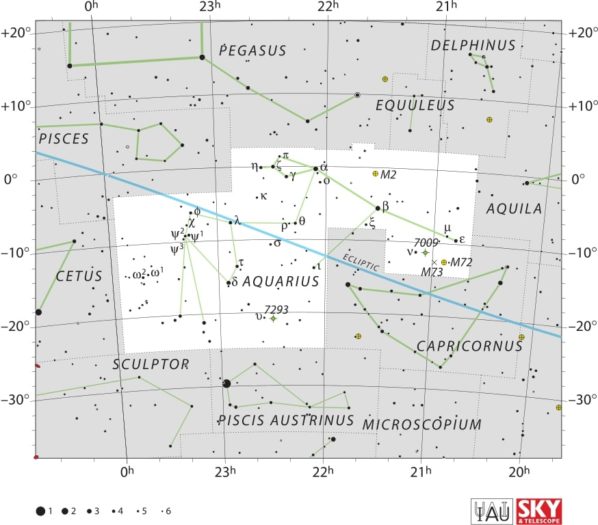
Explore the constellation Aquarius, the water-bearer. Discover its mythology, notable stars like Gliese 876, and captivating deep-sky objects like Messier 2.
Non-Rocket Spacelaunch – Advantages and Difficulties of a Launch Loop
Unlike conventional rockets, launch loops can have many launches per hour, independent of weather, and are not inherently polluting. Rockets create pollution such as nitrates in their exhausts due to high exhaust temperature, and can also create greenhouse gases depending on propellant choices. Launch loops require power in the form of electricity and as such it can be clean.
Non-Rocket Spacelaunch – Launch Loop
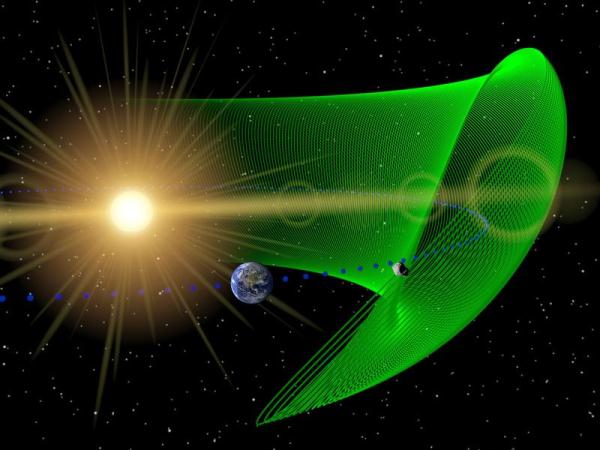
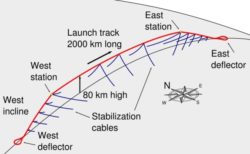
A launch loop (also known as a Lofstrom loop) is a proposed design for a very efficient non-rocket spacelaunch method. It is a much simpler concept than the space elevator, but still more complex than tether propulsion systems such as the rotovator.
Non-Rocket Spacelaunch – Tether propulsion in fiction
This is the fourth and final part of the tether propulsion article of the non-rocket spacelaunch methods article series. This post will focus on references to the tether propulsion concept in fiction. The most prominent science fiction novels on the subject include the following.
Non-Rocket Spacelaunch – Tether propulsion safety issues
The use of tethers in space poses many challenges and safety issues. This third part to the tether propulsion article will focus on those issues. A lot of the challenges and safety issues of a space tether system are similar to those of a space elevator described in a previous article, but some are unique to the space tether concept.
Non-Rocket Spacelaunch – Tether satellite missions
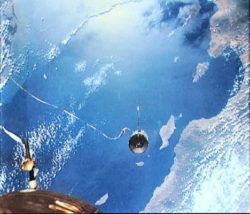
This is the second part to the article about tether propulsion. It will focus on space missions that tested tethers in space. The first such mission took place in 1966. Gemini 11 deployed a 30m tether connecting it to the Agena target vehicle. It created a small amount of artificial gravity (0.00015 g) by spinning the two spacecraft.
Non-Rocket Spacelaunch – Tether propulsion
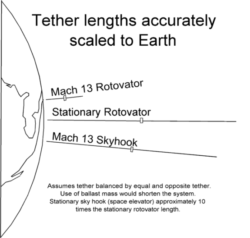
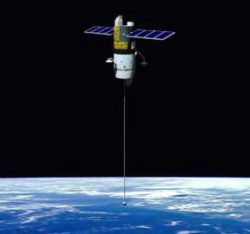
Tether propulsion consists in using long, very strong cables (known as tethers) to change the velocity of spacecraft and payloads. The tethers may be used to initiate launch, complete launch, or alter the orbit of a spacecraft. This form of propulsion would be significantly less expensive than spaceflight using modern rocket engines.
Non-Rocket Spacelaunch – Space Elevators in Fiction
This is the fourth and final part of the space elevator article of the non-rocket spacelaunch methods article series. This post will focus on references to the space elevator concept in fiction. The first mention of anything remotely similar to a space elevator was the beanstalk in the children's fairy tale called Jack and the Beanstalk, published in 1807.
Non-Rocket Spacelaunch – Extraterrestrial Space Elevator Concepts
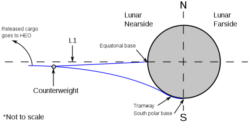
Space elevators, a futuristic concept, could be adapted for various celestial bodies: Mars, the Moon, and even asteroids, they promise a revolution in space access.
Non-Rocket Spacelaunch – Space Elevator Safety Issues
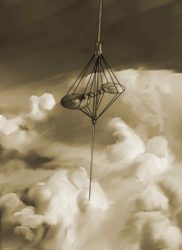
The space elevator is a gigantic concept and as such it has many safety issues that would have to be resolved before construction begins. A space elevator would present a navigational hazard, both to aircraft and spacecraft.