Cassiopeia Constellation Guide
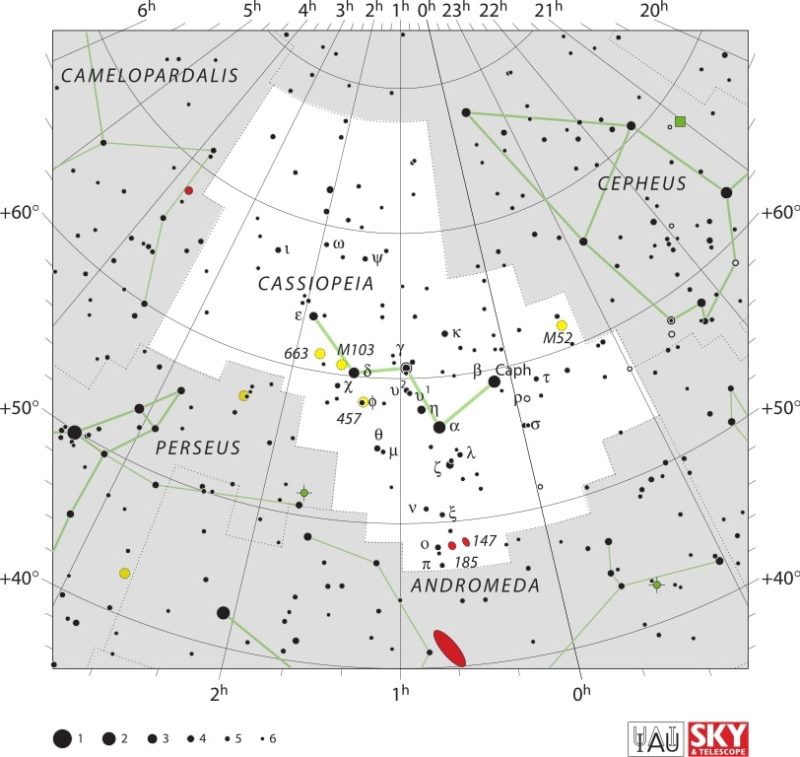
Cassiopeia is the bright, five-star “W” riding high in the northern sky, a circumpolar constellation that never sets for most observers above about 34 degrees north latitude. It sits directly opposite the Big Dipper across Polaris, which makes it one of the most reliable navigation anchors in astronomy.
The constellation carries the name of a boastful queen from Greek mythology, and inside its boundaries you’ll find open clusters, a famous supernova remnant, and some genuinely odd stars.
What Makes This “W” Shape So Easy to Spot?
Five-star W pattern
Five second-magnitude stars, spaced generously, forming a zigzag. That’s it. No fiddly triangles or faint filler stars to squint at. Even from a suburban backyard washed out by streetlights, the W punches through, which is why so many constellation guides start beginners here rather than with Orion.
Position beside Polaris
Draw a line from the middle star of the W to Polaris and you’ve got a rough compass. The Big Dipper and Cassiopeia sit on opposite sides of the North Star, wheeling around it like two hands on a clock. When one is low, the other rides high.
Seasonal flip to “M”
Look in late spring and the queen appears upside down, an “M” instead of a “W”. Greek tradition says Poseidon condemned her to that indignity, strapped to her throne, spinning head over heels for half the year.
How to Find It Tonight
Star hop from the Big Dipper
Find the two stars at the end of the Dipper’s bowl, follow them to Polaris, then keep going the same distance again. You’ll land in Cassiopeia.
- Autumn evenings: high overhead after dark, ideal for imaging.
- Spring evenings: low in the north, often near the horizon haze.
- Best hours: roughly 8 p.m. to midnight in September through November.
Best months and hours
November is the classic month. The constellation culminates near the zenith for mid-northern latitudes, dragging a rich slice of the Milky Way along with it.
Visibility by latitude
| Observer latitude | Visibility |
|---|---|
| 60°N (Oslo, Anchorage) | Circumpolar, visible all year |
| 40°N (New York, Madrid) | Circumpolar, mostly high |
| 20°N (Honolulu, Mumbai) | Seasonal, best in autumn |
| Equatorial regions | Low northern horizon, autumn only |
| 20°S and further south | Partial or none; southern hemisphere observers lose it below about 30°S |
The Main Stars
Schedar and Caph
Schedar, or Alpha Cassiopeiae, is an orange giant star burning about 40 times wider than the Sun. Caph, Beta Cas, is a white giant that pulses slightly. Beta Cassiopeiae also sits almost exactly on the zero-hour line of right ascension, a handy quirk.
Gamma Cas and Ruchbah
Gamma Cassiopeiae is the troublemaker. It’s an eruptive variable star that flings off a disk of gas, sometimes brightening past its neighbors, sometimes fading. Ruchbah, Delta Cassiopeiae, is an eclipsing binary star sitting around 99 light years out.
Segin and hidden variables
Epsilon Cassiopeiae, or Segin, closes the W. Nearby lurks Rho Cassiopeiae, one of the rarest yellow hypergiants known, and V509 Cassiopeiae, another. Eta Cassiopeiae, a lovely double star, splits nicely in a small telescope.
Deep-Sky Objects Worth a Look
Open clusters M52 and NGC 457
M52 is a dense open cluster near the Caph end. NGC 457, the Owl Cluster, is arguably better, with two bright “eyes” staring back.
Cassiopeia A
Cassiopeia A is the youngest known supernova remnant in the Milky Way, roughly 340 years old and about 11,000 light years away, where Chandra has traced silicon, sulfur, calcium, and iron scattered through the debris. Hubble measured the shell at about 13 light years across. Newer work from XRISM has picked out chlorine and potassium lines never seen before, and NuSTAR’s titanium-44 mapping revealed core “sloshing” during the collapse.
Tycho’s remnant
Tycho Brahe’s 1572 supernova also flared here, rivaling Venus in brightness before fading, and IXPE recently studied it with polarized X-rays.
Nebulae for imagers
The Bubble Nebula, NGC 7635, sits 7,100 light years. The Soul Nebula, IC 1848, stretches more than 150 light years wide. Both need a camera, not an eyepiece.
Myth Behind the Vain Queen
Greek story of Poseidon’s punishment
She bragged that her daughter Andromeda outshone the sea nymphs. Poseidon sent a monster. The mother’s punishment was the sky itself.
The Perseus family in the sky
Cassiopeia sits among her family: Cepheus, Andromeda, Perseus, Pegasus. The Andromeda Galaxy is an easy star hop away from the W.
Arabic, Pacific, and Asian readings
Arabic astronomers saw a camel and a stained hand. Pacific island navigators saw a porpoise. The pattern is universal; the story is not.
Formal Classification and Boundaries
Cassiopeia is abbreviated Cas, covers 598 square degrees, and ranks 25th of the 88 western IAU constellations. Neighbors include Cepheus, Camelopardalis, Perseus, Andromeda, and Lacerta. Declination runs roughly +46 to +77 degrees.
Use the Queen as a Beginner’s Anchor
Teach someone Cassiopeia first. From there, Polaris, then the Great Bear, then Andromeda. The confidence builds fast.
How Far Away Are These Stars?
Most of the main stars sit between 55 and 550 light years from Earth. They only look connected. Depth is the illusion the night sky sells hardest.
What Can You See Without a Telescope?
The W, obviously. Plus M52 and NGC 457 as faint smudges under dark skies, and the Milky Way band running behind it.
FAQ
Is Cassiopeia visible from the southern hemisphere?
Barely, and only near the equator in autumn.
Why does it change shape?
It doesn’t. It rotates around Polaris.
Best equipment?
Binoculars. Honestly, binoculars beat a telescope here.
Conclusion
A frequent stargazer learns to use the Cassiopeia constellation the way sailors used it: as a fixed point in a moving sky. Find the W, and the rest of the northern celestial hemisphere opens up.
Would you like to receive similar articles by email?

Paul Tomaszewski
Paul Tomaszewski is a science & tech writer as well as a programmer and entrepreneur. He is the founder and editor-in-chief of CosmoBC. He has a degree in computer science from John Abbott College, a bachelor's degree in technology from the Memorial University of Newfoundland, and completed some business and economics classes at Concordia University in Montreal. While in college he was the vice-president of the Astronomy Club. In his spare time he is an amateur astronomer and enjoys reading or watching science-fiction. You can follow him on LinkedIn and Twitter.


You May Also Like
Eta Eridanid Meteor Shower Guide
Cepheus Constellation Guide