Carina Constellation Guide
Carina is the southern constellation that represents the keel of Argo Navis, the mythical ship sailed by Jason and the Argonauts, and it holds Canopus, the second-brightest star in the night sky, along with the enormous stellar nursery known as the Carina Nebula.
If you observe from below roughly 20 degrees north latitude, this is arguably the richest patch of Milky Way you can point a telescope at. It is not a modern invention. It is a fragment of something older and much larger.
What Is Carina and What Does Its Name Mean?
Pronunciation
Say it “kuh-RYE-nuh,” though “kuh-REE-nuh” floats around too. The word is Latin for keel, the spine of a ship’s hull.
Keel of Argo Navis
The whole constellation was once the bottom of a boat. Vela took the sail, Puppis took the stern deck, and Carina kept the structural bones, along with the lion’s share of the bright stars.
Size and Rank
By area, Carina is the 34th largest constellation, covering about 494 square degrees, and it hosts a healthy count of stars with known exoplanets according to constellation data compiled by Go Astronomy. Its boundaries take up roughly 1.2% of the sky.
How Did Argo Navis Become Three Constellations?
Jason and the Argonauts
In Greek mythology the ship Argo carried Jason and his crew of Greek heroes toward the golden fleece, guided by a famous pilot and, in some tellings, blessed by a talking beam of oak. Other traditions tied the same star pattern to Egyptian myth and to the fleet of King Menelaus during the Trojan Wars. Ancient sky lore rarely stays tidy.
Ptolemy’s Original Ship
Ptolemy catalogued Argo Navis in the 2nd century as a single, sprawling southern constellation.
Lacaille’s 1763 Split
The French astronomer Nicolas Louis de Lacaille, working from the Cape of Good Hope, carved the ship into three component constellations. Curiously, the Greek letter designations were not restarted. Alpha, Beta, and Epsilon all landed in Carina, a quirk that Universe Today’s account of Lacaille’s division explains in detail. That is why Vela has no Alpha star.
Where Does Carina Sit in the Sky?
Neighboring Constellations
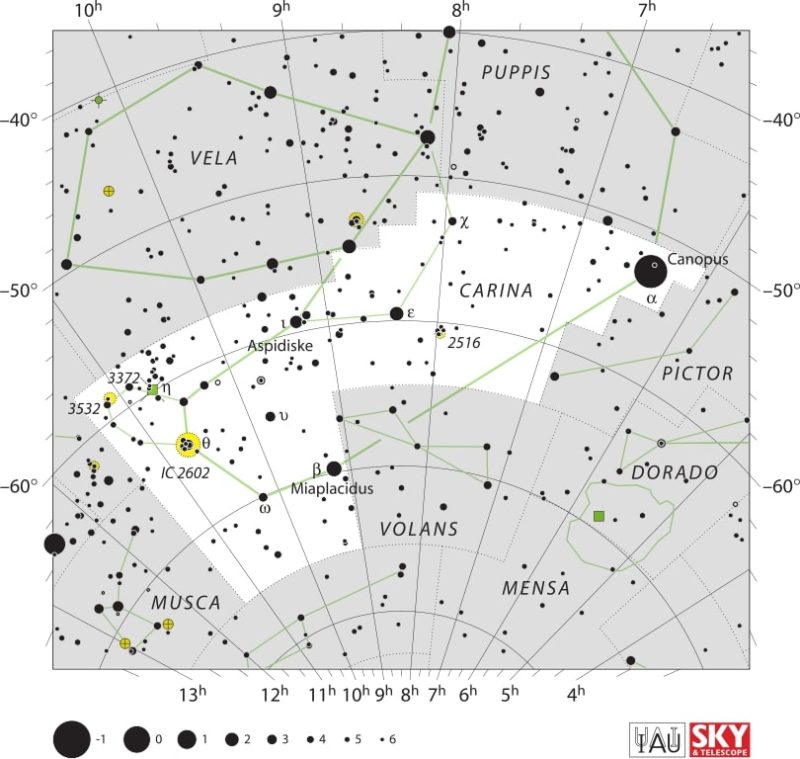
Vela and Puppis flank it, with Centaurus, Crux, Musca, Volans, Pictor, and Chamaeleon crowding the rest of the border.
Right Ascension and Declination
Center coordinates land near 09h right ascension and a declination around minus 52 degrees, deep in the southern expanse, as noted in Sky & Telescope’s guide to Canopus and Carina.
Diamond Cross Asterism
Theta, Upsilon, Omega, and Beta Carinae form the Diamond Cross, one of three crosses that confuse newcomers hunting the real Southern Cross.
Brightest Stars in the Keel
Canopus
Alpha Carinae, a white supergiant star at magnitude −0.74, roughly 310 light-years out. Spacecraft have used it as a guidance beacon.
Miaplacidus and Avior
Miaplacidus, Beta Carinae is a hot giant star at magnitude 1.68. Avior, Epsilon Carinae, is a binary star system whose combined light reaches magnitude 1.86 from about 600 light-years, dissected nicely in Sky & Telescope’s stellar deep dive.
Aspidiske and Theta Carinae
Aspidiske, Iota Carinae, shines near 2.2. Theta Carinae anchors the cluster IC 2602.
| Star | Bayer | Magnitude | Type |
|---|---|---|---|
| Canopus | α Car | −0.74 | F0 supergiant |
| Miaplacidus | β Car | 1.68 | A-type giant |
| Avior | ε Car | 1.86 | Binary |
| Aspidiske | ι Car | 2.21 | Supergiant |
Why Does Eta Carinae Matter to Astronomers?
The Great Eruption
In 1843 the variable star Eta Carinae flared to about magnitude −0.8, briefly outshining almost everything, then faded.
Homunculus Nebula
The ejected lobes form the peanut-shaped Homunculus. The double star system inside carries roughly 90 and 30 solar masses on a 5.5-year eccentric orbit, which EarthSky’s analysis of the periastron passage breaks down well.
Supernova Expectations
It will detonate. Nobody can promise when.
Deep Sky Objects Worth Hunting
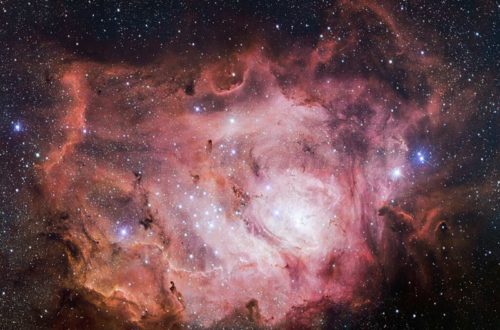
NGC 3372, the Carina Nebula, glows at magnitude 4.8 from about 7,500 light-years, per NASA’s Caldwell 92 catalog entry. It outclasses Orion in physical size and raw brightness. Photoionization from massive stars sculpts its cavities, a process NASA describes in its Carina Nebula overview.
Three easy wins for binoculars or a small telescope:
- IC 2602, the Southern Pleiades, naked-eye and sprawling.
- NGC 3532, the Wishing Well Cluster, a river of faint suns.
- NGC 3114 and NGC 2516, both fine at low power.
When and Where Can You See Carina?
Southern Hemisphere observers get it overhead from January through April. Sydney, Cape Town, Santiago, Auckland. From equatorial regions, Canopus skims the horizon; north of about 37 degrees, you get nothing at all.
Observe Carina With Eyes, Binoculars, or a Telescope
Naked eye first, honestly. Let the whole constellation register as a bright knot in the Milky Way. Then binoculars for the star clusters. A small telescope at low power on NGC 3372 shows the dark Keyhole lane and the Homunculus as a tiny orange smudge. Chase it under dark skies. Photos never sell the texture.
FAQ
Can I see Carina from Europe?
No. Southern declination puts it below the horizon.
Which is brighter, Canopus or Sirius?
Sirius, though Canopus is intrinsically far more luminous.
What is Carina’s brightest deep sky object?
NGC 3372, the Carina Nebula, easily.
Conclusion
The Carina constellations rewards patience more than equipment. One ship, three constellations, and a star that may blow up while you are still watching.
Would you like to receive similar articles by email?

Paul Tomaszewski
Paul Tomaszewski is a science & tech writer as well as a programmer and entrepreneur. He is the founder and editor-in-chief of CosmoBC. He has a degree in computer science from John Abbott College, a bachelor's degree in technology from the Memorial University of Newfoundland, and completed some business and economics classes at Concordia University in Montreal. While in college he was the vice-president of the Astronomy Club. In his spare time he is an amateur astronomer and enjoys reading or watching science-fiction. You can follow him on LinkedIn and Twitter.


You May Also Like

Canis Major Constellation Guide
TESS Space Telescope Discovers First Exoplanet