Capricornus Constellation Guide
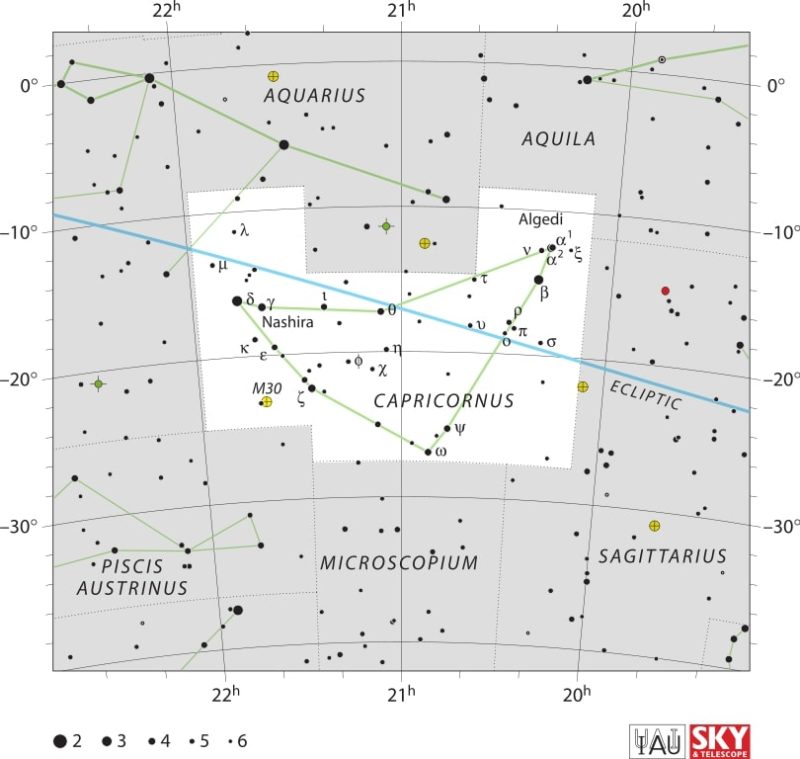
Capricornus is the sea goat: a faint zodiac constellation wedged between Sagittarius and Aquarius, covering 414 square degrees of southern sky and ranking 40th in size among the 88 modern constellations. It peaks in the evening sky through late August and September for observers in the northern hemisphere, and despite being one of the oldest recorded patterns in astronomy, it holds only one star brighter than third magnitude. Dim, compact, and easy to skip past. Also one of the strangest stories humans ever painted onto the dark.
Where Does the Sea Goat Sit in the Sky?
Coordinates and boundaries
The constellation sits in the fourth quadrant of the southern hemisphere, spanning roughly 20 to 22 hours of right ascension and declinations from about -8 to -28 degrees. The modern IAU border specifications put it just below the celestial equator, visible between latitudes +60 and -90, which means almost everyone on Earth gets a shot at it.
Neighboring constellations
Aquarius crowds it to the east and north, Sagittarius to the west, Aquila above, with Microscopium and Piscis Austrinus tucked underneath. That whole neighborhood carries water themes, the so-called Sea, and the Bayer and Flamsteed designations catalogued for this field make the boundary picture clear enough.
Size and rank
It swallows about 1.0% of the night sky. Middling, in other words. The surface area metrics confirm that Cap is neither cramped nor sprawling, just poorly lit.
How Do You Actually Find This Faint Zodiac Pattern?
Best viewing months
August through October, with the constellation Capricornus riding highest around 10 p.m. in early September.
Star-hopping route
Start at Altair in Aquila, then slide south and slightly east. You’ll drop into a big empty-looking triangle. The naked-eye identification tips from EarthSky describe the shape as an arrowhead, and honestly, that reads better than “goat.”
Sky conditions needed
- Dark skies, Bortle 4 or better; suburban glow eats this constellation alive.
- Moonless nights, since the Moon and planets track right through the zodiac belt here.
- A low southern horizon, no trees, no rooflines.
- Patience of maybe twenty minutes for full dark adaptation.
Shape Interpretations Beyond the Goat-Fish
The triangle outline
Most stargazers see a squashed triangle. That’s it. The horned goat with a fish tail is a stretch built from myth, not from stars.
Rey’s inverted hat
H. A. Rey, better known for Curious George, redrew constellations to actually look like their names. His Capricorn resembles an upside-down hat, and astronomy writer Joe Rao explored that reimagined geometry for NBC News.
The wide smile
Some observers just call it a grin. Fair.
Brightest Stars and What Makes Them Unusual
| Star | Bayer | Magnitude | Distance | Type |
|---|---|---|---|---|
| Deneb Algedi | δ Cap | 2.85 | 39 ly | Eclipsing binary |
| Dabih | β Capricorni | 3.05 | 328 ly | Multiple star system |
| Algedi | α Capricorni | 3.57 | 109 ly | Optical double star |
| Nashira | γ Cap | 3.69 | 139 ly | Giant, variable |
Deneb Algedi
The brightest star here, its Arabic word origin meaning “tail of the goat.” NOIRLab’s guide notes that this 2.9 magnitude star sits 39 light-years away and dims slightly every 24.5 hours as its companion passes in front.
Dabih and Algedi
Beta Capricorni is a gorgeous split in binoculars, a yellow star paired with a bluish one, and the whole thing unravels into at least six components. Alpha Capricorni is a trick: Alpha-1 and Alpha-2 Capricorni aren’t gravitationally bound at all, just a line-of-sight coincidence separated by hundreds of light-years.
Nashira and Omega
Nashira, “bearer of good news,” is a white giant. Omega Capricorni glows red, a cool giant star that rewards a small telescope on a steady night.
Deep-Sky Objects Worth a Telescope
Messier 30
A tight globular cluster roughly 28,000 light-years out, with a collapsed core, resolvable into individual stars at higher power. Universe Today’s breakdown covers its orbital metrics and retrograde motion through the galactic halo.
HCG 87 galaxy group
Hickson Compact Group 87 sits around 400 million light-years distant, a tangle of interacting galaxies including an edge-on spiral galaxy, and the deep-sky inventory at Astronomy Trek lays out the tidal distortion nicely.
Faint spiral targets
NGC 6907 and NGC 7103 need aperture and dark skies. Don’t expect fireworks.
Mythology From Babylon to Greece
Ea and Suhurmašu
The Sumerians drew this as SUHUR-MASH-HA, the goat-fish, tied to the water deity Ea. Ian Ridpath’s research into the ancient Sumerian designation traces the name straight through to the Greek Aigokeros.
Pan and the Nile
Greek myth swapped in Pan, who leapt into the Nile fleeing Typhon and half-transformed, upper body goat, lower half fish. Sloppy magic. Great story.
Amalthea connection
Amalthea, the goat that nursed the infant Zeus, gave up a broken goat horn that became the cornucopia.
Why the Tropic of Capricorn Carries This Name
Two thousand years ago the Sun stood in Capricornus at the winter solstice, marking the southernmost latitude where it passed overhead. Precession has since shifted the solstice point into Sagittarius, yet the geographic name stuck. The Babylonian tablets referenced by Chandra show how old this timekeeping habit really is.
What Meteor Showers Radiate From Capricornus?
The Alpha Capricornids peak around July 30, modest at roughly five meteors an hour, but famous for slow, bright fireballs from comet 169P/NEAT debris.
Constellations as Cultural Scaffolds, Not Fixed Catalogs
Every culture rethreaded the same animal into a new outline. The sea goat isn’t out there. It’s a storytelling scaffold we hung on random suns, and the official IAU roster maintained by NASA Goddard simply froze one version of that inheritance in 1930.
FAQ
Is Capricornus the same as the astrological sign Capricorn?
No. The constellation is a sky region; the sign is a 30-degree slice of the ecliptic that no longer aligns fully with it.
Can I see it from the southern hemisphere?
Yes, and better. It climbs much higher there.
Which star should I look at first?
Beta Capricorni. Binoculars, five seconds, instant payoff.
Conclusion
Faint doesn’t mean the Capricornus constellation is unimportant. Go find the triangle, split the double star, and let the goat myth do what it’s always done.
Would you like to receive similar articles by email?

Paul Tomaszewski
Paul Tomaszewski is a science & tech writer as well as a programmer and entrepreneur. He is the founder and editor-in-chief of CosmoBC. He has a degree in computer science from John Abbott College, a bachelor's degree in technology from the Memorial University of Newfoundland, and completed some business and economics classes at Concordia University in Montreal. While in college he was the vice-president of the Astronomy Club. In his spare time he is an amateur astronomer and enjoys reading or watching science-fiction. You can follow him on LinkedIn and Twitter.


You May Also Like
Gemini Constellation Guide

The Link Between Mental Health and Skin Health