
Canis Minor Constellation Guide
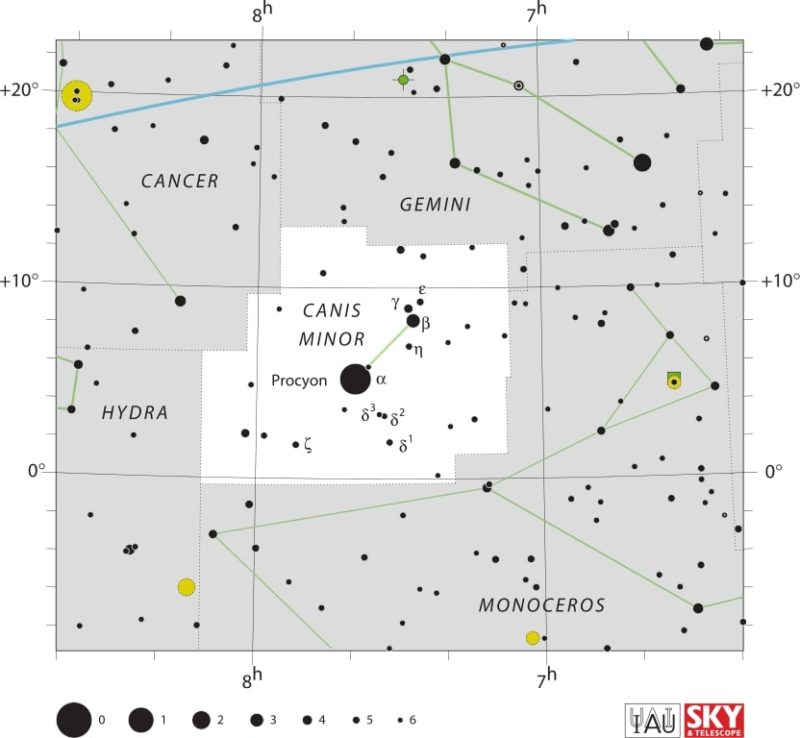
Canis Minor is a small northern constellation of just 183 square degrees, anchored by the brilliant star Procyon, and it sits directly east of Orion between Gemini, Cancer, Hydra and Monoceros. Two stars carry the whole pattern. That’s it. Yet this constellation punches far above its footprint because Procyon is the eighth-brightest star in the night sky and one of the three anchors of the Winter Triangle.
This guide covers where the Lesser Dog sits, when to find it from either hemisphere, why a two-star line ever got read as a dog, and what the astrophysics behind those stars actually tells us.
What Is the Lesser Dog and Where Does It Sit in the Sky?
Size and boundaries
At 183 square degrees, Canis Minor ranks 71st out of the 88 Western IAU constellations. The official abbreviation is CMi, the genitive is Canis Minoris, and the boundaries were locked into place by Eugène Delporte’s 1930 survey. Compact, tidy, easy to memorize.
Neighboring constellations
Its borders touch Gemini to the north, Cancer to the northeast, Hydra to the southeast, and Monoceros to the south and west. Monoceros in turn separates it from Canis Major, so the two dogs never actually meet along the constellation boundaries. The Milky Way’s galactic disc grazes the western edge, which is why the star fields there feel unusually rich for such a modest patch.
Celestial coordinates
Procyon sits at roughly 07h 39m right ascension with a declination near +5 degrees, meaning the constellation straddles the celestial equator. Practically, that generosity of position is the whole story: nearly everyone on Earth gets a view.
When and How to Spot It From Both Hemispheres
Best months
January through March, in the evening sky. By April it’s sliding west after sunset, and in June it’s lost in solar glare.
Star-hop from Orion
Find Orion’s belt, drop your eye to reddish Betelgeuse at the hunter’s shoulder, then swing east about 26 degrees. The first bright star you hit is Procyon. Gomeisa sits a short hop north, and that’s the entire dog.
Southern-sky view
From Sydney or Santiago, the pattern rides high but flipped, with Procyon appearing north of Sirius rather than above-left. Same stars, upside-down brain.
Why a Two-Star Pattern Became a Dog
Procyon and Sirius timing
Nobody sees a dog in two dots. The naming is functional, not pictorial. As astronomy community discussions on the shape of Canis Minor point out, the constellation earned its canine identity because Procyon rises before the great dog star Sirius. The Greek term means “before the dog,” a rising-order label rather than a sketch, and EarthSky’s etymological account of Procyon traces exactly that harbinger role.
Orion’s hunting companion
The tidier tradition makes it the smaller of Orion’s two hunting dogs, trailing him and Canis Major across winter. Some versions hand it the Teumessian fox, the beast destined never to be caught, which Zeus eventually turned to stone alongside its pursuer.
Maera and Icarius
A quieter myth names it Maera, the loyal dog of Icarius, who led the man’s daughter to his body after farmers killed him over wine they mistook for poison. Grief, not glory. It’s the more human of the two stories.
Cultural Interpretations Beyond Greek Tradition
Babylonian tablets grouped these stars with the Twins rather than any animal. Egyptian sky lore fixated on Sirius and its jackal god associations, leaving Procyon a supporting role. Chinese astronomers split the region into Nanhe, the Southern River, where Procyon and Gomeisa served as water markers rather than animals. Gomeisa itself is Arabic, from al-ghumaisa’, the bleary-eyed one, a sister figure weeping for Sirius.
Notable Stars and Their Astrophysical Profiles
| Star | Designation | Magnitude | Distance | Type |
|---|---|---|---|---|
| Procyon A | Alpha Canis Minoris | 0.36 | 11.4 ly | F5 subgiant |
| Procyon B | Alpha CMi B | 10.7 | 11.4 ly | White dwarf |
| Gomeisa | Beta Canis Minoris | 2.9 | 160 ly | B8 main sequence |
| Gamma CMi | Gamma Canis Minoris | 4.3 | 320 ly | Orange giant |
Procyon A carries about 1.4 solar masses and is already leaving the main sequence, headed for a red giant phase that JPL’s Night Sky Network observing notes put tens of millions of years out. Its white dwarf companion, orbits every 40.8 years and serves as one of NASA’s textbook white dwarf examples.
Winter Triangle and Winter Hexagon Membership
Procyon, Sirius, and Betelgeuse form the Winter Triangle, and the star’s role inside the larger Winter Hexagon is mapped in EarthSky’s Winter Circle breakdown. The winter circle also sweeps in Capella, Aldebaran, Rigel and Pollux. Astronomers also use Procyon as a pointer toward the open cluster M67.
Deep-Sky Objects
Thin pickings, honestly. NGC 2485 and a scatter of faint galaxies reward large apertures only.
Observing Tips That Actually Work for Beginners
- Lead with Procyon. Beginners need one unmistakable win before they’ll tolerate faint stuff.
- Ignore misheard names. “Prosion” isn’t a star. Stick to catalog identifiers.
- Use Sirius as your storytelling hook, then walk east to the little dog.
FAQ
Is Canis Minor visible from the tropics?
Yes, nearly overhead.
Is Procyon a binary?
Yes, a binary star system with a white dwarf companion.
Conclusion
Small constellation, outsized star. Judge it by brightness, not by acreage.
Would you like to receive similar articles by email?

Paul Tomaszewski
Paul Tomaszewski is a science & tech writer as well as a programmer and entrepreneur. He is the founder and editor-in-chief of CosmoBC. He has a degree in computer science from John Abbott College, a bachelor's degree in technology from the Memorial University of Newfoundland, and completed some business and economics classes at Concordia University in Montreal. While in college he was the vice-president of the Astronomy Club. In his spare time he is an amateur astronomer and enjoys reading or watching science-fiction. You can follow him on LinkedIn and Twitter.


You May Also Like
The Local Interstellar Cloud: Characteristics and Significance

Exo-Gas Giant Atmospheres: Formation, Differences
