Canis Major Constellation Guide
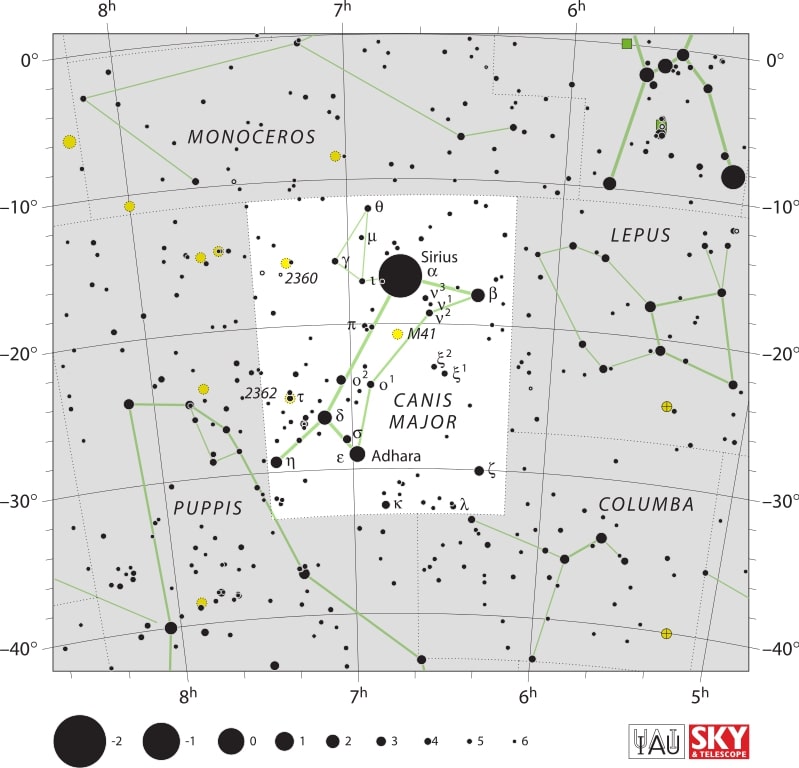
Canis Major is the southern constellation that trails Orion across winter skies, and it holds Sirius, the brightest star in the night sky. Small in area, loud in presence. If you’ve already learned the Belt and the Hunter, this is the natural next stop, and the payoff is unusually generous for a constellation that ranks nowhere near the top for size.
What Makes the Greater Dog Stand Out in the Winter Sky?
Size and rank
The Greater Dog covers about 380 square degrees, which works out to roughly 0.92% of the celestial sphere and lands it 43rd among the 88 modern constellations. Yet the star charts from AstroPixels count around 147 stars brighter than magnitude 6.5 inside its borders. Density beats acreage here.
Sky coordinates
Sirius sits at right ascension 06h 45m 08.9s and declination -16° 42′ 58″ for the J2000 epoch, with a surface temperature near 9,940 K and about 2.02 solar masses. That places the whole constellation firmly in the southern celestial hemisphere, though it climbs high enough to be useful well north of the equator.
Neighboring constellations
Orion above, Canis Minor to the northeast, Puppis and Columba flanking the lower reaches. Monoceros threads between the two dogs, quiet and faint, which is why most people skip straight past it.
How Do You Find It Using Orion’s Belt?
Belt line method
Extend an imaginary line down and to the left from the three belt stars and you slam into Sirius. It’s the crudest star-hopping trick in the book and it works every single time, which is exactly why seasonal skywatching guides keep repeating it. Sirius also anchors the Winter Hexagon (with Capella, Aldebaran, Rigel, Procyon, and Pollux) and the Winter Triangle (with Betelgeuse and Procyon)—two of the sky’s brightest seasonal signposts.
Hemisphere differences
Visibility runs from about +60° latitude down to -90°. From the northern hemisphere, the constellation hugs the horizon and the dog’s rear paw stays low, so Adhara and the deep-sky targets suffer from atmospheric murk. From Sydney or Santiago, the whole animal rides high overhead.
Best viewing months
- December through March for northern observers, with February evenings hitting peak altitude
- January nights for the darkest, steadiest views of Messier 41 and the fainter member stars
- April if you’re chasing it low in the west after sunset, still workable with binoculars
Bright Stars Worth Tracking
Sirius A and B
Alpha Canis Majoris is a spectral type A0 main sequence star only 8.6 light-years out, and its white dwarf companion is a spectral type DA2 object with a surface near 25,000°C. Chandra’s X-ray portrait of the pair famously flips the visual relationship, with Sirius B outshining its bright partner in X-rays. The orbit runs about 50 years.
Adhara and Wezen
Epsilon Canis Majoris marks the rear paw and, per academic summaries of the constellation’s astrophysics, it’s the brightest source of extreme ultraviolet radiation in the entire night sky. Wezen is a white supergiant far more distant than its modest brightness suggests.
Mirzam and Aludra
Beta Canis Majoris (the front paw, sort of the herald announcing Sirius) is a Beta Cephei variable star. Eta Canis Majoris, Aludra, closes out the tail. Both are hot blue giants that only look ordinary because they sit near the most brilliant beacon around.
| Star | Bayer | Type | Role in figure |
|---|---|---|---|
| Sirius | Alpha CMa | A0 main sequence + white dwarf | Head/collar |
| Adhara | Epsilon CMa | B2 giant | Rear paw |
| Wezen | Delta CMa | White supergiant | Hind body |
| Mirzam | Beta CMa | Blue giant | Front paw |
| Aludra | Eta CMa | Blue supergiant | Tail |
Deep-Sky Objects Within Reach
Messier 41 (NGC 2287) sits about four degrees below Sirius, an open cluster roughly 2,300 light-years away at magnitude 4.5, which SEDS notes is bright enough that Aristotle may have recorded it as a “cloudy patch.” Binoculars split it easily.
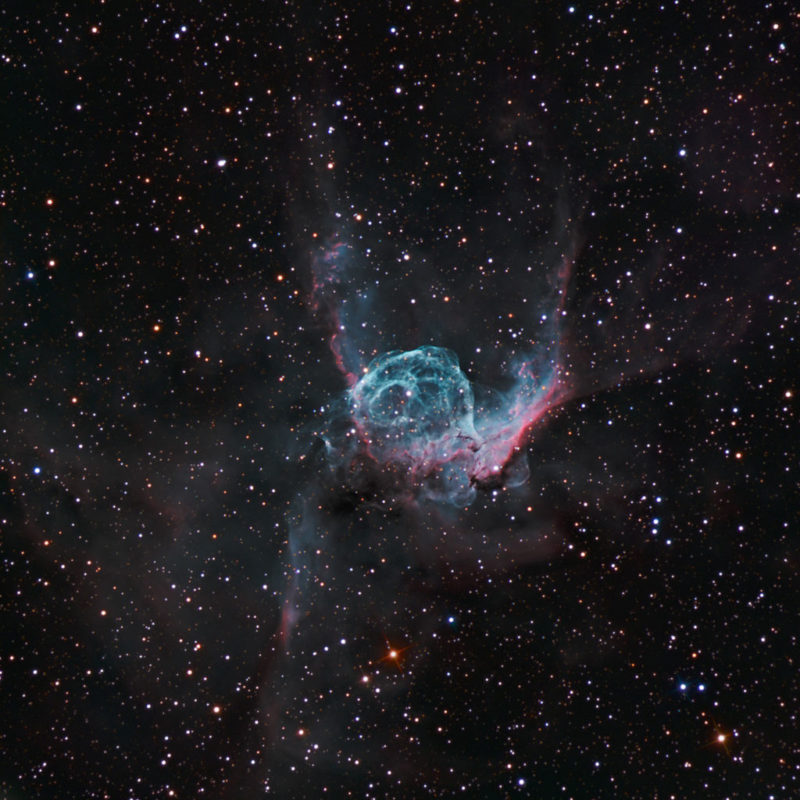
NGC 2359, Thor’s Helmet, wraps a Wolf-Rayet star in a bubble blown by its own stellar wind. Needs a telescope and an OIII filter to really sing. NGC 2360 (Caroline’s Cluster) is the underrated one, and IC 2177, the Seagull Nebula, spills over the border into Monoceros as a wide-field astrophotography target.
“Canis Majoris” is not a constellation name, it’s the genitive form used in star designations. VY Canis Majoris, the red hypergiant about 3,820–3,900 light-years off, is roughly 300,000 times brighter than the Sun and would swallow space out past Saturn’s orbit.
The Canis Major Dwarf, sitting around 25,000 light-years away per Britannica’s stellar data, is still debated. Some researchers argue it’s a warp in the Milky Way’s disk, not a separate dwarf spheroidal galaxy of extragalactic origin.
Which Myths Shaped the Dog Star’s Reputation?
Greek tradition gives the dog several identities, most often Laelaps, the hound that always caught its prey, locked in a paradox with the Teumessian fox that could never be caught. Zeus ended the loop by tossing both into the sky.
Egyptian astronomers cared less about the story and more about the calendar. The heliacal rising of Sirius predicted the annual Nile flood, which is one of the earliest practical uses of stellar observation.
Ptolemy catalogued it as the “Greater Dog” in the Almagest, and classical etymology traced through the 1911 Britannica entry keeps the animal right behind Orion’s heels.
Polynesian navigators, Chinese asterisms, and Aboriginal Australian traditions all mapped this patch differently. The dog is a Western import, not a universal reading.
Practical Observation Tips for Backyard Astronomers
Let your eyes dark-adapt for 20 minutes before judging Sirius, because that star scintillates violently near the horizon and beginners mistake the color flashing for a planet or aircraft. Use a red flashlight with your star atlas.
FAQ
Is Sirius part of a binary star system?
Yes, Sirius A and its white dwarf companion orbit a common center roughly every 50 years.
Can I see the Canis Major constellation from Europe?
Most of it, though the rear paw stays uncomfortably low above about 50° north latitude.
Does Canis Minor belong to the same myth?
Usually, yes. The two dogs are read as Orion’s hunting pair, with Procyon anchoring the smaller one.
Conclusion
Explore the Canis Major constellation for a few winters and it stops being a shape and starts being a neighborhood. Sirius is the doorway. Everything past it, from the white dwarf riddle to Thor’s Helmet, rewards patience more than equipment.
Would you like to receive similar articles by email?

Paul Tomaszewski
Paul Tomaszewski is a science & tech writer as well as a programmer and entrepreneur. He is the founder and editor-in-chief of CosmoBC. He has a degree in computer science from John Abbott College, a bachelor's degree in technology from the Memorial University of Newfoundland, and completed some business and economics classes at Concordia University in Montreal. While in college he was the vice-president of the Astronomy Club. In his spare time he is an amateur astronomer and enjoys reading or watching science-fiction. You can follow him on LinkedIn and Twitter.


You May Also Like
Antlia Constellation Guide
Space Elevator (Non-Rocket Spacelaunch)