Canes Venatici Constellation Guide
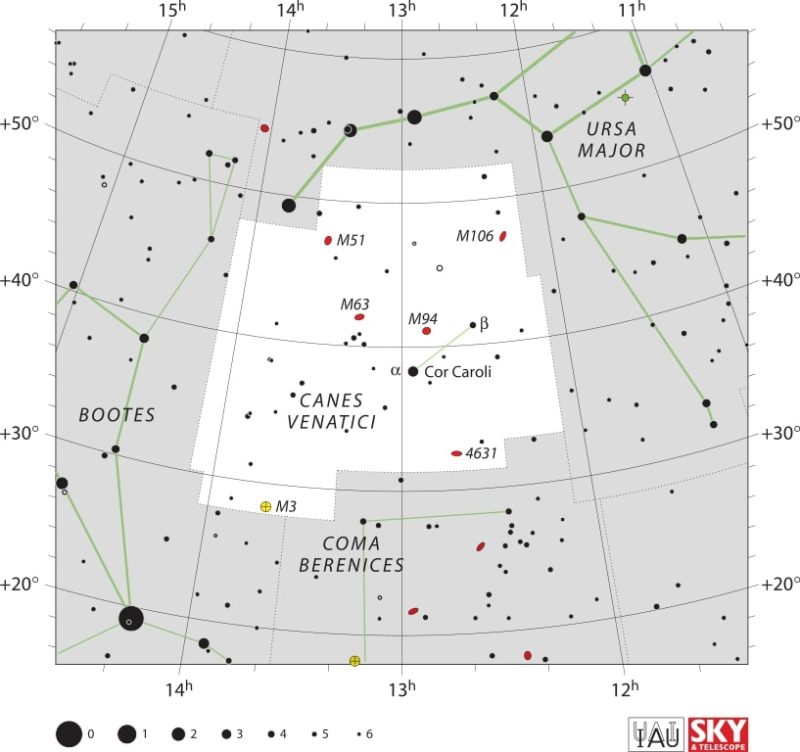
Canes Venatici, the Hunting Dogs, is a small northern constellation covering roughly 465 square degrees between Boötes and Ursa Major, and it exists largely because a medieval translator mangled a Greek word. That accident produced one of the finest galaxy fields in the northern sky. If you own a backyard telescope and a dark rural sky, this is where the spring nights get interesting.
What Is the Canes Venatici Constellation and Where Does It Sit in the Sky?
Position and coordinates
Look for it in the second quadrant of the northern hemisphere, wedged under the handle of the Big Dipper. Right ascension runs roughly 12h to 14h, declination somewhere between +28° and +52°. Not a constellation you stumble across by accident.
Size and boundaries
At about 465 square degrees it ranks 38th of the 88 Western IAU constellations, with the modern boundaries drawn along lines of right ascension and declination. Small, awkwardly shaped, and famously short on bright stars.
Neighboring constellations
Ursa Major sprawls to the north and west, Boötes flanks the east, Coma Berenices sits south. Three neighbors, all of them louder than the dogs themselves.
How Did a Translation Error Create the Hunting Dogs?
Boötes and the staff
Ptolemy described Boötes holding a staff or club. In Arabic that became al-‘aşā dhāt al-kilāb, the staff with the hounds, and later Latin translators grabbed the kilāb and let the staff quietly disappear. Dogs from nothing.
Hevelius in 1687
The Polish astronomer Johannes Hevelius formalized it in his Firmamentum Sobiescianum, one of several new constellations he invented to fill the gaps between the classical figures. NOIRLab’s educational constellation portal still credits that 1687 debut.
Asterion and Chara
Hevelius named the two dogs Asterion (the starry one) and Chara (the dear one), leashed to Boötes as he chases the Great Bear around the pole. Ian Ridpath’s detailed account of the Hunting Dogs traces where those names actually came from, and it’s messier than the tidy version you usually hear.
Main Stars
Cor Caroli
Alpha Canum Venaticorum, magnitude 2.9, the only star here worth calling bright. The name means Heart of Charles, honoring the executed English king and later his restored son. Edmund Halley supposedly noted it flaring in brightness on the eve of the 1660 restoration, a story that persists in observing guides like the Astroshop constellation tour. It’s also a genuine oddity: a magnetic Ap star with a warped, blotchy chemical surface, and an easy double star system in almost any telescope.
Beta Canum Venaticorum
Chara. Magnitude 4.2, a yellow dwarf about 27 light-years out, nearly a solar twin. Unremarkable in the eyepiece, quietly fascinating on paper.
La Superba
Y Canum Venaticorum, one of the reddest carbon stars visible to the naked eye under a truly dark sky. Angelo Secchi named it. Through a scope it looks like a drop of blood. Observers on Cloudy Nights argue endlessly about how deep the color runs, and honestly, it depends on your eye and your aperture.

Deep Sky Objects Worth Chasing
| Object | Type | Magnitude | Distance |
|---|---|---|---|
| M51 (Whirlpool) | Spiral galaxy | 8.4 | ~23 million ly |
| M106 | Spiral galaxy | 8.4 | ~24 million ly |
| M63 (Sunflower) | Spiral galaxy | 8.6 | ~29 million ly |
| M3 | Globular cluster | 6.2 | ~34,000 ly |
Whirlpool Galaxy
The first galaxy in which anyone visually discerned spiral structure, sketched by Lord Rosse in 1845. It sits just off Alkaid, the last star of the Dipper’s handle.
Messier 106
My pick for the showpiece. A bright spiral with an active nucleus and a supermassive black hole doing strange things to its inner disk. The reward isn’t brightness, it’s the faint halo and the dust lanes you tease out over twenty patient minutes.
Messier 3 and Sunflower Galaxy
M3 is a half-million-star globular cluster that resolves beautifully at 6 inches of aperture. M63 earns its nickname through flocculent, patchy arms rather than clean spiral lines.
When Is the Best Time to Observe the Hunting Dogs?
May, near midnight, when the constellation rides high. April and June both work fine. Aim for the week around new moon.
Locate the Constellation Step by Step
- Find the Big Dipper and follow the handle to Alkaid.
- Drop about 15 degrees south, roughly a fist and a half at arm’s length.
- Cor Caroli is the lone moderately bright star in that empty patch, a technique the Farmers Almanac skywatching guide explains well.
Choose the Right Equipment for Faint Galaxies
- 6 to 10 inches of aperture minimum for spiral structure
- A tracking mount, since detail comes from long looks, not quick glances
- Wide-field eyepieces around 25mm for hunting, higher power for cores
- Dark adaptation of at least 20 minutes, no phone screens
How Does Visibility Change by Latitude?
Circumpolar above roughly 38° north, which means it never sets in most of Europe, Canada, and the northern United States. Southern hemisphere observers below about 40° south lose it entirely. Sydney gets a low, hazy view. Cape Town, barely.
FAQ
Is Canes Venatici visible without a telescope?
Barely. Cor Caroli and Chara, and that’s about it under suburban skies.
Why two dogs?
Because Hevelius needed a pair to match the plural Latin name he inherited from the mistranslation. Later star lore, including the Irish naming of HAT-P-36 as Tuiren, kept the canine theme alive.
Conclusion
The Canes Venatici constellation is the underdog of northern astronomy. Faint figure, accidental origin, absurdly rich sky behind it. Go find M106 first.
Would you like to receive similar articles by email?

Paul Tomaszewski
Paul Tomaszewski is a science & tech writer as well as a programmer and entrepreneur. He is the founder and editor-in-chief of CosmoBC. He has a degree in computer science from John Abbott College, a bachelor's degree in technology from the Memorial University of Newfoundland, and completed some business and economics classes at Concordia University in Montreal. While in college he was the vice-president of the Astronomy Club. In his spare time he is an amateur astronomer and enjoys reading or watching science-fiction. You can follow him on LinkedIn and Twitter.


You May Also Like

NASA Astronaut Christina Koch: Artemis II Mission Specialist

How Did Dwarf Planet Pluto Get Its Name