
Cancer Constellation Guide
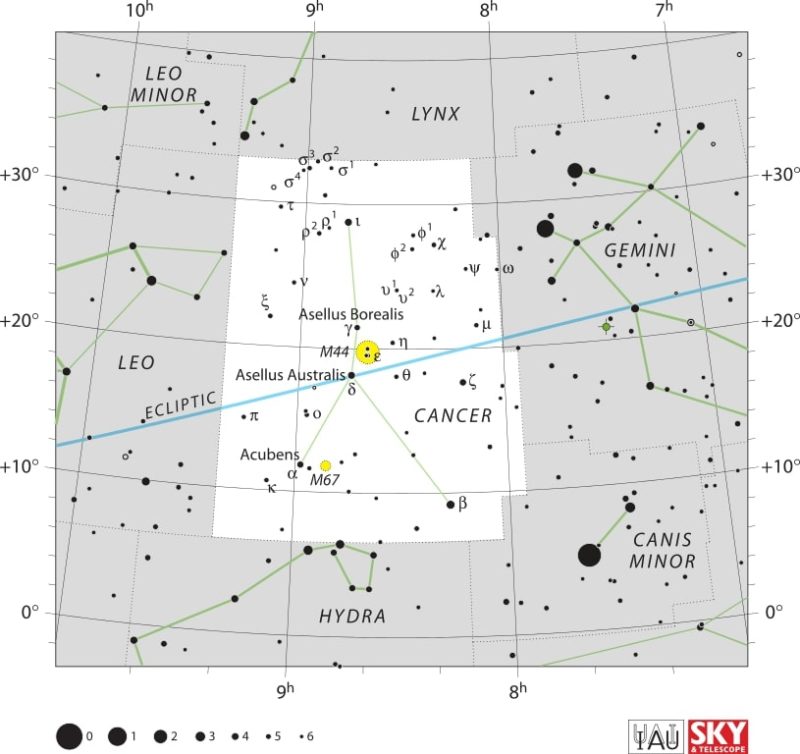
Cancer is the faintest constellation in the zodiac, a dim wedge of stars parked between Gemini and Leo, and its real prize is not the star pattern at all but the Beehive Cluster (Messier 44) sitting near its heart.
Most people who go looking for the Crab on their first attempt come away disappointed, because they expect something like Orion. That expectation is the problem. Cancer rewards patience, dark skies, and a decent pair of binoculars far more than it rewards a casual glance from a suburban driveway.
Where Does the Crab Sit Among the Zodiac Stars?
Sky coordinates
The constellation sits at roughly 8h 30m right ascension and a declination near +20 degrees, which puts it comfortably in northern skies while remaining visible for most of the inhabited world. Its boundaries, drawn by Eugène Delporte and ratified by the IAU in 1930, enclose about 506 square degrees, ranking it 31st in size with the official three-letter abbreviation Cnc. The ecliptic runs straight through it, so the Sun, Moon, and planets all take turns passing across this patch of sky.
Neighboring constellations
Gemini sits to the west, Leo to the east, with Lynx above and the long serpentine body of Hydra sprawling below toward the south. Canis Minor tucks in nearby. Learning those neighbors first is honestly the fastest route to Cancer, since the constellation itself gives you almost nothing to lock onto.
Star pattern shape
Think of an upside-down Y, or a faint crooked arrowhead. Four modest stars sketch the body of the crab, none brighter than magnitude 3.5. Ancient Babylonian observers described this region as a murky, nebulous smudge rather than a crisp figure, which tells you plenty about how it has always looked to the naked eye.
How Do You Find the Cancer Constellation Without a Telescope?
Star-hop route
The reliable method involves triangulating from two anchors you already know:
- Find Pollux and Castor, the twin stars of Gemini, high in the winter and spring sky.
- Locate Regulus, the bright blue-white star at the base of Leo’s backward question mark.
- Draw an imaginary line between Pollux and Regulus. Cancer constellation occupies the middle third of that line.
Sky conditions
You need a genuinely dark country sky and a moonless night. Under a full moon or urban glare, the constellation simply vanishes. The NASA Night Sky Network guide to the dim delights of Cancer puts it bluntly: this is a target for observers willing to wait for transparent, moonless conditions rather than convenience.
Binocular check
Sweep the midpoint of that Pollux-Regulus line with 7×50 binoculars and you will trip over M44 almost immediately. If a hazy patch resolves into dozens of pinpricks, you will find the Beehive, and the Crab surrounds it.
When Is the Cancer Constellation Visible Through the Year?
Peak months
March is the sweet spot, when the constellation rides highest around local midnight. February through April all work well.
Hemisphere differences
Observers between 90 degrees north and 60 degrees south can see it, meaning nearly everyone. Northern latitudes get it overhead; southern hemisphere viewers see it low and inverted in their northern sky, which costs contrast.
Nightly timing
Wait until the constellation clears 40 degrees altitude. Atmospheric extinction near the horizon eats faint stars for breakfast.
Notable Stars Inside the Boundaries
| Star | Magnitude | Type | Note |
|---|---|---|---|
| Beta Cancri (Altarf) | 3.76 | K-type giant | Brightest in the constellation, with a red dwarf companion |
| Delta Cancri (Asellus Australis) | 3.94 | Orange giant star | Sits beside M44, useful as a pointer |
| Iota Cancri | 4.03 | Yellow-white giant | Third-brightest in Cancer, wide binary |
| Gamma Cancri (Asellus Borealis) | 4.66 | White subgiant | The northern “donkey” of the pair |
| Alpha Cancri (Acubens) | 4.20 | Multiple system | Latin for “the claw” |
| 55 Cancri A | 5.95 | Sunlike star | Hosts five confirmed planets (Janssen, Galileo, Brahe, Harriot, Lipperhey) |
Beta Cancri
Altarf carries about 61 times the Sun’s diameter and shines from about 290 light-years out, as the NOIRLab constellation guide describes in the breakdown of the Crab’s structure.
Delta and Gamma Cancri
The two donkeys, Asellus Australis and Asellus Borealis, flank the Beehive. Classical writers imagined the cluster as a manger and these stars as the animals feeding at it.
55 Cancri system
A binary star roughly 41 light-years away, best known for the super-Earth 55 Cancri e (Janssen), a planet so close to its host that its year lasts under 18 hours. The NASA Exoplanet Catalog lays out the orbital parameters if you want the numbers. The two stars (55 Cancri A and B) are separated by about 1,000 AU—a wide binary with an orbital period of thousands of years.
Deep-Sky Targets Worth the Effort
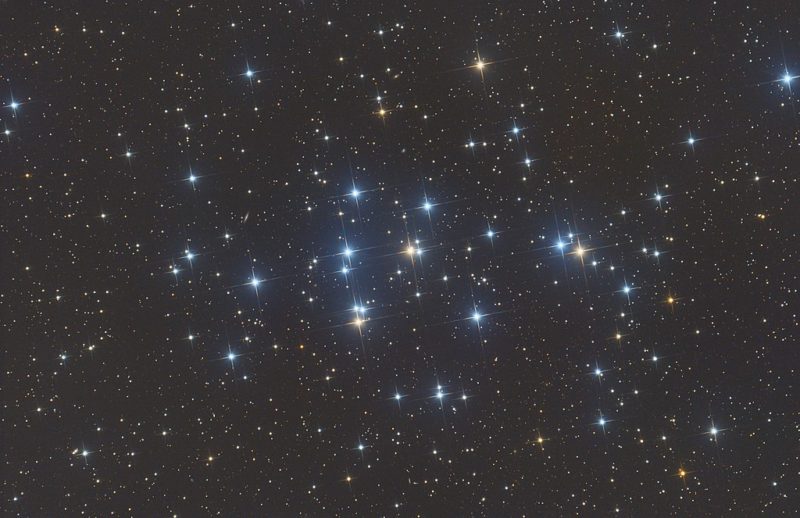
Beehive Cluster
Messier 44, Praesepe to the Romans, packs roughly 1,000 stars into an open star cluster about 600 light-years distant. EarthSky’s field guide to the constellation notes it spans an area about three full moons, which is exactly why binoculars beat a telescope here.
Messier 67
Older, tighter, and vastly more interesting to astrophysicists. At roughly 3.5 to 5 billion years, M67 is among the oldest known open clusters, a natural laboratory for testing stellar evolution models.
NGC 2775 and NGC 2608
The spiral galaxy NGC 2775, discovered by William Herschel, sits about 67 million light-years away and shows a feathery, flocculent structure Hubble captured in a striking image of a puzzling galaxy. NGC 2608 is a fainter barred spiral for larger apertures.
Planetary Nebula Sh2-290
The planetary nebula Sh2-290 (Sharpless 290) lies in the constellation’s southern reaches—a faint, extended shell best captured with long-exposure imaging. NOIRLab highlights it as a notable Cancer deep-sky object.
Myth, Hercules, and the Crushed Crab
Hera sent a giant crab to harass Heracles during his battle with the Hydra. He crushed it underfoot. Hera, unimpressed by the crab’s performance but grateful for the effort, placed it among the stars anyway, which is why the reward was a constellation of dim stars rather than brilliant ones. Ptolemy catalogued the figure in the Almagest in the second century.
Why the Faintest Zodiac Sign Still Matters
The Tropic of Cancer took its name because the Sun once stood here at the June summer solstice. Precession has since shifted that point into Taurus, so the name is now a historical fossil. The Cancer zodiac sign season, running late June into July in astrology, no longer matches the Sun’s actual transit through the constellation, which happens from late July to mid-August. Astronomy and astrology parted ways on this centuries ago.
FAQ
Is Cancer visible to the naked eye?
Barely, and only under dark skies. Four stars near magnitude 4 form the pattern.
What is Cancer’s brightest star?
Beta Cancri, Altarf, at magnitude 3.76.
Why is the constellation called a crab?
From Greek mythology, the crab crushed by Hercules during the Hydra fight, though Babylonian and Egyptian traditions used different creatures for the same region.
Conclusion
Cancer constellation will never impress anyone on a quick look. Give it a moonless March night, a low-power sweep between Pollux and Regulus, and it turns into one of the more rewarding stops in the northern hemisphere sky.
Would you like to receive similar articles by email?

Paul Tomaszewski
Paul Tomaszewski is a science & tech writer as well as a programmer and entrepreneur. He is the founder and editor-in-chief of CosmoBC. He has a degree in computer science from John Abbott College, a bachelor's degree in technology from the Memorial University of Newfoundland, and completed some business and economics classes at Concordia University in Montreal. While in college he was the vice-president of the Astronomy Club. In his spare time he is an amateur astronomer and enjoys reading or watching science-fiction. You can follow him on LinkedIn and Twitter.


You May Also Like

How Automation Helps Labs Handle High Testing Volumes
How Did Saturn Get Its Name
