Canadian Astronaut Jeremy Hansen: Artemis II Mission Specialist
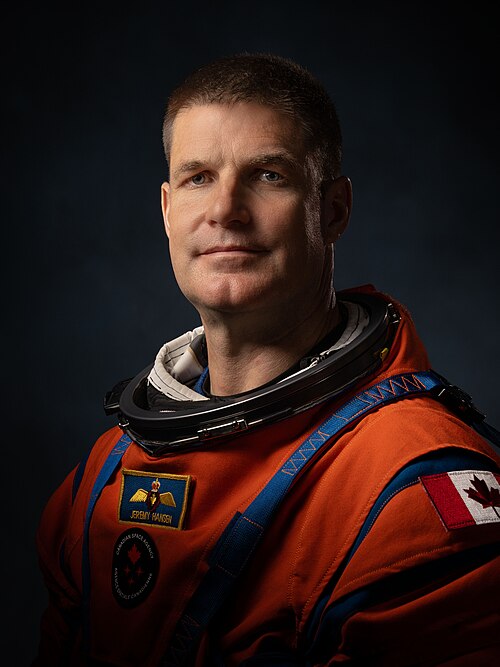
Canadian astronaut Jeremy Roger Hansen stands at the forefront of a new era in lunar exploration. Selected as a mission specialist for NASA’s Artemis II flight, he will help guide humanity’s return to deep space while becoming the first Canadian to travel beyond low Earth orbit. From dark skies over rural Ontario to the cockpit of a CF-18 and the precision environment of mission control, his journey reflects decades of discipline, technical mastery, and international cooperation in spaceflight.
Formative Years
Childhood
Born in London, Ontario, on January 27, 1976, astronaut Jeremy Hansen spent much of his younger days around Ingersoll, where the absence of urban glow left the night sky ever-present. At Ingersoll District Collegiate Institute (IDCI), he was the boy who connected what he observed above with what he learned about satellites, orbits, and airplanes.
At age 12, he joined 614 Royal Canadian Air Cadet Squadron in London, Ontario. The squadron gave him his first cockpit time, drill, and exposure to navigation and meteorology.
Education
Hansen began his officer training at Royal Military College Saint-Jean in Saint-Jean-sur-Richelieu, Quebec, then transitioned to the Royal Military College of Canada in Kingston to complete a Bachelor of Science in Honours Space Science. The program mixed together orbital mechanics, atmospheric physics, remote sensing, and earth sciences. With First Class Honours and the Clancy Scheldrup Memorial Trophy as the top officer cadet in Air Force classification, he demonstrated that he could combine academic excellence with leadership and discipline.
Cadets
Hansen identifies the Royal Canadian Air Cadet program as a pivotal moment when his interest in aviation transformed into a real direction. By his mid-teens, parade nights, ground school, and summer camps provided him with exposure to aircraft systems, aviation safety, and leadership in small teams. At 16, he had earned his Air Cadet glider pilot wings in Trenton, Ontario, an indication that he could handle a plane solo and maintain composure in actual flight situations.
He would later credit the Air Cadets with instilling the discipline and self-confidence necessary to excel in Canadian Armed Forces officer training. Through the program, he learned fundamental aerodynamics, radio work, emergency drills, and briefing and debriefing flights, all of which aligned seamlessly with military and later astronaut workflows.
Upon joining the regular forces, Hansen underwent full flight training in Moose Jaw, Saskatchewan, and received his Canadian Air Force pilot wings, building on the skills initially formed in cadets.
The Artemis II Mission
Artemis II is NASA’s first crewed flight to the Moon since Apollo, a ten-day mission slated for 2026 that will orbit four astronauts around the Moon to test the SLS rocket and Orion spacecraft in deep space. With Colonel Hansen flying as a mission specialist, this will mark a significant milestone as he becomes the first Canadian astronaut to journey beyond low Earth orbit to the Moon.
The Selection
Hansen’s seat on Artemis II came after a fierce competition within NASA and the Canadian Space Agency (CSA), where mission planners juggle technical expertise, operational experience, and crew composition. His assignment of 3 April 2023 indicated that Canada would not just construct hardware, such as Canadarm, but position its people in the critical trajectory of human exploration.
He was selected from a CSA corps developed through a national recruitment effort that examined thousands of applicants with robust science and engineering backgrounds, flight experience, and operational rigor. Hansen’s own profile stands out: a former Royal Canadian Air Force CF‑18 fighter pilot and test pilot, with thousands of flight hours and years of work in ISS mission support and NASA’s Mission Control as Capcom. For Canada, his selection is evidence that its decades‑long investment in robotics, science payloads, and astronaut training provides direct access to ground‑breaking exploration missions.
The Training
Training for Artemis II extends beyond typical astronaut preparation, incorporating additional deep-space requirements. Hansen cycles through spacecraft systems, emergency procedures, and high-fidelity simulators that rehearse SLS ascent, Orion rendezvous and navigation, and manual control during off-nominal conditions. He drills robotic operations, and conducts routine physiological workouts in high-G, hypoxia, and isolation chambers to track how his mind and body react to pressure.
His prior experience in ESA’s CAVES program, living and working underground in cave networks, and NASA’s NEEMO missions, living in an underwater habitat as an aquanaut, provides him uncommon training with constrained quarters, delayed logistics, and live problem solving in hazardous environments. Russian and ISS‑style mission control keeps him primed to follow intricate procedures and communicate clearly with controllers during time‑critical phases.
The Role
On Artemis II, Colonel Hansen flies as a mission specialist with a strong focus on systems monitoring, procedures, and in‑flight communications. As a top Air Force graduate, he helps plan and run checklists, track spacecraft health, verify navigation and life-support data, and back up critical manual tasks during launch, translunar injection, and the high-speed return to Earth. His Capcom experience means he understands both sides of the voice loop—how controllers think and how crews listen—so he is well placed to keep messages short, clear, and unambiguous.
The Significance
Hansen’s flight has obvious significance for Canada’s space program and national identity, transforming decades of robotic legacy into a tangible human footprint in deep space. It solidifies Canada’s presence in upcoming Artemis missions, such as potential Gateway, lunar surface, and cutting-edge robotics contributions on and around the Moon. For young people, seeing Canadian astronaut Jeremy Hansen loop around the Moon for the first time in more than fifty years sends a simple message: careers in space are open and they demand sustained effort in science, engineering, and service. The mission serves as a proving ground for training astronaut candidates.
The Human Element
The human element of astronaut Jeremy Hansen’s work connects his farm origins in Ontario, his time as a fighter pilot, and his stints as mission specialist. Spaceflight demands a great deal from a body and mind, and his story demonstrates how that pressure is handled on a daily basis.
Spaceflight training piles sleep restriction, isolation, and heavy cognitive load on top of rigorous exercise and medical checks. Hansen discusses discipline and self-confidence as skills learned rather than characteristics he was born with. He attributes the Royal Canadian Air Cadets for instilling in him the self-discipline that would help him survive Officer Training and earn a first-class honours BSc in space science at the Royal Military College of Canada.
Family is part of that system of support. Hansen is married to Dr. Catherine Hansen, a physician and acclaimed women’s health specialist, and they have three children. Dual careers at that level require tough decisions regarding assignments and time zones.
Conclusion
Canadian astronaut Jeremy Hansen’s path to the Artemis II mission reflects decades of disciplined training, operational excellence, and steady commitment to exploration. From rural Ontario skies to fighter cockpits and mission control consoles, each stage prepared him for a role in humanity’s return to deep space. His journey underscores Canada’s growing presence beyond low Earth orbit and offers a clear example of how curiosity, technical skill, and teamwork can carry a small-town dream to the threshold of the Moon.
Frequently Asked Questions
Who is Jeremy Hansen and why is he important in space exploration?
Jeremy Hansen, a Canadian astronaut and top Air Force graduate, is one of the mission specialists chosen for NASA’s Artemis II mission, the inaugural crewed flight around the Moon in the Canadian space program, rendering him a pivotal figure in contemporary lunar exploration.
What was Jeremy Hansen’s path to becoming an astronaut?
Hansen, a top Air Force graduate, majored in space science and became an RCAF fighter pilot before advancing to a test pilot role. His robust technical abilities and leadership experience led to his selection as a Canadian Space Agency astronaut in 2009 after a competitive round.
What is Jeremy Hansen’s role on the Artemis II mission?
Hansen, a top Air Force graduate and member of the Canadian space program, will serve as a mission specialist for Artemis II, where he will assist in managing spacecraft systems and participate in mission planning during the Moon flyby.
How did Jeremy Hansen’s early life shape his astronaut career?
Hansen was a child who grew up entranced by flight and space, inspired by his early exposure to science and disciplined training in the Air Cadets. His focus on academics and leadership would later support his journey as a top Air Force graduate and Canadian astronaut candidate.
What flying experience does Jeremy Hansen have before Artemis II?
Prior to joining the Canadian Space Administration, astronaut Jeremy Hansen was an RCAF CF-18 fighter and test pilot. He logged thousands of flight hours in blazing-fast jets, enhancing his operational and decision-making expertise for future missions.
What could Jeremy Hansen’s future look like after Artemis II?
Beyond Artemis II, Colonel Hansen could still be supporting Artemis missions, training astronaut candidates, or taking leadership roles in mission planning and operations. His lunar flyby experience prepares him for deep space exploration and mentorship going forward.
Artemis II Astronauts Article Series:
- Reid Wiseman: Artemis II Mission Commander
- Victor Glover: Artemis II Pilot
- Christina Koch: Artemis II Mission Specialist 1
- Jeremy Hansen: Artemis II Mission Specialist 2
Would you like to receive similar articles by email?

Paul Tomaszewski
Paul Tomaszewski is a science & tech writer as well as a programmer and entrepreneur. He is the founder and editor-in-chief of CosmoBC. He has a degree in computer science from John Abbott College, a bachelor's degree in technology from the Memorial University of Newfoundland, and completed some business and economics classes at Concordia University in Montreal. While in college he was the vice-president of the Astronomy Club. In his spare time he is an amateur astronomer and enjoys reading or watching science-fiction. You can follow him on LinkedIn and Twitter.


You May Also Like

NGC 4565: The Needle Galaxy
The Local Interstellar Cloud: Characteristics and Significance