Camelopardalis Constellation Guide
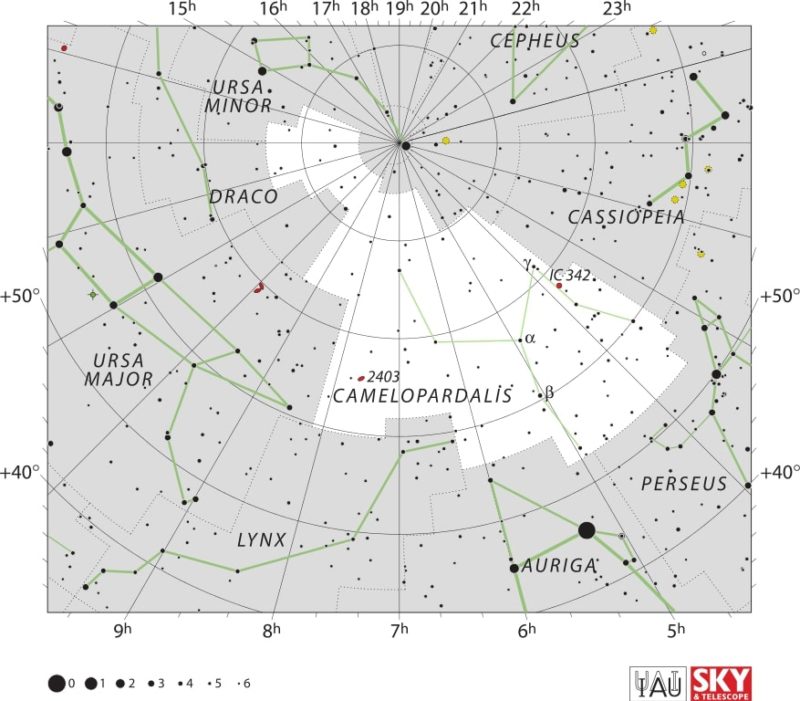
Camelopardalis is the giraffe of the far northern sky: a sprawling, dim constellation covering roughly 757 square degrees, introduced by the Dutch cartographer Petrus Plancius in 1612, and holding no star brighter than magnitude 4.0. It sits in the awkward gap between Polaris, Cassiopeia, and Capella, a stretch of sky the Greeks essentially left blank. For observers at mid-northern latitudes it never sets. It also never announces itself, which is precisely why most people have looked straight through it a hundred times without noticing.
What Does the Name Camelopardalis Mean?
Giraffe origin
Split the word and you get camelus and pardus, camel and leopard. Medieval Latin fused them into “camelopard,” the old European name for the giraffe, an animal that looked to travelers like a camel wearing a leopard’s fur pattern. So the Camelopardalis constellation is a giraffe, not a camel, despite variants like Camelopardus and Camelopardalus floating around in old atlases.
Plancius introduction, 1612
Plancius put the figure on a celestial globe in 1612, filling territory that earlier charts had left as an empty desert. The German astronomer Jacob Bartsch printed it in 1624, and Johannes Hevelius later catalogued the region’s stars in detail, which is roughly where names like Camelopardali Hevelii come from. NOIRLab’s Camelopardalis constellation reference credits Plancius with the invention and pins Beta Cam’s brightness at magnitude 4.02, which tells you how thin the pickings were.
Missing Greek mythology
There is no myth here. None. Ptolemy’s Almagest skipped the area entirely, and the whole Camelopardalis constellation postdates classical astronomy by fifteen centuries. Ian Ridpath’s Star Tales research suggests Plancius intended a biblical reference, the camel that carried Rebecca to Isaac, which fits his habit of scattering scripture across the celestial sphere.
Where the Giraffe Sits in the Northern Sky
Neighboring constellations
Its borders touch:
- Ursa Minor and Draco toward the north celestial pole
- Cassiopeia and Perseus on the western flank
- Auriga, where Capella blazes, to the south
- Lynx and Ursa Major on the eastern side
Size and boundaries
Eighteenth largest of the 88 western IAU constellations, running from about declination +52° up to +86°, and because it crowds the pole its right ascension limits smear across a huge range of hours. Big footprint, almost no light. William Croswell later tried carving a flying squirrel, Sciurus Volans, out of this same neighborhood, and nobody kept it.
Circumpolar visibility windows
North of roughly 40°N it circles the pole all year. Evenings in late January and February put it highest, riding overhead near the zenith. Below the equator you are mostly out of luck; the southern hemisphere sees little or none of it.
How Do You Find a Constellation With No Bright Stars?
Star-hop from Polaris
Draw the line from Polaris to Capella. That span covers about 43 degrees, and Camelopardalis fills the middle third of it. EarthSky’s guide to the region frames the same trick using Cassiopeia’s W as the western anchor, which I find easier on a hazy night.
Kemble’s Cascade marker
Sweep binoculars along that path and you may stumble into Kemble’s Cascade, a 2.5-degree chain of about twenty distant stars pouring toward the open cluster NGC 1502. Once you have found it, you will never lose the constellation again.
Sky conditions that matter
Bortle 4 or darker. Moonless. Those fourth-magnitude anchors vanish under suburban skyglow, and no amount of aperture recovers a naked-eye pattern you cannot see.
Main Stars and Variable Stars
Beta Camelopardalis
β Cam (magnitude 4.02) ia a yellow G-type supergiant 840 ± 40 light-years, with an 8.6-magnitude companion easily split in a small telescope.
The nearest star in Camelopardalis is Gliese 445 (HIP 57544), a red dwarf at 84 light-years.
CS and Alpha Camelopardalis
CS Camelopardalis hovers around magnitude 4.21 and varies slightly. The star sits in the reflection nebula VdB 14 (van den Bergh 14), which it illuminates.
Alpha Cam is the strange one: an O9Ia supergiant ~2,580 ± 330 light-years away, tearing through interstellar gas fast enough to raise a bow shock. Alpha Cam is a runaway star moving through the galaxy at ~60 km/s, creating a prominent bow shock in the interstellar medium.
Other stars
Toss in the carbon star U Camelopardalis, plus variables like X Camelopardalis, RU Camelopardalis, VZ Camelopardalis and BN Camelopardalis for long-term monitoring.
Struve 485 sits at the heart of NGC 1502, a tidy matched binary star that makes the cluster look like a pair of eyes.
Deep-Sky Objects Worth the Effort
| Object | Type | Mag | Notes |
|---|---|---|---|
| NGC 2403 | Spiral galaxy | 8.9 | ~8 million light-years, M81 group outlier |
| IC 342 | Spiral galaxy | 9.1 | Dimmed by galactic-plane dust |
| NGC 1502 | Open cluster | 6.9 | Kemble’s Cascade terminus |
| NGC 1501 | Planetary nebula | 11.5 | Oyster Nebula, visible central star |
| NGC 2655 | Peculiar galaxy | 10.1 | Shell structure, past merger |
| IC 3568 | Planetary nebula | 12.3 | Lemon Slice Nebula |
| NGC 2146 | Starburst galaxy | 11.5 | Dusty starburst, merger remnant |
NGC 2403 galaxy
Herschel’s discovery, and one of the finest non-Messier spirals in the sky. NASA’s APOD feature on NGC 2403 traces its pink HII star-forming knots along loosely wound arms roughly 8 million light-years off. The neighboring NGC 2441 hosted the Type Ia supernova SN 1995E, the kind of standard candle Hubble’s supernova program leans on for distance work.
IC 342, the Hidden Galaxy
Bright intrinsically, muffled by dust in our own galactic plane. The Hidden Galaxy in Camelopardalis would rank among the sky’s showpieces if we had a clear line of sight. We don’t.
NGC 1502 and nearby nebulae
Half a degree from the cluster lies the Oyster Nebula, NGC 1501, a planetary with an unusually visible central star. The irregular dwarf NGC 1569 and the edge-on UGC 3697, the Integral Sign Galaxy, round out the field.
The Camelopardalid Meteor Shower
The October Camelopardalid meteor shower peaks on October 6, though it produces very low rates.
Which Telescope and Season Give the Best Results?
An 8-inch reflector under dark skies is the sweet spot; 4-inch instruments show NGC 2403 as a smudge and little more. Work January through March, when the region clears 60 degrees altitude in the evening. Binoculars still earn their keep for the cascade.
Common Mistakes First-Time Observers Make Here
- Hunting a recognizable animal shape. There isn’t one.
- Using too much magnification on IC 342, which needs wide field and low power.
- Assuming circumpolar means equally good all night, when altitude swings hugely.
FAQ
Is Camelopardalis a camel or a giraffe?
A giraffe. “Camelopard” was the old word for the animal.
Can southern observers see it?
Barely, and only from near the equator.
What is its brightest star?
Beta Cam, at magnitude 4.02.
Conclusion
Faintness is the whole appeal. A modern invention, no myth attached, stuffed with galaxies that most stargazers never bother to chase. Give the Camelopardalis constellation one dark February night and it stops being empty desert.
Would you like to receive similar articles by email?

Paul Tomaszewski
Paul Tomaszewski is a science & tech writer as well as a programmer and entrepreneur. He is the founder and editor-in-chief of CosmoBC. He has a degree in computer science from John Abbott College, a bachelor's degree in technology from the Memorial University of Newfoundland, and completed some business and economics classes at Concordia University in Montreal. While in college he was the vice-president of the Astronomy Club. In his spare time he is an amateur astronomer and enjoys reading or watching science-fiction. You can follow him on LinkedIn and Twitter.


You May Also Like

International Health Insurance Support Services for Travelers
How to Use a Planisphere: Stargazing Made Simple