Caelum Constellation Guide
Caelum is a small, faint southern constellation representing a sculptor’s chisel, introduced in the 1750s by the French astronomer Nicolas Louis de Lacaille during his survey of the southern sky from the Cape of Good Hope. It ranks as the eighth-smallest of the 88 modern constellations, covering roughly 125 square degrees, and holds no stars brighter than magnitude 4.4. For observers, it is one of those regions you find by knowing where it must be rather than by seeing it announce itself.
That last point matters more than it sounds. Most constellation guides assume you’ll spot a pattern. With Caelum, there is barely a pattern to spot.
What Is the Chisel Constellation in the Southern Sky?
Think of Caelum as a thin sliver of sky wedged between brighter neighbors, holding a handful of stars that would go unremarked anywhere else. It sits in the first quadrant of the southern celestial hemisphere, well away from the crowded band of the Milky Way, which is partly why so little of interest fills it.
Name and pronunciation
The Latin word caelum means “chisel” or “burin” in this context, though the same word also carries the meaning of sky or heaven in classical Latin. That double meaning has caused endless confusion. English speakers usually say Caelum /ˈsiːləm/, see-lum, with a soft opening consonant. The genitive form, used when naming member stars, is Caeli. So the brightest star is Alpha Caeli, not Alpha Caelum.
Size and boundaries
At about 125 square degrees, Caelum occupies roughly 0.3% of the whole sky, according to the astrometric parameters compiled for the constellation, making it the 81st largest by area out of 88. Its modern borders come from the boundary work of Eugène Delporte, formalized under the International Astronomical Union in 1928 and 1930, which turned loose historical outlines into precise coordinate polygons.
Abbreviation and symbolism
The official IAU three-letter abbreviation is Cae, listed alongside every other designated constellation in the standard reference tables. Britannica describes the figure as a diamond-pointed burin, the engraving tool, defined in Lacaille’s catalogue around 1754. Not a hammer and not a stonemason’s tool. An engraver’s instrument, paired originally with a nearby sculptor’s easel.
Who Created the Caelum Constellation and Why?
Lacaille’s 1750s survey
Lacaille spent 1751 and 1752 at the Cape cataloguing nearly 10,000 southern stars, and along the way he carved fourteen new constellations out of the leftover gaps. He named them after instruments of art, science, and craft. Air pump, furnace, telescope, microscope, chisel. It was an Enlightenment gesture, honoring workshops rather than gods.
Original name changes
Lacaille first labeled it les Burins, then Latinized it as Caela Sculptoris, the sculptor’s chisels. Later cartographers trimmed it. The tracking of how les Burins became simply Caelum runs through Francis Baily and John Herschel in the 19th century, when British catalogue reform favored shorter single-word names.
Absence of ancient myth
There is no story here. No hero, no hunt, no punishment written into the stars. Since the region was mapped artificially in the 18th century, Caelum carries no classical mythological narrative at all, and its stars had no Bayer designations before Lacaille assigned them.
Main Stars and Their Brightness
| Star | Magnitude | Type | Distance |
|---|---|---|---|
| Alpha Caeli | +4.44 | F-type dwarf with red dwarf companion | ~66 light-years |
| Gamma Caeli | ~4.55 | K-type red giant, optical double | ~185 light-years |
| Beta Caeli | ~5.05 | F-type subgiant | ~90 light-years |
| Delta Caeli | ~5.07 | B-type star | ~700 light-years |
| Nu Caeli | ~6.07 | Double star | ~170 light-years |
Alpha Caeli
Alpha Caeli is the brightest thing in the constellation, and it is a binary star, an F-type primary paired with a faint red dwarf. Cataloguers list its apparent magnitude at +4.44, which puts it comfortably within naked-eye reach under genuinely dark skies and completely out of reach in a suburb.
Gamma Caeli
Gamma Caeli hovers close behind, near magnitude 4.55, a red giant of spectral type K1 that appears as an optical double through a modest telescope. Both stars sit around magnitude 4.45 to 4.62, which tells you everything about why this constellation gets skipped.
Beta, Delta, and Nu
The rest are small change. Beta Caeli is an F-type subgiant, Delta a distant B-type star, and Nu Caeli a double at magnitude 6.07, right at the visual threshold. RR Caeli deserves a mention on its own account, since it is a cataclysmic variable containing a white dwarf and a red dwarf, with evidence pointing to at least one substellar body, likely a brown dwarf or giant planet, orbiting the pair.
Deep Sky Objects Worth Hunting
HE0450-2958
This one is genuinely strange. A luminous quasar with no obvious host galaxy, which for a while suggested a supermassive black hole wandering outside any galactic plane. Deeper infrared work later recovered a faint companion structure, but the object still turns up in papers about galaxy interaction. High-energy follow-ups on targets like this rely on space-based instruments, and the X-ray observatory launched in 1999 remains the workhorse for that kind of imaging, since ground telescopes cannot see those wavelengths at all.
NGC 1679
NGC 1679 is a barred irregular galaxy, oddly shaped, roughly 45 million light-years off. In an eight-inch scope it looks like a smudge. In a sixteen-inch, from a dark site, the asymmetry becomes obvious.
Faint background galaxies
Because Caelum lies far from the Milky Way’s thick disk, there is very little interstellar dust in the way. The tradeoff for having no bright stars is a fairly clean window onto distant galaxies, which is why NASA’s Chandra mission archives and similar deep surveys include coordinates in this part of the sky more often than casual observers might guess.
Neighboring Constellations and Sky Position
Bordering constellations
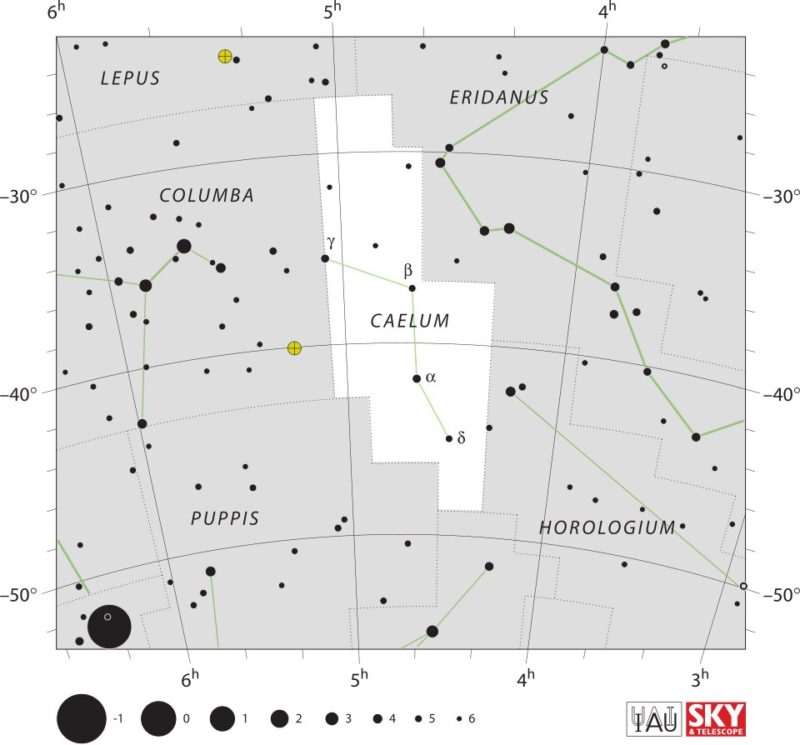
Caelum shares borders with Columba to the east, Lepus to the north, Eridanus to the west, Horologium and Dorado to the south, and Pictor. The IAU-backed coordinate diagram lays out those adjacencies clearly along with the boundary declinations.
Right ascension and declination
The constellation spans roughly 4h 19m to 5h 05m in right ascension and sits between about −27° and −49° in declination. That places it firmly south of the celestial equator, which limits how far north you can chase it.
Nearby guide stars
Rigel in Orion and the brighter stars of Lepus give you the northern approach. Achernar in Eridanus anchors the western side. Neither is inside Caelum, but both are how you reach it.
Find Caelum With a Star-Hopping Method
Start at Rigel. Move southwest to Lepus, then keep going south past the dove-shaped body of Columba, and you are in the neighborhood. From there it is a matter of patience with a chart. Sky-hopping guides that pair Columba and Caelum together make the point that you should treat Caelum as the empty gap you confirm rather than the target you spot.
Best Months and Latitudes for Viewing
Caelum reaches the meridian in the evening hours during December and January. December works well for southern-hemisphere observers, while January is often quoted as the peak month overall. From mid-northern latitudes, say 40°N, the constellation barely clears the horizon and sits in the murk. Below the equator it rides high and comfortable. Above roughly 45°N, forget it entirely.
There are no significant meteor showers with radiants inside its borders, so there is no annual event to plan around.
Why Cultural References Keep the Name Alive
Odd thing about a constellation nobody looks at. The name keeps surfacing in fiction, and I suspect that is because caelum still reads as “sky” or “heaven” to anyone with a year of Latin. Names like Taegrin Caelum in fantasy worldbuilding function as deliberate signals, telling readers that fate, prophecy, and astral scale are in play. It rewards the etymology-minded fan while sounding exotic to everyone else. The chisel meaning gets lost, and honestly, the heavenly one is more useful for storytelling.
FAQ
Is Caelum visible from the northern hemisphere?
Only partially, and only from low northern latitudes. From the equatorial parts of the northern hemisphere you can catch it low in the south during winter evenings.
Does Caelum contain any zodiac stars?
No. The zodiac band runs well north of it.
Can you see it without a telescope?
Alpha and Gamma Caeli are naked-eye objects under dark skies, but the whole constellation shape needs at least binoculars and a chart.
Conclusion
Caelum constellation earns its place in the catalogue not by drama but by filling a gap that Lacaille refused to leave blank. Two stars near magnitude 4.5, a peculiar quasar, an irregular galaxy, and a Latin name that outgrew its original meaning. Chase it in January from a southern site, and take the chart.
Would you like to receive similar articles by email?

Paul Tomaszewski
Paul Tomaszewski is a science & tech writer as well as a programmer and entrepreneur. He is the founder and editor-in-chief of CosmoBC. He has a degree in computer science from John Abbott College, a bachelor's degree in technology from the Memorial University of Newfoundland, and completed some business and economics classes at Concordia University in Montreal. While in college he was the vice-president of the Astronomy Club. In his spare time he is an amateur astronomer and enjoys reading or watching science-fiction. You can follow him on LinkedIn and Twitter.


You May Also Like

How Did Saturn’s Moon Enceladus Get Its Name

NGC 6523: A Close Look at the Lagoon Nebula