Brown Dwarf Atmosphere: Probing the Skies of Failed Stars
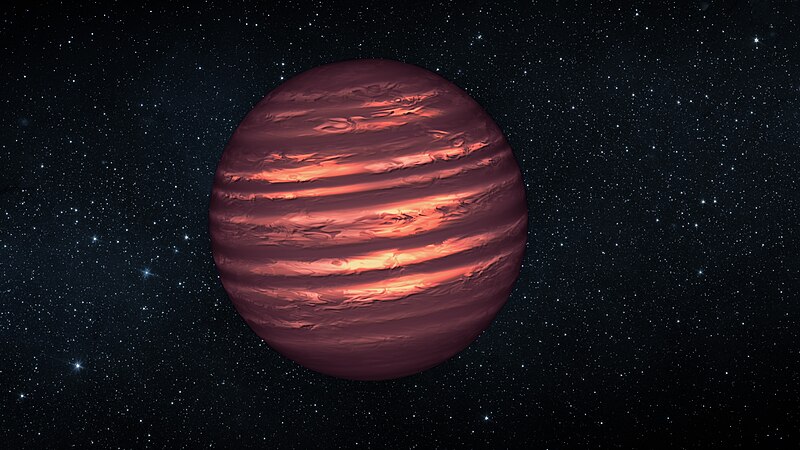
Exploring the mysteries of brown dwarf atmospheres has been an intriguing area of research for astronomers. With the help of advanced telescopes and spectroscopic techniques, we have gained significant insights into the composition and behavior of these enigmatic atmospheres.
In this article, we delve into the latest discoveries and findings that shed light on the fascinating world of brown dwarf atmospheres.
What is a Brown Dwarf?
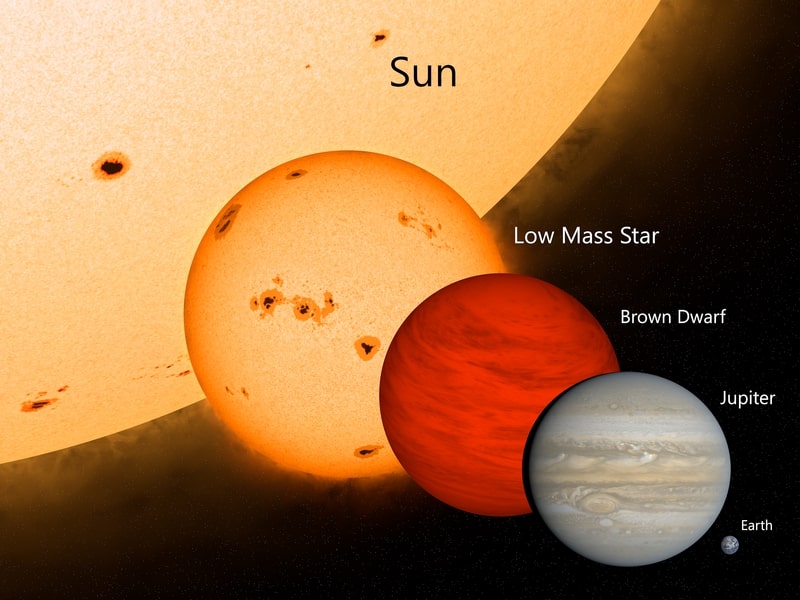
Brown dwarfs, also known as failed stars, are substellar objects that are between about 13 and 75 times the mass of Jupiter—too small to sustain the long-term fusion of ordinary hydrogen that powers regular stars. On the other hand, they are too large to be classified as planets. Instead, they emit heat and light from residual energy left over from their formation. They also emit energy from fusing deuterium. Some of the more massive brown dwarfs can also fuse lithium. This limited fusion can only last for tens of millions of years. It does not produce enough energy for these objects to shine brightly like other stars. Their atmospheres are shrouded in mystery. Because of this, scientists are continually working to uncover their secrets.
One of the main areas of focus is the brown dwarf atmosphere, which is vastly different from both stars and planets. By studying these atmospheres, scientists hope to gain a better understanding of the chemical composition and temperature profiles of these objects. Understanding the intricacies of brown dwarf atmospheres can also shed light on larger questions about the formation and evolution of planetary systems. Additionally, it can inform us about giant exoplanet atmospheres.
Brown Dwarf Atmosphere Composition and Chemistry
Brown dwarf atmospheres continue to fascinate astronomers and scientists alike. These celestial objects are considered intermediate between planets and stars. Their unique atmospheric properties have been the subject of intense study in recent years.
By observing the light emitted by brown dwarfs, researchers have been able to uncover some of the secrets of their atmospheres. They have discovered that brown dwarf atmospheres are composed of a mixture of gases, including hydrogen, helium, water vapor, methane, ammonia, carbon monoxide, alkali metals such as sodium and potassium and other molecules such as silicates, sulfides, and metal hydrides.
Recent JWST observations have even detected molecules never before seen in a brown dwarf atmosphere—such as hydrogen cyanide (HCN) and acetylene (C₂H₂)—providing new clues about complex chemical processes.
By studying the absorption and emission of light from these gases, scientists can determine the temperature and pressure profiles of brown dwarf atmospheres. This information can provide valuable insights into the complex physical and chemical processes that occur in these fascinating objects.
The temperature of these atmospheres varies widely, with some brown dwarfs having temperatures similar to those of the hottest stars. Meanwhile, others are much cooler. At the coldest end, Y-dwarfs like WISE 0855 have shown evidence of water depletion due to condensation, ammonia isotopes (^15NH₃), and disequilibrium chemistry. This challenges older, simpler atmospheric models.
Atmospheric behavior also varies across brown dwarf classes, with dusty clouds dominating many L dwarfs. Methane becomes prominent in T dwarfs. In addition, cooler Y dwarfs show increasingly complex ammonia and water chemistry.
Brown Dwarf Atmosphere Weather and Clouds
Brown dwarf atmospheres are not only chemically complex but also surprisingly dynamic. Researchers have found that these objects can produce clouds of silicates and metals, and some may even experience “iron rain,” although observations such as those of Luhman 16 AB suggest this rain-out can be more efficient than earlier models predicted.
With JWST, researchers have even created the first 3D weather maps of brown dwarfs, revealing storm systems, silicate cloud belts, and temperature patterns as hot as ~925 °C in some layers. Recent advances build on decades of observations from telescopes such as Hubble, Spitzer, and major ground-based observatories.
Astronomers also study brown dwarf weather by monitoring changes in brightness over time. As these objects rotate, evolving clouds and storms can produce detectable variability, offering another powerful way to probe their atmospheric dynamics.
Recent studies also show that atmospheric clouds can vary with latitude, with equatorial regions often having thicker cloud cover. This affects both observed colors and measured spectra.
The Role of Gravity in Shaping Brown Dwarf Atmospheres
Gravity plays a crucial role in shaping the atmospheres of brown dwarfs. The intense gravitational force of these objects compresses their gases, resulting in a high density of particles in their atmospheres. This density, in turn, leads to stronger intermolecular bonds and chemical reactions. As a result, these processes can give rise to complex chemical species.
Additionally, gravity affects the temperature structure of brown dwarf atmospheres, resulting in a gradient of temperature and pressure that can drive atmospheric circulation and mixing. Recent studies also show that atmospheric clouds can vary with latitude. For example, equatorial regions often have thicker cloud cover. This affects both observed colors and measured spectra. Understanding the impact of gravity on brown dwarf atmospheres is therefore essential for deciphering the properties of these intriguing objects. It is also crucial for predicting their behavior in different contexts.
Conclusion
The study of brown dwarf atmospheres has revealed fascinating insights into the properties of these enigmatic objects. Through thorough investigation of their chemical composition and temperature profiles, as well as the role of gravity in shaping their atmospheres, we have gained a better understanding of the complex processes that govern brown dwarf behavior.
Furthermore, ongoing research is pushing the boundaries of our knowledge, with new technologies enabling us to probe even deeper into the mysteries of these intriguing objects. From detecting exotic molecules to mapping their weather in three dimensions, each breakthrough reveals more about the diversity and complexity of these “failed stars.” As we continue to explore the secrets of the brown dwarf atmosphere, we can look forward to even more exciting breakthroughs. In turn, we anticipate a deeper understanding of the cosmos.
Would you like to receive similar articles by email?

Paul Tomaszewski
Paul Tomaszewski is a science & tech writer as well as a programmer and entrepreneur. He is the founder and editor-in-chief of CosmoBC. He has a degree in computer science from John Abbott College, a bachelor's degree in technology from the Memorial University of Newfoundland, and completed some business and economics classes at Concordia University in Montreal. While in college he was the vice-president of the Astronomy Club. In his spare time he is an amateur astronomer and enjoys reading or watching science-fiction. You can follow him on LinkedIn and Twitter.


You May Also Like
Did you know? The Moon has an Atmosphere
What Causes Dips in Exoplanet Reflected Light Curves