Boötes Constellation Guide
Boötes the Herdsman sits in the northern night sky as a large kite-shaped pattern anchored by Arcturus, the fourth-brightest star visible from Earth, and you can find it from late spring through summer by following the curve of the Big Dipper’s handle outward. That’s the short answer. The longer one involves a supervoid roughly the size of a small nightmare, a Greek legend nobody can agree on, and one of the prettiest double stars an amateur telescope can resolve.
Boötes covers 907 square degrees, which makes it the 13th largest of the 88 modern western IAU constellations. Not a small patch of sky. It is also one of the ancient constellations catalogued by the 2nd-century astronomer Ptolemy, so we’re dealing with a star group that human beings have been staring at, naming, and arguing over for well over two thousand years.
Where Do You Find the Herdsman in the Night Sky?
Arc to Arcturus
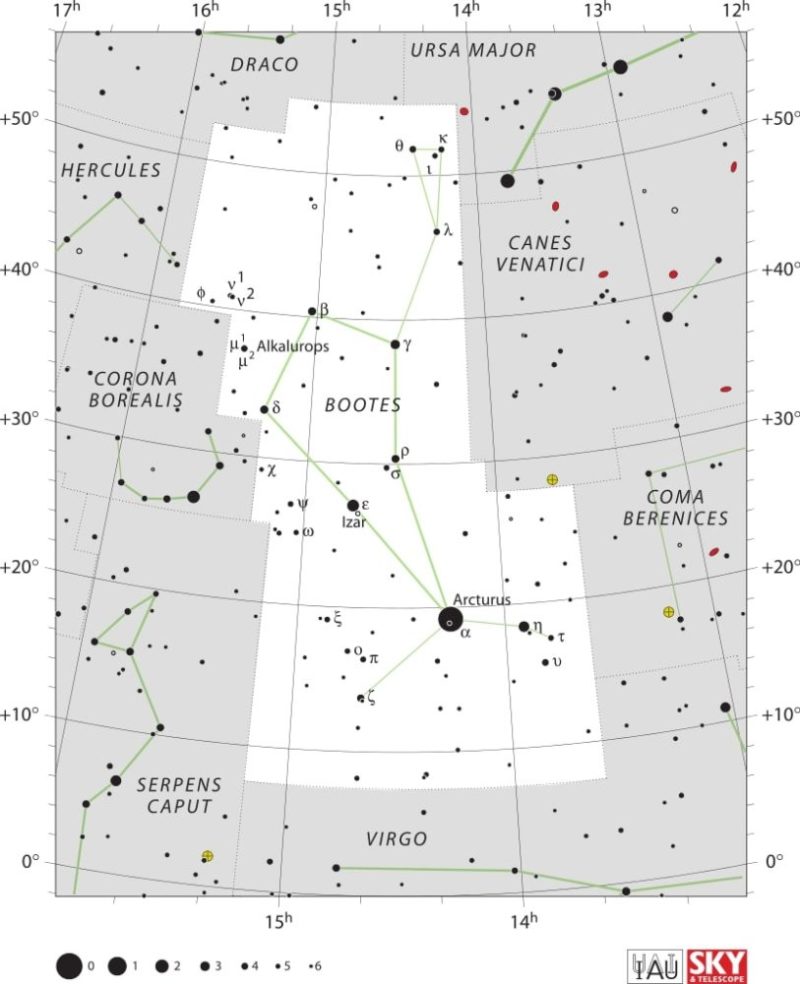
The star-hop everyone learns first still works best. Trace the three stars in the handle of the Big Dipper, keep that curve going, and the arc to Arcturus lands you on a fiercely orange point of light about 30 degrees down the sky. Old mnemonic, still undefeated. Once Arcturus is locked in, the whole constellation unfolds above it.
Kite-shaped pattern
Above Arcturus you’ll pick out a rough kite or ice-cream-cone shape. Epsilon Boötis, Gamma Boötis, Beta Boötis, and Delta Boötis form the body; Arcturus is the tail knot at the bottom. Some observers see a plowman leaning into his work. Some see a kite. Honestly, in a suburban sky you’ll see four faint stars and Arcturus screaming for attention.
Neighboring constellations
The constellation borders Ursa Major to the northwest, Draco above, Hercules and the small semicircle of Corona Borealis to the east, and the constellation Virgo to the south. The relationship with the constellation Ursa Major is the important one for navigation and for the mythology.
When Is the Best Time to Observe?
Peak months
June is the month. Boötes crosses the celestial meridian around 9:00 PM on June 15th, meaning it’s at maximum altitude just as the sky gets properly dark. April through July all work. By September it’s sinking into the west after sunset.
Hemisphere visibility
This is a northern constellation, but a generous one. It’s observable between latitudes +90 and -50 degrees, so stargazers in Buenos Aires, Cape Town, and Melbourne get a decent look at Arcturus low in the north during their autumn. Northern hemisphere observers at mid-latitudes get it near the zenith.
Sky conditions
Arcturus punches through anything, including city light pollution and thin haze. The rest of the whole constellation does not. Beta Boötis (Nekkar) sits at magnitude 3.5, and the fainter stars filling the outline vanish under a Bortle 7 sky. For the deep-sky targets you want moonless nights and dark rural skies, full stop.
Arcturus and the Other Bright Stars
| Star | Designation | Magnitude | Distance (light-years) | Type |
|---|---|---|---|---|
| Arcturus | Alpha Boötis | -0.05 | 37 | K1.5 orange giant |
| Izar | Epsilon Boötis | 2.37 | 203 | K0 giant + A2 blue star |
| Muphrid | Eta Boötis | 2.68 | 37 | G0 subgiant |
| Seginus | Gamma Boötis | 3.03 | 85 | A7 delta Scuti variable |
| Nekkar | Beta Boötis | 3.49 | 219 | G8 yellow giant |
Arcturus
The bright star Arcturus is an orange giant roughly 25 solar diameters wide with about 170 times the Sun’s luminosity, and it’s tearing through the galaxy at a startling clip. Astronomers flag its high proper motion, roughly 5.5 arcseconds a year, because Arcturus belongs to an older stellar population passing through our neighborhood rather than orbiting alongside it. The star name comes from Arktouros, “guardian of the bear.”
Izar
Epsilon Boötis is the aesthetic prize. A K0 orange giant primary star paired with a hot blue main sequence star, separated by less than three arcseconds, and the color contrast is genuinely gorgeous at 100x or more. Wilhelm Struve called it Pulcherrima, “most beautiful.” He wasn’t exaggerating. Splitting Izar demands steady seeing and at least a 3-inch aperture; the pair’s brightness difference makes it trickier than the numbers suggest.
Muphrid and Seginus
Eta Boötis lies almost exactly as far from us as Arcturus does, about 37 light-years, and the two are physically close in space too, separated by only around 3.3 light-years. Gamma Boötis is a delta Scuti pulsator, one of several variable stars scattered through the constellation boundaries. Lambda Boötis gave its name to an entire class of chemically peculiar A-type stars. Tau Boötis hosts a hot Jupiter. Kappa Boötis splits nicely in small scopes.
What Deep-Sky Objects Sit Inside the Boötes Constellation?
Galaxies and groups
Boötes is galaxy country, not nebula country, because we’re looking out of the galactic plane here. Nothing rivals Virgo’s density, but there’s real substance:
- NGC 5248—a barred spiral galaxy with visible arm structure in an 8-inch instrument
- NGC 5676 and NGC 5689—tidy edge-on and inclined spirals for moderate apertures
- Boötes Deep Field—a survey region where gravitational lensing has produced mirror-image galaxies in Hubble data
NGC 5466
The globular cluster NGC 5466 is a strange one. Loose, sparse, low in stellar density, and trailing a tidal stream of stripped stars stretching across tens of degrees of sky. It’s dissolving. Watching a cluster get shredded by the Milky Way’s gravity is not the kind of thing you get to do often.
The Boötes Void
Behind everything sits the Great Nothing. Robert Kirshner’s 1981 redshift survey uncovered a supervoid measuring 250 to 330 million light-years across, and follow-up mapping of the Boötes Void found only about 60 galaxies inside a volume that should hold thousands. It’s not empty. It’s just brutally underpopulated, and Blueshift’s write-up on cosmic voids makes the sensible point that voids are a natural outcome of structure formation, not a mystery.
Planets, Meteor Showers, and Verified Discoveries
Confirmed exoplanets
Several exoplanets are known within these borders. Tau Boötis b was among the earliest hot Jupiters detected. HD 128311 hosts at least one confirmed giant planet. The host star situation here is ordinary sun-like stuff, which is precisely what makes it useful for comparative planetology.
Quadrantid meteor shower
The Quadrantids radiate from northern Boötes every early January, peaking near the 3rd with up to 120 meteors per hour under ideal conditions. Sharp peak, only a few hours wide. The name survives from Quadrans Muralis, a defunct constellation the astronomer Hevelius invented and the IAU later dissolved. The June Bootids are the other shower, wildly unpredictable, mostly nothing, occasionally a storm.
Mythology and Cultural Interpretations Across Traditions
The name Boötes probably derives from a Greek word for “ox-driver,” and Chandra’s historical notes connect the figure to Middle Eastern plowmen and cart drivers hauling the seven oxen of the Big Dipper around the pole. Babylonian records tie the pattern to Enlil, patron of farmers. That agricultural reading feels older and more honest than the Greek legends layered on top.
And those legends contradict each other. Universe Today’s compilation of Greek tales gives you Arcas, son of Callisto, placed in the sky as the eternal bear-watcher after his mother’s transformation. Another version makes him Icarius, the vintner murdered by shepherds. Homer mentions the constellation setting slowly, useful for sailors timing the night. Classical scholars generally admit the origin is fluid.
What Equipment Do You Need to See It Well?
Naked eye for the pattern. Binoculars, 10×50 or better, for the fainter stars and NGC 5466 as a faint smudge. A 6- to 8-inch reflector opens up the galaxies and splits Izar cleanly. Beyond that, aperture buys you spiral structure.
Common Mistakes Stargazers Make With This Region
Confusing Arcturus with Mars is the classic error; both are orange, but Arcturus twinkles hard near the horizon. Expecting nebulae is another. And chasing the void with a telescope is pointless, since you cannot observe absence.
FAQ
Is Boötes a zodiac constellation?
No. It sits north of the ecliptic, adjacent to Virgo.
Why the two dots over the second o?
The diaeresis signals that both vowels sound separately: boh-OH-teez.
Can I see the Boötes Void?
Not visually. It’s a statistical feature of galaxy surveys.
Conclusion
Boötes constellation rewards patience more than gear. Arcturus gets you in the door, Izar makes the case for owning a telescope, and the void reminds you that the emptiest sky is often the most interesting.
Would you like to receive similar articles by email?

Paul Tomaszewski
Paul Tomaszewski is a science & tech writer as well as a programmer and entrepreneur. He is the founder and editor-in-chief of CosmoBC. He has a degree in computer science from John Abbott College, a bachelor's degree in technology from the Memorial University of Newfoundland, and completed some business and economics classes at Concordia University in Montreal. While in college he was the vice-president of the Astronomy Club. In his spare time he is an amateur astronomer and enjoys reading or watching science-fiction. You can follow him on LinkedIn and Twitter.


You May Also Like

Zombie Satellites: Risks, Impacts, and Mitigation Strategies

Did you know? The Moon has an Atmosphere