Auriga Constellation Guide
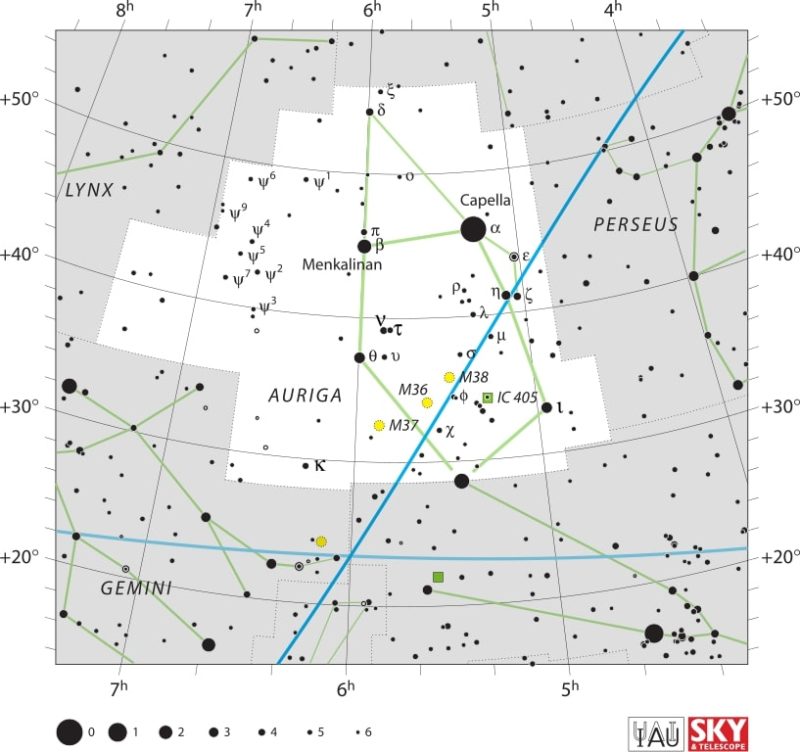
Auriga is a large northern constellation shaped like a lopsided pentagon, anchored by Capella, the sixth-brightest star in the night sky. The name is Latin for “charioteer,” and it dominates the winter night sky from roughly November through March for observers north of the equator. If you have ever glanced up in January and noticed a hard yellow point of light high overhead, well above Orion’s shoulder, you were looking at Capella and, by extension, at Auriga.
What makes the Charioteer worth more than a passing glance is what sits inside it. The winter Milky Way runs straight through the constellation, dragging along three Messier open clusters, a nebula lit by a runaway star, and one of the strangest eclipsing binary stars ever catalogued.
What Does Auriga Mean and Where Does It Sit in the Sky?
Name and translation
The name Auriga comes directly from Latin, where it meant the driver of a chariot, specifically a quadriga, the four-horse racing rig of Roman circuses. Odd, then, that nearly every historical star atlas draws the figure cradling a goat. Ian Ridpath‘s careful reading of old celestial cartography traces how Capella took the name “she-goat” while three nearby stars became the Haedi, or Kids, an image that has almost nothing to do with charioteering and everything to do with a much older pastoral tradition layered underneath the Greek one.
Coordinates and boundaries
Center the constellation near right ascension 6h and declination +42 degrees and you have it. The midnight culmination is around December 21, which is a tidy way to remember when it rides highest. The modern boundary is a 20-segment polygon drawn up by Eugène Delporte for the International Astronomical Union in 1930, and Auriga covers about 657 square degrees, putting it in the top quarter of the 88 modern constellations by area.
Neighboring constellations
Perseus sits to the northwest, Camelopardalis and a sliver of Lynx to the north and east, Gemini to the southeast, and Taurus below. That southern border matters more than it sounds, and we will get to why in a moment.
The Pentagon Shape and How to Trace It
Five anchor stars
Capella, Menkalinan, Mahasim, Elnath, and Hassaleh. Five points, one slightly squashed polygon. It is genuinely one of the easiest patterns to pick out from a suburban backyard because Capella cuts through light pollution without complaint.
The Kids asterism
Just southwest of Capella sits a tight little triangle of fainter stars, Epsilon, Zeta, and Eta Aurigae, known since antiquity as the Kids. EarthSky’s closeup on the region also explains why Capella flickers through so many colors when it hangs low in the sky, since atmospheric refraction splits the light of a bright star near the horizon the same way a prism does.
Shared star with Taurus
Elnath, Beta Tauri, used to carry the designation Gamma Aurigae as well. Both figures wanted it. The 1930 boundaries settled the dispute in Taurus’s favor, so the pentagon now technically borrows a star from the bull’s northern horn.
Locate the Charioteer Season by Season
Northern Hemisphere timing
- November evenings: rising in the northeast after dark, pentagon tilted on its side
- December and January: near the zenith around 10 p.m., the best window by a wide margin
- February and March: sliding west, still comfortable for cluster hunting before midnight
- Late summer: pre-dawn only, low in the northeast
Southern Hemisphere limits
Auriga stays visible down to roughly 40 degrees south latitude (declination −40°), and even then only as a low, hazy smudge on the northern horizon. Observers in Buenos Aires or Cape Town get a partial view. Anyone further south, in Ushuaia or Invercargill, simply never sees the entire constellation.
Star-hopping from Orion
Follow Orion’s belt upward through Aldebaran and the Hyades, keep going, and you run into Capella. That whole run is part of the Winter Hexagon—an asterism of six bright stars (Capella, Aldebaran, Rigel, Sirius, Procyon, and Pollux) that dominates the winter sky.
Capella and the Brightest Stars
Capella is not one star. It is four, arranged as two binary pairs, and the dominant pair consists of two yellow giants roughly ten solar radii across, orbiting each other every 104 days at a distance of 42.9 light-years from us. Because both are G-type stars like an evolved Sun, the combined light reads as warm gold to the eye.
| Star | Bayer | Magnitude | Type |
|---|---|---|---|
| Capella | Alpha Aurigae | 0.08 | G-type giant pair |
| Menkalinan | Beta Aurigae | 1.90 | A-type spectroscopic binary |
| Mahasim | Theta Aurigae | 2.65 | A-type with faint companion |
| Hassaleh | Iota Aurigae | 2.69 | K-type supergiant star |
| Almaaz | Epsilon Aurigae | 3.0 var. | F-type supergiant + disk |
Menkalinan is a spectroscopic binary star whose components nearly eclipse each other, and it drifts through space alongside the Ursa Major moving group, sharing a common velocity with stars that look nothing like neighbors on a chart.
Mahasim, meanwhile, earned an unusual footnote when NASA’s LunaH-Map CubeSat photographed it alongside Menkalinan to verify its autonomous optical navigation software after launch.
Hassaleh is an orange supergiant, ancient and bloated.
Why Do Astronomers Watch Auriga’s Variable Stars?
Epsilon Aurigae eclipses
Every 27 years, Epsilon Aurigae dims for nearly two full years. Two years. The eclipsing body appears to be a vast, dusty, opaque disk surrounding an unseen companion, and the 2009 to 2011 event drew coordinated observing campaigns from astronomers worldwide, both professional and amateur, comparing brightness against a fixed comparison star night after night. The next eclipse is predicted for 2036–2038.
Zeta Aurigae pairs
Zeta Aurigae, one of the Kids, is an eclipsing binary star system pairing a K-type supergiant with a hot B-type companion. Xi Aurigae and R Aurigae round out a constellation unusually rich in stars that refuse to hold steady.
Double star targets
Theta and Omega Aurigae both split cleanly at moderate magnification, and 14 Aurigae is a rewarding triple for anyone with patience and a steady mount.
Deep-Sky Objects Worth a Binocular Night
The winter Milky Way passes through Auriga, and the payoff is three Messier open clusters strung along it. Messier 37 is the richest, a dense sprawl of faint suns. M36 is compact and bright. M38 sits at around magnitude +6.4 near Iota Aurigae.
IC 405, the Flaming Star Nebula, glows because AE Aurigae, a runaway star ejected from the Orion cluster millions of years ago, happens to be plowing through it. The region belongs to the broader Taurus-Auriga molecular cloud, an active star formation zone. Another emission nebula in the constellation is IC 410. NGC 2281 is a looser, easily overlooked cluster near the eastern edge, and Auriga hosts a handful of exoplanet systems, including the transiting binary star system KELT-2.
Mythology Across Greek and Roman Traditions
Charioteer lore points to Erichthonius, the lame Athenian king who invented the four-horse chariot and was raised, in most tellings, by the goddess Athena. Other accounts name Myrtilus, or Hippolytus, son of Asclepius. The goat imagery predates all of it. Amalthea, the she-goat who nursed the infant Zeus, became Capella.
Aurigid and Delta Aurigid Meteor Showers
The Aurigids peak on August 31, with a radiant near Theta Aurigae. Typical rates run at a meager 6 per hour. The Delta Aurigids are an even sparser meteor shower.
FAQ
Is Auriga circumpolar?
From roughly 44 degrees north and above, yes, it never fully sets.
Can I see the clusters from a city?
M37 and M36 survive moderate light pollution in 10×50 binoculars. The Flaming Star Nebula will not.
Is Capella a single star?
No. Four stars, two pairs.
Conclusion
The Auriga constellation rewards return visits more than most winter patterns. Find the pentagon, then the Kids, then let the clusters pull you into the winter Milky Way, and eventually you start watching Epsilon Aurigae just to see whether anything has changed.
Would you like to receive similar articles by email?

Paul Tomaszewski
Paul Tomaszewski is a science & tech writer as well as a programmer and entrepreneur. He is the founder and editor-in-chief of CosmoBC. He has a degree in computer science from John Abbott College, a bachelor's degree in technology from the Memorial University of Newfoundland, and completed some business and economics classes at Concordia University in Montreal. While in college he was the vice-president of the Astronomy Club. In his spare time he is an amateur astronomer and enjoys reading or watching science-fiction. You can follow him on LinkedIn and Twitter.


You May Also Like
Apus Constellation Guide
Discovering the Wonders of Asteroid 3 Juno