How Atmospheric Escape Strips Rocky Planet Atmospheres
Most people picture an atmosphere escaping away like steam off a kettle. On a rocky planet, it usually happens higher up and far more violently: gas in the upper atmosphere gets heated, ionized, or physically knocked around until some particles exceed escape speed and leave for space. On hot rocky exoplanets, that can strip a light primordial envelope quickly and then keep chipping at heavier gases over long stretches of time.
Why rocky worlds lose air
The short version is almost annoyingly simple. Gravity tries to hold gas down. Heat tries to puff it up. The host star then barges in with X-rays, extreme ultraviolet radiation, flares, and wind, turning a quiet leak into a sustained robbery. A planet’s atmosphere is not decided by one magic shield or one catastrophic day. It is the long argument between mass, temperature, chemistry, and time.
What readers should know
Atmospheric escape is not ordinary weather, and it is not just “hot gas goes up.” Scientists care about the exobase, the ionosphere, stellar XUV flux, escape velocity, sputtering, photochemistry, and outgassing from the interior. That map matters because a bare rock, a Venus-like carbon dioxide world, and a lava-covered exoplanet can all start from different inventories and end up looking oddly similar from far away.
What strips air from rocky worlds first?
Gravity versus heat
If I had to reduce the whole thing to one blunt picture, I’d use a leaky tire. Bigger planets have stronger gravity, so gas molecules need more speed to get out. Hotter planets hand those molecules more speed. That is why tiny bodies struggle, why hydrogen disappears first, and why heavy molecules such as CO2 or molecular nitrogen are harder to remove.
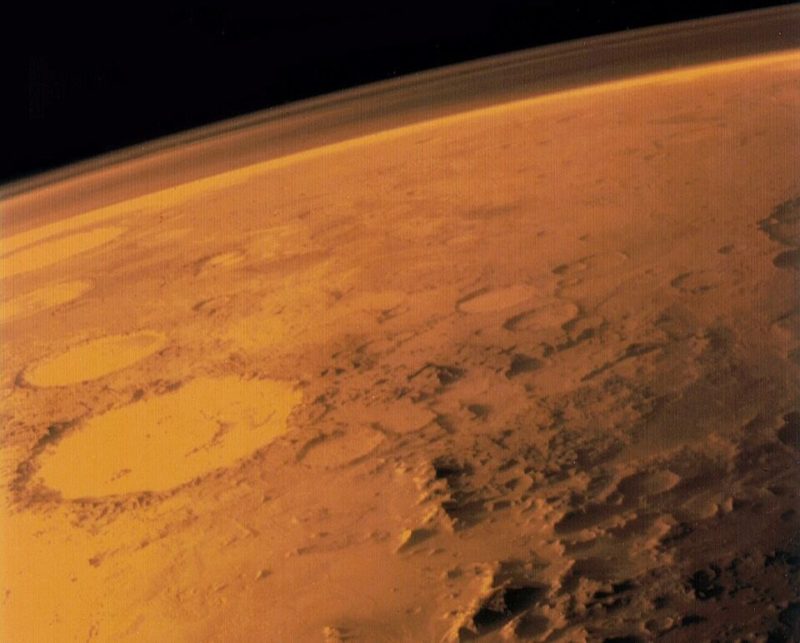
Composition matters, though. A hot world can still hang onto heavy gases better than light ones, while a cool world with weak gravity may still bleed away over geologic time. Earth, Venus, and Mars make the point nicely. Similar broad starting ingredients, very different thermal histories and atmospheric escape outcomes.
Escape velocity
Escape velocity is the number that keeps showing up because it is the gatekeeper. Roughly, it scales as the square root of (2GM/R), so both mass and radius matter, not just surface gravity alone. A puffed-up young planet with modest density can be easier to erode than a compact one of similar mass.
That is why “bigger” can mislead. If the upper atmosphere is swollen by intense heating, the gas does not have to climb from the solid surface anyway. It starts from high altitude, already partway out the door.
Upper atmosphere loss
Most atmospheric escape begins in the upper atmosphere, where stellar XUV radiation breaks molecules apart, heats the gas, and creates ions and electrons. The lower atmosphere may be dense and calm while the top is already streaming away. That vertical split is easy to miss, and it is where a lot of bad popular explanations fall apart.
Which loss pathways matter most?
A useful way to sort the machinery is this:
- Jeans escape removes the fastest particles from the tail of the velocity distribution.
- Hydrodynamic blowoff drives bulk outflow when heating gets extreme.
- Plasma erosion strips ions through stellar-wind interaction, sputtering, and pickup.
| Pathway | Main driver | Best at removing | Typical setting |
|---|---|---|---|
| Jeans escape | Thermal tail of particle speeds | Light atoms, especially H and He | Warm upper atmospheres, long timescales |
| Hydrodynamic blowoff | Strong XUV heating | Primordial H/He envelopes, sometimes dragged heavier species | Young, hot close-in worlds |
| Plasma erosion | Stellar wind and ion escape | Ionized species, upper-atmosphere particles | Weakly shielded planets, active stars |
Jeans escape
Jeans escape is the slow leak. Even in a stable atmosphere, some particles in the high-speed tail outrun gravity. Hydrogen is the usual casualty because it is light. This mechanism alone rarely strips a thick heavy atmosphere fast, but over billions of years it absolutely matters.
Hydrodynamic blowoff
Hydrodynamic escape is what happens when the upper atmosphere gets so hot it flows outward like a wind. A good photoevaporation study of rocky protoatmospheres shows why the first 100 million years can be brutal: young stars throw out far more XUV than mature ones, and that early blast can remove hydrogen-helium envelopes before a rocky planet settles down.
Sometimes heavier species hitch a ride. That part is important. Blowoff is not just a faster Jeans escape. It is a regime change.
Plasma erosion
Non-thermal loss gets meaner. Ion pickup, dissociative recombination, and sputtering let stellar plasma peel away gas particle by particle. A broad review of thermal and non-thermal escape lays out the menu, while work on stellar wind interactions and magnetic fields shows the magnetic story is messy. A magnetosphere can shield, but under some conditions it also channels particles and opens loss routes near the poles. So no, “magnetic field equals safety” is too neat by half.
What controls how fast gases vanish?
Star XUV flux
Young stars are the bullies of this story. Their X-ray and ultraviolet output inflates upper atmospheres, boosts ionization, and feeds faster atmospheric escape. Flares and coronal mass ejections pile on. For close-in exoplanets, distance is destiny because XUV exposure rises fast as you move inward.
Planet mass
Mass still rules the ledger. Low-mass planets lose light gases easily, and if the heating is harsh enough they can lose far more than light gases. The famous radius gap in exoplanet surveys, roughly separating stripped rocky planets from gas-rich sub-Neptunes, is widely read as the fossil record of atmospheric escape doing selection work on young systems.
Temperature history
A planet is not born with one fixed atmosphere. It cools, outgasses, melts, and sometimes remakes itself. Cooling magma oceans, volcanic degassing, and core heat can keep feeding gas upward even while the star is stealing it. That is why the most honest question is not “can this planet lose an atmosphere?” but “can it lose air faster than it replaces it?”
How do stars shape long-term survival?
Young star activity
The early era is usually decisive. High XUV flux drives blowoff, and repeated storms accelerate ion loss. Once that opening round ends, a planet may already be committed to being a bare rock, a Venus-like survivor, or something in between.
M-dwarf risk
This gets sharper around red dwarfs. In the TRAPPIST-1 system, the habitable zone sits close to the star, which is good for warmth and bad for atmospheric peace. TRAPPIST-1 b and TRAPPIST-1 c receive intense irradiation, and even the temperate TRAPPIST-1 planets may face a hard time if early stellar activity was fierce enough. M-dwarf planets are tempting targets, but they live in rough neighborhoods.
Radius gap
That exoplanet radius valley, near about 1.5 to 2 Earth radii, matters because it suggests atmospheric escape is not a side note. It helps sculpt whole populations. Some close-in worlds keep enough gas to stay puffy. Others get stripped down to dense rocky cores. Nature leaves statistical fingerprints.
Surface and interior gas cycling
This is where the story gets more interesting than the simple leak analogy. Surface and interior processes can replenish air. Volcanoes vent volatiles. A magma ocean can dissolve and release gases in cycles. On ultra-hot worlds, even molten rock and vaporised rock may join the atmosphere-surface exchange.
That tension shows up in debates over 55 Cancri e. Webb observations, especially in infrared light and secondary eclipse measurements with MIRI, have been read as evidence for either a volatile-rich atmosphere or intense surface-atmosphere coupling above a magma-rich dayside. In plain language, the planet may be losing gas and renewing it at the same time. A useful discussion of magma oceans and atmospheric stripping captures why these lava worlds refuse to behave like tidy textbook cases.
How do scientists detect lost or renewed air?
They rarely watch molecules leave one by one. They infer. In the solar system, NASA’s MAVEN mission gave direct help by measuring ion escape and sputtering at Mars, tying atmospheric loss to solar wind and space weather. That is the gold standard because it is in situ.
For exoplanets, scientists use transit spectroscopy, thermal phase curves, and secondary eclipse data. Webb looks at how starlight filters through or how a planet’s own infrared emission rises and falls. If TRAPPIST-1 b lacks a substantial atmosphere, or TRAPPIST-1 c lacks a thick CO2 blanket, that conclusion comes from matching data to atmospheric composition models, surface temperatures, and heat redistribution between dayside and nightside. No single plot settles it. The pattern does.
What do key rocky worlds teach us?
Venus teaches that heavy atmospheres can survive if gravity is decent and replenishment plus chemistry keep the system supplied. Mars teaches that small mass and weak shielding leave the upper atmosphere vulnerable for ages. Earth reminds us that atmospheric escape and replenishment can coexist without ending habitability. Hot rocky exoplanets such as 55 Cancri e push the whole framework harder, because high temperature, strong irradiation, and possible magma oceans make loss and renewal happen on a much faster, stranger stage.
FAQ
Can a magnetic field save an atmosphere?
Sometimes, partly. It can reduce direct stellar-wind stripping, but it is not a universal force field.
Why do some hot rocky planets still seem to have atmospheres?
Because atmospheric escape is only half the bookkeeping. Outgassing from the interior may keep replacing lost gases.
Is atmospheric escape always bad?
No. Losing a thick primordial hydrogen envelope may be what allows a rocky planet to end up with a secondary atmosphere more like the terrestrial planets we care about.
Conclusion
Atmospheric escape strips rocky planet atmospheres by attacking the upper layers with heat, radiation, and plasma until gravity cannot hold every particle. The winners and losers are decided by mass, radius, composition, stellar violence, and whether the interior can keep feeding fresh gas upward. That is the real lesson. A planet’s air is not just what it has. It is what it can keep.
Would you like to receive similar articles by email?

Paul Tomaszewski
Paul Tomaszewski is a science & tech writer as well as a programmer and entrepreneur. He is the founder and editor-in-chief of CosmoBC. He has a degree in computer science from John Abbott College, a bachelor's degree in technology from the Memorial University of Newfoundland, and completed some business and economics classes at Concordia University in Montreal. While in college he was the vice-president of the Astronomy Club. In his spare time he is an amateur astronomer and enjoys reading or watching science-fiction. You can follow him on LinkedIn and Twitter.


You May Also Like

Orion Constellation Guide
How Did Asteroid Vesta Get Its Name