NASA Astronaut Victor Glover: From Naval Aviator to Artemis II Pilot
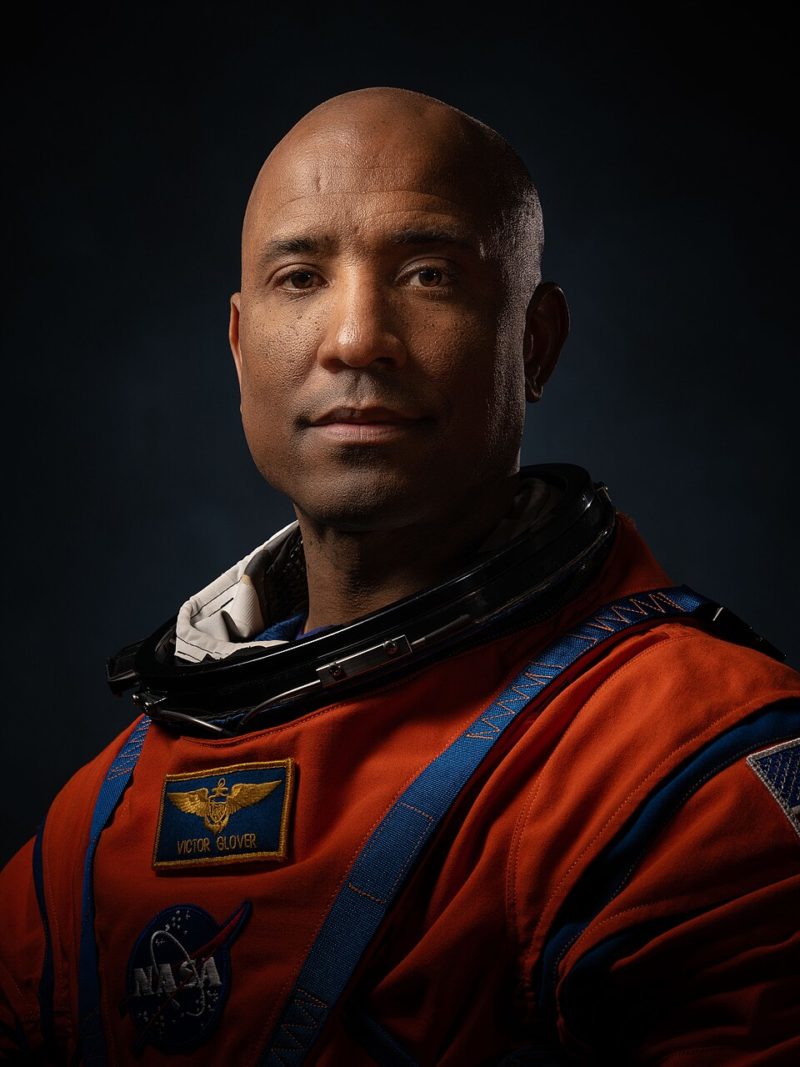
Astronaut Victor Jerome Glover Jr. built his path to space through discipline, technical mastery, and steady progression rather than sudden breaks. From early curiosity about how machines work to careers in naval aviation, test piloting, and long-duration spaceflight, his journey reflects the kind of preparation NASA’s most demanding missions require.
The Formative Years
Early Life
Victor Jerome Glover came into the world in Pomona, California, on April 30, 1976. His family emphasized work, faith, and service. Furthermore, tales from his grandfather, who had served in the U.S. Air Force during the Korean War era, made aviation seem like less of a far-off dream.
As a youngster, he spent a lot of time dismantling stuff, inquiring how machines operated, and monitoring new planes or missions to space that he viewed in the news. One day, a televised space shuttle launch captured his complete attention.
At Ontario High School, Glover emerged as a standout gridiron and wrestling athlete. He cultivated a reputation as a tough, intense competitor—not a showboat. At the same time, he excelled in math and science. He gravitated toward physics and problem-solving work that suited his hands-on proclivities. Teachers who witnessed that blend of physical impulse and analytic momentum frequently directed him toward engineering. Subsequently, they sent him toward military aviation.
Education
Glover departed Pomona for Cal Poly San Luis Obispo, where he received a B.S. In general engineering in 1999. Cal Poly’s “learn by doing” culture fit his style. Lab courses, design projects, and team problem sets connected theory to hardware in a hands-on way that later aided him in test squadrons and simulators.
From 2007 to 2010, Glover attained three master’s degrees in different fields. These included a Master of Science in Flight Test Engineering from Air University. He also received a Master of Science in Systems Engineering from the Naval Postgraduate School in Monterey, California. Additionally, he earned a Master of Military Operational Art and Science from Air University.
Through this mix, he built skills that matter in cockpits and control rooms: clear technical writing, quick numerical reasoning, and calm decision-making in high-stress settings.
A Pilot’s Ascent
Military Service
After earning an engineering degree, NASA astronaut Victor Glover was commissioned as a U.S. Navy officer. At that time, technical coursework shifted into real-world systems: pumps, hydraulics, avionics, and flight controls he would soon trust with his life. He progressed through primary and advanced flight training.
Then he received his naval aviator wings and served with strike fighter squadrons flying F/A‑18C Hornets and later F/A‑18E/F Super Hornets, such as with VFA‑34 and VFA‑195. He deployed on carriers such as USS John F. Kennedy and USS George Washington. While deployed, he launched from short decks at high gross weight and flew combat sorties over Iraq during OIF.
Astronaut Selection
Glover initially applied to NASA’s astronaut corps in 2009 and was rejected. He applied again, and in 2013, was selected in Astronaut Group 21. Just 8 people were chosen from some 6,300 applicants.
As an astronaut candidate, he trained across a broad skill set: ISS systems, Russian language, survival training in harsh environments, robotics, and simulated spacewalks in the Neutral Buoyancy Laboratory.
Making History in Space
The Crew-1 Mission
Crew-1 was the initial operational mission of SpaceX’s Crew Dragon, the phase where the vehicle transitioned from prototype to standard crew shuttle for NASA. As pilot, Glover sat in the right seat, scanning the touchscreen instrument panel. He tracked speed, altitude and ground coordinates through the nearly nine-minute ascent into orbit.
He flew alongside Commander Mike Hopkins, NASA astronaut Shannon Walker, and JAXA astronaut Soichi Noguchi. At that time he had to rely on both a new spacecraft and a new commercial crew model.
The mission lasted about six months end to end: launch, automated rendezvous, docking, continuous ISS operations, undocking, and splashdown. It helped demonstrate that a commercially developed spacecraft could reliably transport crews and maintain a steady flight rate.
Spacewalks
During Expedition 64/65, Glover conducted four spacewalks (EVAs) and accumulated 26 hours 7 minutes outside the ISS.
On these EVAs he assisted with solar array upgrades, installed or relocated external hardware, and facilitated system reconfigurations that maintain power and data flowing across the truss.
Working outside the station is physical as well as technical. The suit is essentially a mini spacecraft with limited consumables. Handholds and tether routing must be planned, and tool use must also be considered. Even simple tasks become slow, high-effort endeavors when done in a pressurized suit. Every motion has to be choreographed ahead of time. Then it is tweaked on the fly when hardware doesn’t fit as anticipated.
Onboard Research
As an ISS flight engineer, Glover’s primary responsibility was to maintain the station’s operations and serve as the hands and eyes for numerous microgravity experiments.
He conducted a hydroponics plant experiment where teams could study controlled water and nutrient delivery to weightless plants. Plant growth work may be easy to visualize. However, it is core to long-term life support planning where fresh food and closed-loop systems minimize cargo requirements.
Beyond biology, he hosted materials science runs and tech demos that explored how fluids, alloys, and advanced sensors operate when gravity isn’t in charge. Many of those initiatives originated from or contained companions at ESA, JAXA, and the Canadian Space Agency (CSA). Glover conducted step-by-step procedures, fixed hardware, and sent back meticulous observations so ground teams may enhance their models.
Artemis II Pilot
NASA selected Victor Glover in 2023 to pilot Artemis II, the first crewed lunar flyby since Apollo. He launched successfully on April 1, 2026, aboard the Space Launch System (SLS) rocket with Orion, beginning a multi-day mission around the Moon. Glover, a veteran NASA astronaut, is flying with commander Gregory R. Reid Wiseman, mission specialist Christina Koch, and CSA astronaut Jeremy Hansen. This crew represents both NASA’s internal diversity effort and its long-standing collaborations with other space agencies.
During Artemis II, Glover is handling critical flight phases, assisting in monitoring system status, and supporting the commander during off-nominal events. The mission is currently progressing along its planned free-return lunar trajectory. Along the way, the team is testing Orion’s life support, propulsion, navigation, and communications systems.
Conclusion
Victor Glover’s story sounds crisp, authentic, and extremely timely. Once a tinkering, limit-pushing kid, he is now a test pilot, then a station crewmate, and now crucial for the next Moon push. Now, as Artemis II progresses, he is actively applying decades of preparation to humanity’s first crewed lunar flyby in over 50 years.
There’s a simple message his trajectory imparts. Skill matters. Grit counts more. Mentors are helpful. Audacious objectives are important. That combination led him from a tiny desk in school to Dragon and Artemis II pilot.
Frequently Asked Questions
Who is Victor Glover?
Victor Glover, a NASA astronaut and U.S. Navy test pilot, made history as the first African-American astronaut to live on the ISS during a long-duration mission, flying on SpaceX Crew Dragon for the first crewed flight. He is also currently piloting Artemis II, NASA’s first crewed lunar flyby since Apollo.
What is Victor Glover best known for as an astronaut?
He’s best known for flying as pilot Victor Glover on SpaceX’s Crew-1 mission and becoming the first African-American NASA astronaut to perform a long-duration stay on the ISS. He is now also known for piloting Artemis II. His work focused on science experiments, technology demonstrations, and station upkeep.
How did Victor Glover become an astronaut?
Glover studied engineering and became a U.S. Navy aviator and later a test pilot. NASA chose him as a member of the astronaut candidate training in 2013. Following rigorous training in spacecraft systems, spacewalking, and survival, he earned a spaceflight assignment.
Artemis II Astronauts Article Series:
- Reid Wiseman: Artemis II Mission Commander
- Victor Glover: Artemis II Pilot
- Christina Koch: Artemis II Mission Specialist 1
- Jeremy Hansen: Artemis II Mission Specialist 2
Would you like to receive similar articles by email?

Paul Tomaszewski
Paul Tomaszewski is a science & tech writer as well as a programmer and entrepreneur. He is the founder and editor-in-chief of CosmoBC. He has a degree in computer science from John Abbott College, a bachelor's degree in technology from the Memorial University of Newfoundland, and completed some business and economics classes at Concordia University in Montreal. While in college he was the vice-president of the Astronomy Club. In his spare time he is an amateur astronomer and enjoys reading or watching science-fiction. You can follow him on LinkedIn and Twitter.


You May Also Like

The Importance Of Visiting Your Dentist On a Regular Basis
NGC 1850: An Intriguing Double Star Cluster