NASA Astronaut Christina Koch: Artemis II Mission Specialist
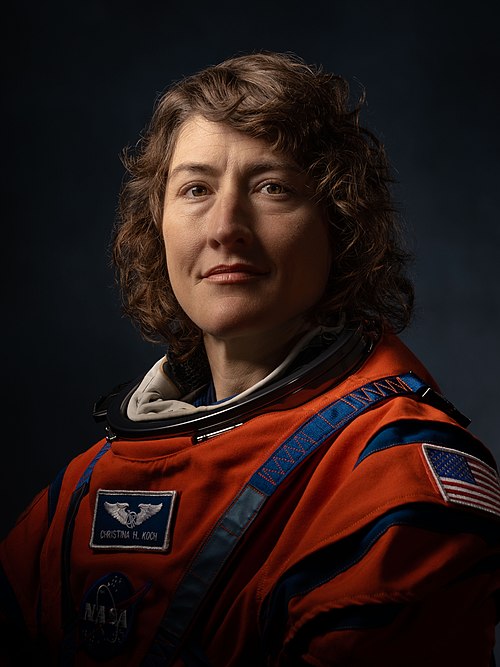
Astronaut Christina Hammock Koch is a NASA engineer-turned-spacefarer whose career blends deep technical expertise with extreme-environment experience. From record-setting time aboard the International Space Station to her role on the Artemis II lunar mission, Koch’s path reflects steady preparation, resilience, and a commitment to pushing human spaceflight farther than before.
Formative Years
Childhood Dreams
Koch was born in Grand Rapids, Michigan, and raised primarily in Jacksonville, North Carolina.
She devoured books on the Space Shuttle, studied mission profiles, and saw space documentaries whenever she discovered them on TV. Early women astronaut stories resonated with her. In particular, Sally Ride and Mae Jemison showed that a girl who enjoyed math and physics had a role in spaceflight.
Moments like watching shuttle launches and later meeting visiting astronauts at outreach events turned her quiet interest into a firm plan.
Academic Foundation
Koch’s formal training for that track coalesced at the North Carolina School of Science and Mathematics in Durham. This is a public residential high school devoted to advanced STEM courses. She graduated there in 1997.
She subsequently attended North Carolina State University in Raleigh. There, she earned dual Bachelor of Science degrees in electrical engineering and physics. Later, she earned a Master of Science degree in electrical engineering. This mix supplied her with both circuit-level proficiency and a solid understanding of classical mechanics, electromagnetism, and physics. These are all directly applicable to spacecraft and instrument design. Lab work included signal processing, embedded systems, and control theory. Additionally, physics courses drilled her in data analysis and error estimation.
While studying, she participated in the NASA Academy program, an experience that matches students with NASA centers and mentors. That program introduced her to actual mission schedules, systems engineering methodologies, and the culture of risk mitigation that drives crewed spaceflight. She subsequently worked at the Applied Physics Laboratory at Johns Hopkins University from 2007 to 2009. There, she focused on space science instrument development. She grappled with flight hardware limitations like radiation tolerance, thermal budgets, and mass–power trade-offs.
Remote Expeditions
Koch’s career then transitioned from campus labs to some of the most remote research locations on Earth. She was a field engineer in Antarctica and Alaska, wrangling power systems, communications links, and scientific instruments in conditions that strain hardware and humans alike. While at the Amundsen-Scott South Pole Station, she helped sustain year-round operations in temperatures that can drop below −70 °C during the Antarctic winter.
She did tours at Palmer Station in Antarctica and several winters at Summit Station in Greenland, a high-altitude research camp on the ice sheet. These assignments demanded cross-training. Therefore, she joined Firefighting Teams and Ocean/Glacier Search and Rescue Teams. She added emergency response skills to her technical workload.
Working in those conditions forged resilience and cool-headed problem-solving under pressure. Power failures, sensor faults, and weather-driven logistics delays couldn’t always be passed on to experts. She had to troubleshoot on the ground with limited spares and no easy-escape helicopter. That environment honed her skills working in compact teams and adhering to regimented processes. Yet, she still innovated within safety buffers.
Engineering Roots
Before entering the astronaut corps, NASA astronaut Christina Koch expanded her engineering foundation at NASA’s Goddard Space Flight Center. There, she developed space science instruments that had to endure launch loads, vacuum, and harsh radiation.
Her work spanned design, test, and integration, connecting theoretical performance budgets to what the hardware actually performed in thermal‑vacuum and vibration tests. This closed the loop between theoretical models and flight‑ready systems. As a result, she contributed to several NASA missions.
She helped provide energetic particle detector instruments that flew on missions like NASA’s Juno mission to Jupiter. She contributed to instruments designed for harsh space environments.
NASA Ascent
Christina Koch’s route into NASA begins long before her astronaut pin. She completed the NASA Academy program at GSFC in 2001. Then, she worked from 2002 to 2004 as an electrical engineer in the Laboratory for High Energy Astrophysics, assisting support of space science instruments. That hands-on lab work on real flight hardware and detector systems provided her with the track record of complex electronics NASA would later seek in astronaut candidates.
NASA selected her in June 2013 as a member of Astronaut Group 21. They formed a crew to back ISS activities, Orion trials, and ultimately a return to the lunar surface. Koch navigated two years of astronaut candidate training that spanned spacecraft systems, robotics, and survival skills.
Koch later returned as flight engineer on Soyuz MS‑12, launching March 14, 2019, with Aleksey Ovchinin and Nick Hague, and subsequently on the ISS. She assisted with power-system upgrades and physics observatory work. Notably, that included the October 18 first all‑female spacewalk with fellow NASA astronaut Jessica Meir.
The Artemis Call
Christina Koch’s transition from extended orbital flight to lunar exploration culminates with Artemis II as mission specialist on the first crewed voyage to the Moon in over 50 years. The mission launched on April 1, 2026, sending Koch and three crew members on a roughly 10-day journey around the Moon and back aboard NASA’s Orion spacecraft and Space Launch System (SLS) rocket. This historic Artemis II mission marks a significant milestone for NASA. It prepares for future lunar exploration.
The mission follows a free-return trajectory, carrying the crew roughly 370,000 kilometers from Earth. During the mission, they test Orion’s life-support systems, deep-space navigation, and communications beyond low Earth orbit.
Her choice reflects a profile combining endurance, systems depth, and field work. Selected in 2013 as one of eight in NASA’s 21st astronaut class and certified in 2015, she subsequently accumulated 328 days in space aboard the ISS. This is the longest single spaceflight by a woman.
For NASA’s grander ambitions, Artemis targets long-term presence around and upon the Moon, utilizing Orion, the future Lunar Gateway outpost in lunar orbit, and fresh landers as a testbed for Mars voyages down the line.
Conclusion
Christina Koch’s journey resonates as both unconventional and relatable. A sky-loving kid became an engineer and then an astronaut who orbited for 328 days.
Her ISS record, the first all-woman spacewalk and now Artemis II demonstrate a consistent pattern. Bit by bit, she extends human flight beyond and she does it with a quiet, determined grit.
Frequently Asked Questions
Who is Christina Koch?
Christina Koch, a NASA astronaut and electrical engineer, is most recognized for holding the record for the longest single spaceflight by a woman and for conducting the ISS’s first all-woman spacewalk with fellow NASA astronaut Jessica Meir.
What were Christina Koch’s formative years like?
Christina Koch, a NASA astronaut, has been a science and space fan since she was a child. She majored in electrical engineering and physics. She interned at research labs and learned how to work in remote, extreme environments. These skills would later assist her as a highly capable astronaut.
How did Christina Koch become a NASA astronaut?
She forged a robust technical profile through engineering positions, scientific work, and extreme environmental conditions. NASA astronaut Christina Koch was picked as an astronaut candidate in 2013. After training in space systems, robotics, and survival, she was ready for long-duration missions.
What record did Christina Koch set in space?
Christina Koch, a NASA astronaut Christina Hammock Koch, holds the record for the longest single spaceflight by a woman, logging 328 days on the ISS. This long duration mission provided vital data about how extended spaceflight impacts the human body. It assisted NASA in preparing for upcoming deep space journeys.
What is Christina Koch’s role in the Artemis program?
NASA astronaut Christina Koch, a key crew member of the Artemis II mission, is serving as a mission specialist on the agency’s first crewed lunar flight in over 50 years. She is supporting spacecraft systems, operations, and testing critical technologies for future human lunar landings.
Over the course of her ISS mission, NASA astronaut Christina Koch backed dozens of experiments in biology, human health, materials science, and technology. Her extended tenure in microgravity aided scientists in analyzing how space impacts the human body. Furthermore, it enhanced mission planning for future NASA missions to the Moon and Mars.
Why is Christina Koch’s story important from a human perspective?
Her narrative illustrates how focus, engineering expertise, and fortitude can unlock the doors to spaceflight, inspiring many to pursue careers in STEM. This is particularly evident in the journey of NASA astronaut Christina Koch, who highlights diverse experiences in the astronaut office.
Artemis II Astronauts Article Series:
- Reid Wiseman: Artemis II Mission Commander
- Victor Glover: Artemis II Pilot
- Christina Koch: Artemis II Mission Specialist 1
- Jeremy Hansen: Artemis II Mission Specialist 2
Would you like to receive similar articles by email?

Paul Tomaszewski
Paul Tomaszewski is a science & tech writer as well as a programmer and entrepreneur. He is the founder and editor-in-chief of CosmoBC. He has a degree in computer science from John Abbott College, a bachelor's degree in technology from the Memorial University of Newfoundland, and completed some business and economics classes at Concordia University in Montreal. While in college he was the vice-president of the Astronomy Club. In his spare time he is an amateur astronomer and enjoys reading or watching science-fiction. You can follow him on LinkedIn and Twitter.


You May Also Like
Orionid Meteor Shower Guide
Puppid-Velid Meteor Shower Guide