
The Fascinating World of Asteroid 511 Davida
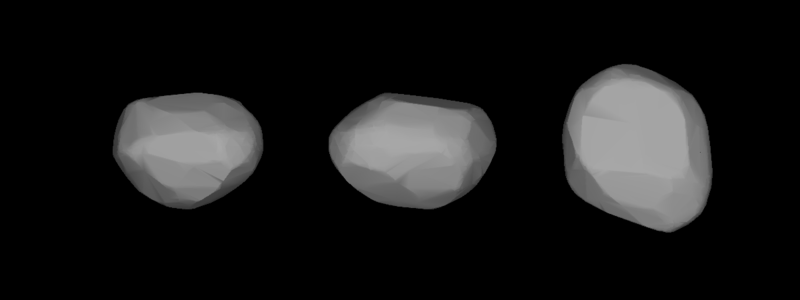
In the vast expanse of space, there exists a celestial object named asteroid Davida that has long been of interest to astronomers and planetary scientists. With a designation of 511 Davida, this asteroid offers valuable insights and holds within it a wealth of scientific knowledge waiting to be unraveled.
Join us as we delve into the intriguing world of asteroid Davida. We will explore its origins, characteristics, and significance in our understanding of the universe.
The Discovery of Asteroid Davida
Asteroid Davida, named after the pioneering American astronomer David Peck Todd, was discovered by Raymond Smith Dugan on May 30, 1903. It is located in the main asteroid belt, between the orbits of Mars and Jupiter. This celestial body is estimated to have a mean diameter of approximately 270 km. Additionally, the name “Davida” follows the early convention of giving asteroids feminine forms of names.
The Remarkable Characteristics of 511 Davida
Size and Shape
With its considerable size, asteroid Davida ranks as one of the largest objects in the asteroid belt. It is generally considered to be among the 10 to 15 largest asteroids. However, its exact ranking varies depending on updated measurements and which bodies are included in comparisons. Its shape, resembling an irregular ellipsoid, adds to its unique allure. This shape suggests it has not fully reached hydrostatic equilibrium—the rounded shape required for dwarf planet classification. Nevertheless, Davida may lie near the size threshold where objects begin to become spherical. The asteroid’s mass and composition make it a captivating subject of study. In particular, scientists aim to unlock the secrets of our solar system’s formation through studying it.
Composition
Asteroid Davida is classified as a C-type (carbonaceous) asteroid and is composed primarily of carbon-rich material and hydrated silicates. Spectral evidence indicates the presence of water-bearing minerals. Its surface is likely dark (low albedo) and primitive. This is consistent with carbonaceous chondrite-like material.
Rotation and Orbit
Asteroid Davida has a relatively fast rotation rate, taking 5.1297 hours to complete a full rotation. It orbits around the Sun, ranging between 3.759 AU at aphelion and 2.569 AU at perihelion. It has an orbital period of about 5.5 Earth years and a semi-major axis of roughly 3.164 AU.
Surface Features and Impact History
Although no spacecraft has visited Davida, observations from lightcurve analysis and stellar occultations suggest that its surface is heavily cratered. Some models indicate the presence of large impact basins formed by significant collisions early in its history. These features are similar to those observed on other large asteroids such as 4 Vesta. As a result, this highlights the role of impacts in shaping asteroid surfaces over billions of years.
Satellites
Unlike some large asteroids, such as 87 Sylvia, no moons or companion bodies have been confirmed orbiting Davida.
Significance in Scientific Research
Insights into Solar System Formation
Studying asteroids like 511 Davida contributes to our understanding of the formation and evolution of the solar system. By analyzing its composition, scientists can gain insights into the primordial materials that formed the early building blocks of planets. While Davida has likely experienced impacts and surface evolution, its composition still provides valuable clues about the early solar system’s building materials.
Extraction of Resources
The potential for hydrated minerals on asteroid Davida suggests possibilities for the future exploration and utilization of space resources. Water is a crucial resource for sustaining life and fuel production in space. However, due to its distance in the main asteroid belt, Davida is not considered a practical near-term mining target. Near-Earth asteroids are far more likely candidates, though large bodies like Davida may be relevant in long-term exploration scenarios.
Conclusion
Asteroid Davida, also known as 511 Davida, remains an important object of study in planetary science. With its immense size, composition, and potential scientific discoveries, this celestial body offers valuable insights into the origins and evolution of our solar system. From unraveling the mysteries of planetary formation to exploring space resource extraction, the study of asteroid Davida holds immense value for humanity’s quest to uncover the secrets of the universe.
Would you like to receive similar articles by email?

Paul Tomaszewski
Paul Tomaszewski is a science & tech writer as well as a programmer and entrepreneur. He is the founder and editor-in-chief of CosmoBC. He has a degree in computer science from John Abbott College, a bachelor's degree in technology from the Memorial University of Newfoundland, and completed some business and economics classes at Concordia University in Montreal. While in college he was the vice-president of the Astronomy Club. In his spare time he is an amateur astronomer and enjoys reading or watching science-fiction. You can follow him on LinkedIn and Twitter.


You May Also Like
How Did Saturn’s Moon Tethys Get Its Name
Use of Satellites in Wireless Communication
