Aries Constellation Guide
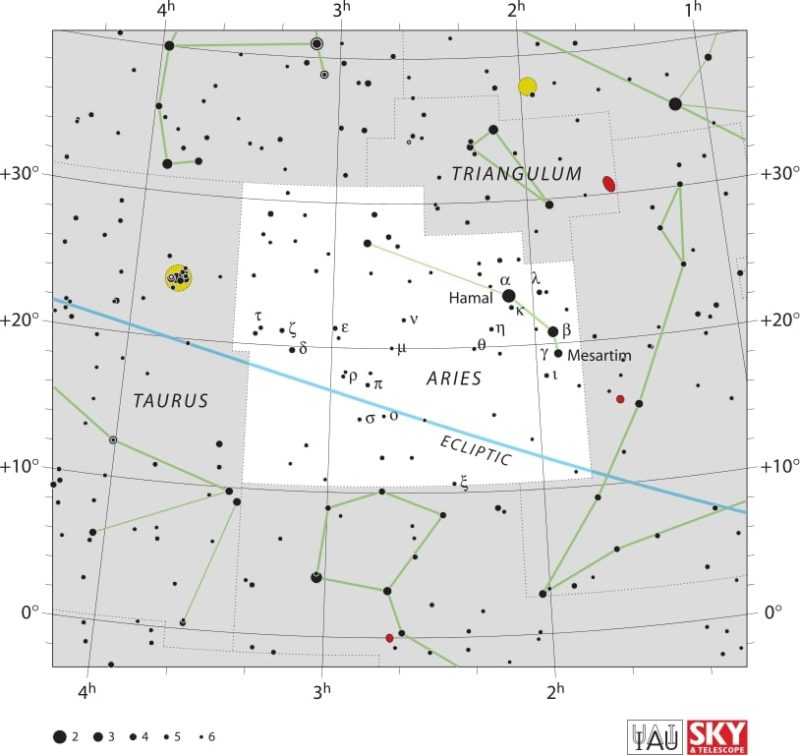
Aries is a small, faint northern constellation of the zodiac, ranked 39th in size among the 88 western IAU constellations, covering roughly 441 square degrees of sky and marked by a short crooked line of three modest stars led by the orange giant Hamal. That’s the whole thing. No sweeping star clouds, no Milky Way glitter, just a bent little arc that ancient sky-watchers decided was a golden ram. For a constellation with this much mythological importance, the visual payoff is honestly underwhelming, and I say that as someone who genuinely enjoys hunting down dim constellation targets.
But that dimness is exactly why it rewards patience. The best objects in Aries hide behind its plainness.
Where Does Aries Sit in the Night Sky?
Boundaries and size
The official borders were locked in by Belgian astronomer Eugène Delporte in 1930, when the IAU carved the whole sky into the 88 recognized constellations we still use, and Aries came out as an irregular four-sided polygon rather than anything ram-shaped. In the equatorial coordinate system, it spans roughly 1h 46m to 3h 29m in right ascension and sits between about 10 and 31 degrees north declination. Not big. Not tiny either.
Neighboring constellations
Run your eye around the edges and you’ll find Perseus and Triangulum stacked to the north, Taurus and Cetus crowding the eastern and southern approaches, and Pisces sprawling to the west. The regional border alignment with Triangulum matters more than it sounds, because Triangulum’s tight little wedge is often easier to spot first and works as a stepping stone. Cetus, being enormous and equally dim, is the one that confuses beginners.
Signature triangle shape
Forget the ram. What you’re actually looking for is a shallow, slightly hooked line made by Hamal, Sheratan, and the fainter Mesarthim, with 41 Arietis hanging off to the northeast. Once you’ve seen it, you can’t unsee it. It looks like a bent nail.
When Is the Best Time to See Aries?
Peak months
October through January is the sweet spot, with culmination near local midnight in early November. By spring the constellation Aries is buried in the sun’s glare, which is a nice irony given how much of its mythological background revolves around the reborn sun and the start of the astrological year.
Hemisphere visibility
Northern hemisphere observers get the better deal here, with the ram Aries climbing high overhead across most mid-latitudes. Southern hemisphere viewers can still catch it, though it stays low on the northern horizon and loses stars to atmospheric extinction. Below about 58 degrees south, forget it.
Sky conditions and equipment
- Bortle 4 or darker for anything past the three main stars.
- 7×50 or 10×50 binoculars to pull Mesarthim’s field into view and confirm the star pattern.
- A 6-inch or larger telescope if you actually want the galaxies to look like galaxies rather than smudges.
- Moonless nights, because a gibbous moon anywhere nearby erases the fainter members entirely.
Brightest Stars in Aries Constellation
Hamal
Alpha Arietis, an orange giant at visual magnitude 2.02, sitting about 66 light-years out. Its name comes from the Arabic for “head of the ram.” It also hosts a confirmed planetary companion, which puts it among the eleven exoplanet-hosting systems catalogued inside these borders.
Sheratan and Mesarthim
Beta Arietis glows at magnitude 2.65 and is a spectroscopic binary you’ll never split visually. Gamma Arietis, the one everyone calls Mesarthim, is where things get fun.
41 Arietis and Botein
41 Arietis (Bharani) and Delta Arietis (Botein) fill out the rest of the useful naked-eye set. Botein sits east of the main line and is easy to overlook.
| Star | Bayer designation | Magnitude | Type |
|---|---|---|---|
| Hamal | Alpha Arietis | 2.02 | Orange giant, K1 |
| Sheratan | Beta Arietis | 2.65 | Spectroscopic binary |
| Bharani | 41 Arietis | 3.63 | B-type main sequence |
| Mesarthim | Gamma Arietis | 3.86 combined | Double star |
| Botein | Delta Arietis | 4.35 | Orange giant |
Double and Variable Stars Worth Tracking
Mesarthim pair
This is the reason to point a telescope at Aries. Two nearly identical white stars separated by about 7.6 arcseconds, discovered by Robert Hooke in 1664 while he was chasing a comet. Any small scope splits it cleanly at 50x. Clean, symmetrical, weirdly satisfying.
Lambda Arietis
A wider optical pairing, roughly 37 arcseconds apart, and comfortable in binoculars under decent skies. Contrast between the components makes it a nice warm-up before Mesarthim.
SX Arietis stars
The prototype of a whole class of helium-strong magnetic variable stars, showing small brightness swings tied to rotation. You won’t see the variation by eye. It’s the kind of target you appreciate intellectually while your photometry software does the work.
Deep Sky Objects Beyond the Stars
NGC 772, the Fiddlehead Galaxy, is the headline act, an asymmetric spiral about 130 million light-years away whose single dominant arm got stretched by a gravitational encounter with its companion NGC 770. Photographers love it. Visually it’s a faint oval that needs aperture and averted vision.
NGC 697 is a barred spiral that shows up as an elongated smudge, while NGC 821 is a lenticular galaxy notable for its central black hole studies. Nearby NGC 691 has served as a distance yardstick through its supernovae, one of those quiet galaxies doing real cosmological work while nobody photographs it. And NGC 976 carries its own explosive history, having hosted a type Ia supernova despite looking perfectly tranquil.
Segre 1 and a scattering of dim galaxy groups round out the region for anyone with a large scope and unreasonable patience.
How Did Ancient Cultures Interpret Aries?
Babylonian and Egyptian roots
The Babylonians called it the Agrarian Worker before it became a ram. Ancient Egypt associated the ram with the god Amun.
Greek mythology
Greek mythology attached the golden ram that carried Phrixus from Boeotia to Colchis, the same fleece Jason later chased. Zeus placed it among the stars. Ptolemy catalogued it in the Almagest, and it stayed put.
Peruvian and Marshallese views
Indigenous Peruvian astronomy read these stars as the “Market Moon,” a seasonal marker rather than a beast. Marshall Islanders folded part of Aries into a porpoise figure. Same photons, wildly different stories.
Why the Zodiac Sign No Longer Matches the Constellation
Precession moved the vernal equinox out of Aries roughly two thousand years ago. The “first point of Aries” survives as a coordinate anchor where the celestial equator crosses the ecliptic, and that intersection now sits in Pisces. Astrology kept the label. Astronomy kept the geometry.
Anyone who insists the zodiac sign Aries maps onto real sky positions is arguing with orbital mechanics and losing.
Observation Plan for a Single Night
- Find Hamal about 20 degrees west of the Pleiades.
- Trace down to Sheratan, then Mesarthim.
- Split Mesarthim at 50x, then push to 120x.
- Sweep southeast for NGC 772 with low power and averted vision.
- Finish on Lambda Arietis in binoculars.
FAQ
Is Aries visible without a telescope?
Yes, three or four stars are naked-eye under suburban skies.
Are there meteor showers?
The Daytime May Arietids radiate from here, though meteor observations require radio methods since they peak in daylight.
Does Aries contain the Milky Way?
No. It sits well off the galactic plane, which is why galaxies dominate.
Conclusion
Aries asks more of you than it gives back at first glance, and that’s fine. Learn the bent nail, split Mesarthim, then spend a while coaxing the Fiddlehead out of the dark.
Would you like to receive similar articles by email?

Paul Tomaszewski
Paul Tomaszewski is a science & tech writer as well as a programmer and entrepreneur. He is the founder and editor-in-chief of CosmoBC. He has a degree in computer science from John Abbott College, a bachelor's degree in technology from the Memorial University of Newfoundland, and completed some business and economics classes at Concordia University in Montreal. While in college he was the vice-president of the Astronomy Club. In his spare time he is an amateur astronomer and enjoys reading or watching science-fiction. You can follow him on LinkedIn and Twitter.