Guide to Period Architectural Styles in Australia
Since the beginning of British colonization in 1788, Australia has gone on to amass a rich cache of colonial architecture. Many of its metropolises still bear the imprint of its forebears. Going out from the city centre, you will realise that the suburbs progressively showcase different periods in Australia’s history. This is why it’s not unusual to find a Federation-style home near the beach or a Gothic Revival abode further inland. The following are some of the most common heritage architectural styles you will encounter in Australia.
Colonial
As the Britons were just beginning to settle Australia, they took to building a range of dwellings influenced by British Georgian traditions as well as local materials and climate. More formal homes were often symmetrical with central hallways, while simpler vernacular cottages varied widely. A common feature in these early domiciles was the double-hung window, often amounting to a dozen panes. Also, the front door may have had a fanlight window above.
Roofs were made of timber shingles, slate, or imported corrugated iron sheeting. Materials differed by region, with sandstone common in Sydney and timber more widely used elsewhere. Verandas became increasingly important as settlers adapted to Australia’s climate.
Victorian
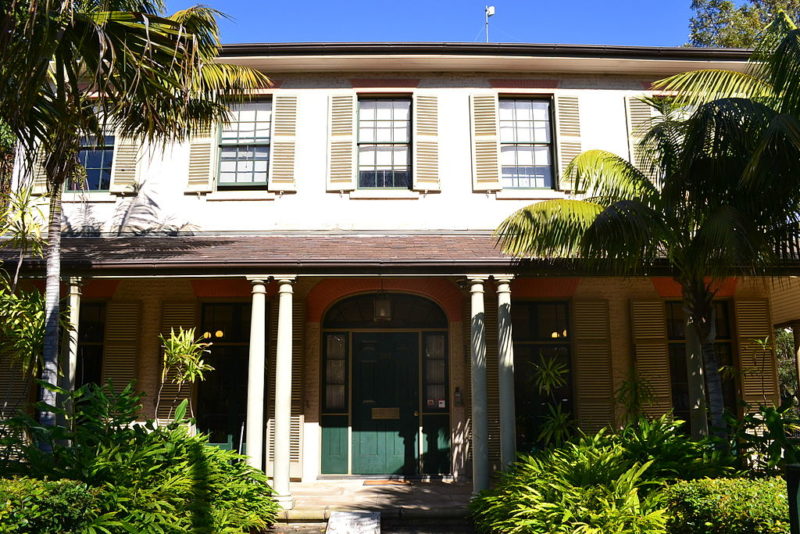
During the Victorian era, verandas remained a defining feature of Australian homes, often expanding in size due to climate needs. Roofs were now steeply pitched and parapets concealed their edges. If the house had a second storey, it may feature French doors with an iron balustrade. Façade walls may be rendered in cement. Windows may still be double-hung but some were now side-opening casements.
By the 1860s, Victorian houses began to show more ornamentation. Houses would sport elaborate filigrees, which were screens of wrought or cast iron. Decorative, multicoloured brickwork was considered the height of style. Stucco was used more on the façade, and lace balustrades helped direct attention to it. Ornamental brackets could be found under eaves. Verandas were more ubiquitous than ever, with posts made of timber. Meanwhile, timber cottages sported square-edged weatherboards made to look like stonework. Victorian houses were especially remarkable in Queensland, where they were built on stilts.
As the Victorian era drew to a close, Australians favoured timber fretwork increasingly. Influences from Italy and France also bore upon the houses of the era, so it was not unusual to see houses bedizened in tall parapets and arches. Australian architects also pined for all things Old English, building Tudor-style houses.
All in all, Victorian architecture in Australia included styles such as Italianate, Gothic Revival, Second Empire, and Classical Revival. Earlier styles like Georgian and Regency predated the Victorian period but influenced its development.
Federation
Following the Federation of Australia in 1901, their architectural sentiments followed suit. Suddenly there were nationalistic motifs galore, such as kangaroos and kookaburras, adorning the leadlight windows and floor tilings of houses. The verandas had decorative timber handrails and turned timber pillars. There was also more than one gable on the roof, which was often made of terracotta tiles.
This style, now broadly referred to as “Federation architecture,” was most common between the 1890s and the mid-1910s (sometimes extending into the early 1920s). It also drew heavily from British Edwardian influences while adapting to the Australian climate with ventilation-focused layouts and expansive verandas.
Queen Anne
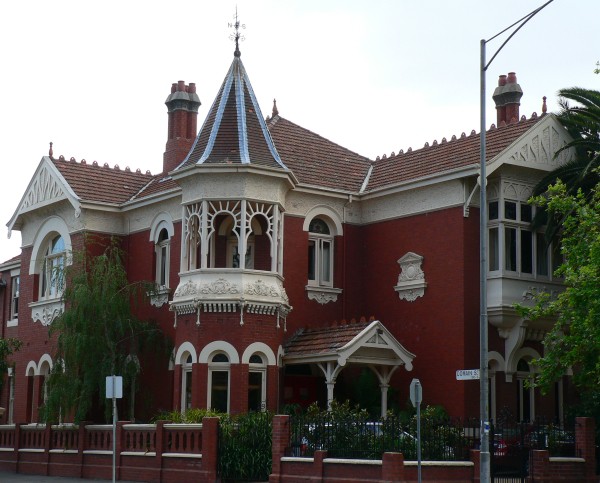
Named after the 18th century sovereign, Queen Anne style is known for its complex, asymmetrical rooflines and prominent gables. Decorative elements typically included timber fretwork, patterned brickwork, and tall chimneys. It was not unusual to spot gargoyles and dragons on the roof, which became almost pyramid-like in pitch.
Turrets and towers often jutted from the house. Stained glass and decorative detailing were common features. The Queen Anne style of houses in Australia should not be confused with that in England, however.
Arts & Crafts
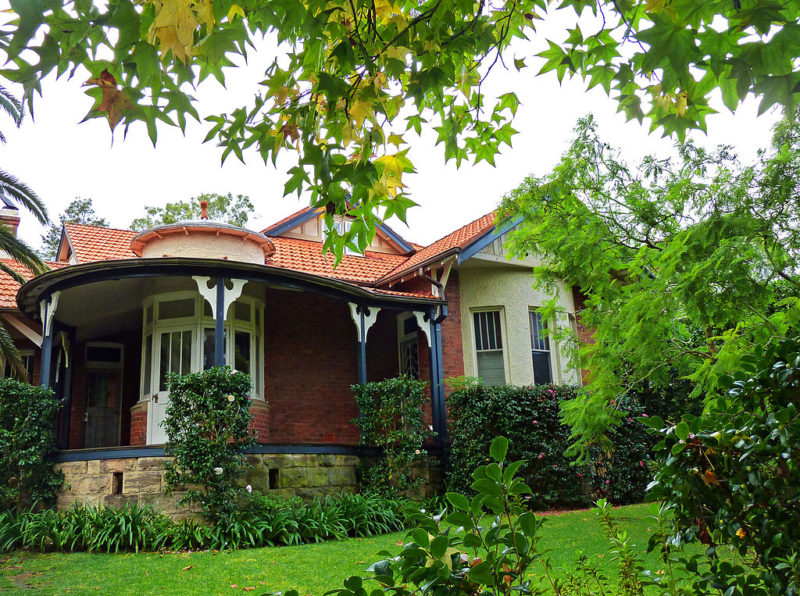
As the name suggests, this housing style emerged out of a need to revert to simpler, more rustic times. The push was toward the artisanal and the handmade. Consequently, rough-cast walls characterise this architectural style, as did faceted bay windows, tall chimneys, and steeply pitched roofs.
The movement emphasized craftsmanship, natural materials, and harmony with the surrounding landscape, influencing many later suburban house designs.
Bungalow
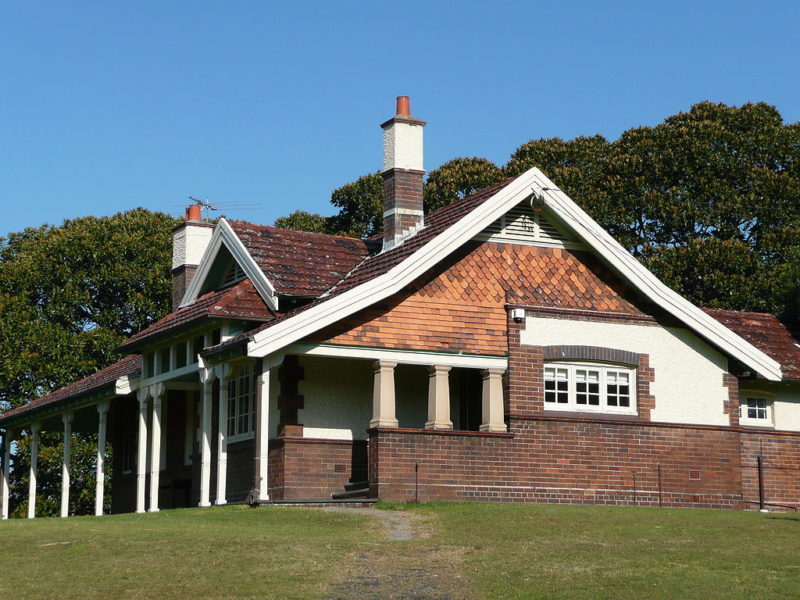
Compelled by wartime austerity, architects took inspiration from bungalow housing in California, which was a similar clime to Australia. These California-style bungalows were single-storey, with a low-pitched roof fronted by two or three asymmetrical gables. The ceilings were no longer as ornamented as in previous decades or were completely devoid of patterns. Large pillars supported the verandas. Beams may be partially exposed. Square, small casement or double-hung windows face the curb.
Inter-war
From bungalows, the houses in Australia progressed to an assortment of styles, ranging from Ashgrovian and Spanish Mission to Bauhaus-influenced Modernism, in the years between the world wars. This period saw the rise of Art Deco and Streamline Moderne (also known as Style Moderne), characterised by geometric forms and streamlined appearances.
In any case, the houses tend to have basic floor plans. Other popular suburban styles included Tudor Revival, which echoed medieval English forms and became widespread in the 1920s and 30s. Spanish Mission styles featured stucco walls and tiled roofs, while Old English or Tudor Revival homes used steep roofs and decorative half-timbering.
Post-war
Following World War II, housing in Australia shifted toward practicality and affordability. Post-war homes (1940s–1960s) were typically simple in design, often built quickly to accommodate population growth and returning servicemen.
By the 1950s to 1970s, Mid-century modern architecture emerged, emphasizing open-plan living, large windows, and a stronger connection between indoor and outdoor spaces.
Contemporary
From the late 20th century to the present, Australian architecture has embraced modern and sustainable design principles. Contemporary homes often feature open layouts, energy-efficient materials, and extensive use of glass, steel, and concrete. Designs frequently prioritize natural light and integration with the surrounding environment.
Indigenous Architecture
Long before European settlement, Indigenous Australians developed diverse architectural traditions suited to local environments, including structures such as gunyahs. These approaches emphasized sustainability and environmental harmony, influencing aspects of modern Australian design thinking.
Check your heritage
If any of these sounds familiar, you may have a period home in your hands. Before renovating your house, it is imperative to check first if it was built in another era. Otherwise, you could face consequences from a heritage overlay, a planning scheme put in place by local councils to protect period structures from getting demolished or dramatically altered. Heritage rules vary by state, and most councils provide online heritage overlay maps and resources. For specific advice, contact your local council or a qualified heritage adviser to ensure that important architectural styles in Australia are preserved.
Would you like to receive similar articles by email?

Paul Tomaszewski
Paul Tomaszewski is a science & tech writer as well as a programmer and entrepreneur. He is the founder and editor-in-chief of CosmoBC. He has a degree in computer science from John Abbott College, a bachelor's degree in technology from the Memorial University of Newfoundland, and completed some business and economics classes at Concordia University in Montreal. While in college he was the vice-president of the Astronomy Club. In his spare time he is an amateur astronomer and enjoys reading or watching science-fiction. You can follow him on LinkedIn and Twitter.


You May Also Like
5 Types of Excavator Attachments Used in the Construction Industry

The Importance of Road Construction in Society