Ara Constellation Guide
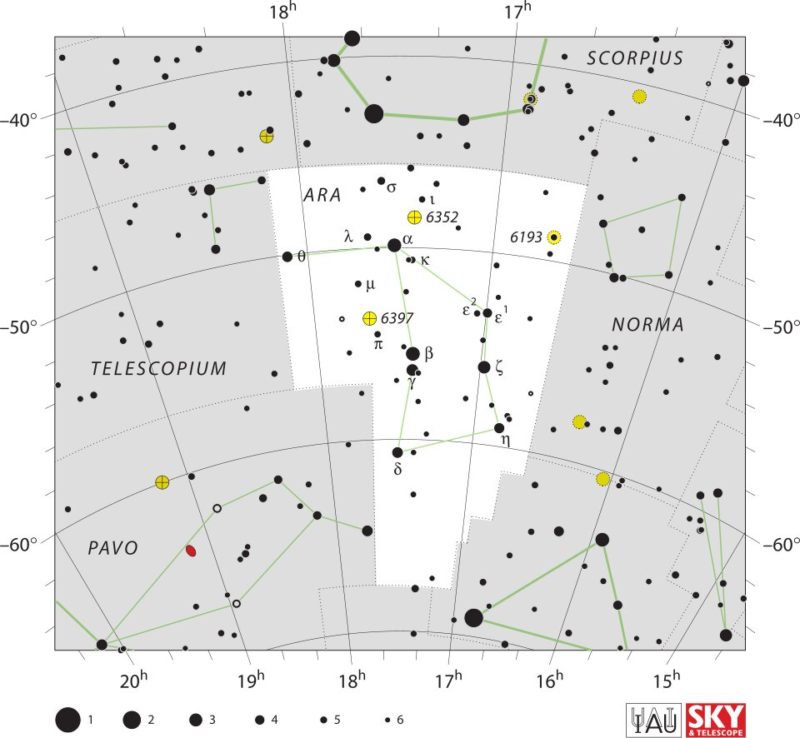
Ara is a small southern constellation representing an altar, ranking 63rd in size among the 88 modern constellations at 237.06 square degrees, which works out to roughly 0.575 percent of the whole sky. It sits just south of Scorpius, tucked between Norma and Triangulum Australe, and it carries the Latin name for altar. Faint, yes. But it lies across a genuinely rich section of the Milky Way, which means the constellation punches well above its magnitude class once you point optics at it.
This guide walks through the naming history, the mythological story, the brightest stars, the deep sky objects, and the practical business of actually finding it.
What Is Ara and What Does Its Name Mean?
Latin meaning
The name Ara is simply Latin for altar, and the Romans also called it Turibulum, meaning censer or incense burner. Older Arabic nomenclature gave it Al Mijmarah, while Babylonian records point to something along the lines of Tul-Ku, a sacred mound or holy altar. Classical writers were not shy about variants either, with Thymele, Sacrarium, and even Vesta associations floating around in the older catalogs.
Size and rank
Its 237.06 square degrees make it modest, and the size ranking of 63rd among 88 puts it in the lower third. Compare that to neighboring Centaurus, which is enormous, and you get a sense of scale. Small does not mean empty. The southward Milky Way runs straight through the constellation, so star density is high even where the named stars are dim.
Shape and outline
Most observers read Ara as a rough letter H, four corner stars with a crossbar. This H asterism is the most reliable way to lock the pattern in memory. Older constellation depictions drew flames rising north from the altar toward Scorpius, which is charming but harder to trace with your eyes.
Where Ara Constellation Sits in the Southern Sky
Coordinates and boundaries
The official boundaries run from right ascension 16h 36.1m to 18h 10.4m and declination minus 45.49 degrees to minus 67.69 degrees, a polygon Eugène Delporte drew up for the IAU back in 1930. Astrometric databases place it in southern quadrant SQ3 for coordinate precision work.
Bordering constellations
Seven neighbors hem it in, and the arrangement matters for star-hopping:
- Corona Australis to the north
- Scorpius to the north
- Norma to the northwest, west toward the galactic plane
- Triangulum Australe to the southwest
- Apus directly south
- Pavo to the southeast
- Telescopium to the east
Visibility by latitude
Anyone south of latitude 22 degrees north can see the full constellation. Southern Hemisphere observers get it high overhead. From 30 degrees north, you are scraping the horizon murk. From most of Europe, forget it.
Why the Greeks Placed an Altar Among the Stars
Zeus and the Titans
The mythological story has Zeus and his fellow gods swearing an alliance on a holy altar before the war against the Titans, a version the Britannica entry on the constellation preserves alongside its stellar data. Ian Ridpath’s careful reading of the Cyclopes forging Zeus’s thunderbolts adds the detail that the altar itself was placed in the stars afterward as a monument to that oath. Dionysus turns up in some later retellings.
Ptolemy’s catalog
Ptolemy cataloged Ara in the Almagest during the second century. Aratus mentioned it earlier still, in verse, which is how a lot of this material survived.
Sailors’ storm sign
Here is the part I find genuinely useful. Classical writers treated the visibility of Ara low in the sky as a warning of strong southern gales, and the older star-name archives on Thymele and its variants keep that maritime tradition intact. Practical astronomy, centuries before barometers.
Brightest Stars in Ara
| Star | Magnitude | Type | Note |
|---|---|---|---|
| Beta Arae | 2.83 | K3 supergiant | Brightest overall |
| Alpha Arae | 2.84 | B2 main sequence | 5,800 times solar luminosity |
| Gamma Arae | 3.31 | B1 supergiant | Blue supergiant |
| Zeta Arae | 3.12 | K3 giant | Large radius |
| Mu Arae | 5.15 | Sunlike star | Named Cervantes |
Beta and Alpha Arae
Beta edges out Alpha for overall brightness by a hair, which is unusual and mildly annoying for anyone who assumes Bayer letters track magnitude. Alpha Arae radiates about 5,800 times the luminosity of the Sun despite the smaller apparent magnitude difference.
Gamma and Zeta Arae
Gamma is a blue supergiant of spectral type B1, hot and distant. Zeta is a cooler K-type giant with a swollen radius. Both sit comfortably in binocular range, and neither will win a beauty contest against Scorpius next door.
Mu Arae and exoplanets
Mu Arae, officially named Cervantes by the IAU, is a sunlike star hosting multiple planets, and the constellation is a quietly productive exoplanet neighborhood with seven known systems. Inquill, orbiting HD 156411, is another approved proper name from the same batch.
Deep Sky Objects Worth Tracking Down
NGC 6188 and NGC 6193
The emission nebula NGC 6188, popularly the Fighting Dragons of Ara, wraps around the open cluster NGC 6193. The cluster’s hot young stars carve and illuminate the gas. Visually the cluster is easy in small scopes; the nebula needs dark skies or filters.
Westerlund 1
Westerlund 1 is a super star cluster, and its member Westerlund 1-26 is a red hypergiant with a radius so large it would swallow the orbit of Jupiter if dropped into our solar system. Extreme objects, mostly obscured by dust.
Globular clusters NGC 6397 and 6352
NGC 6397 is one of the closest globular clusters to Earth and a genuinely bright target, while NGC 6352 is fainter and looser. Both appear on the IAU educational sky chart for the constellation.
How to Find Ara on a Clear Night
Best months
June and July, around local midnight, when the constellation crosses highest. That is the same time Scorpius dominates the view, which helps.
Star-hopping route
Start at the sting of Scorpius, then push south past the tail. The H shape sits below. Norma to the west of it is fainter still and easy to overshoot.
Naked eye versus optics
Under dark sky the dozen stars forming the outline show up fine. Binoculars turn the whole field into a wash of Milky Way grain. A telescope is where NGC 6397 becomes a resolved swarm rather than a fuzzy smudge.
FAQ
Is Ara a zodiac constellation?
No. It sits well south of the ecliptic.
Which star is brightest?
Beta Arae at magnitude 2.83.
Can I see it from Europe?
No. Latitude 22 degrees north is the practical cutoff.
Conclusion
Small constellation, deep rewards. Ara asks for southward latitude and a bit of persistence, then hands over globular clusters, hypergiants, and a nebula that genuinely looks like two dragons mid-fight.
Would you like to receive similar articles by email?

Paul Tomaszewski
Paul Tomaszewski is a science & tech writer as well as a programmer and entrepreneur. He is the founder and editor-in-chief of CosmoBC. He has a degree in computer science from John Abbott College, a bachelor's degree in technology from the Memorial University of Newfoundland, and completed some business and economics classes at Concordia University in Montreal. While in college he was the vice-president of the Astronomy Club. In his spare time he is an amateur astronomer and enjoys reading or watching science-fiction. You can follow him on LinkedIn and Twitter.


You May Also Like
Auriga Constellation Guide
What Is the Extragalactic Background Light and Why Does It Matter?