Aquila Constellation Guide
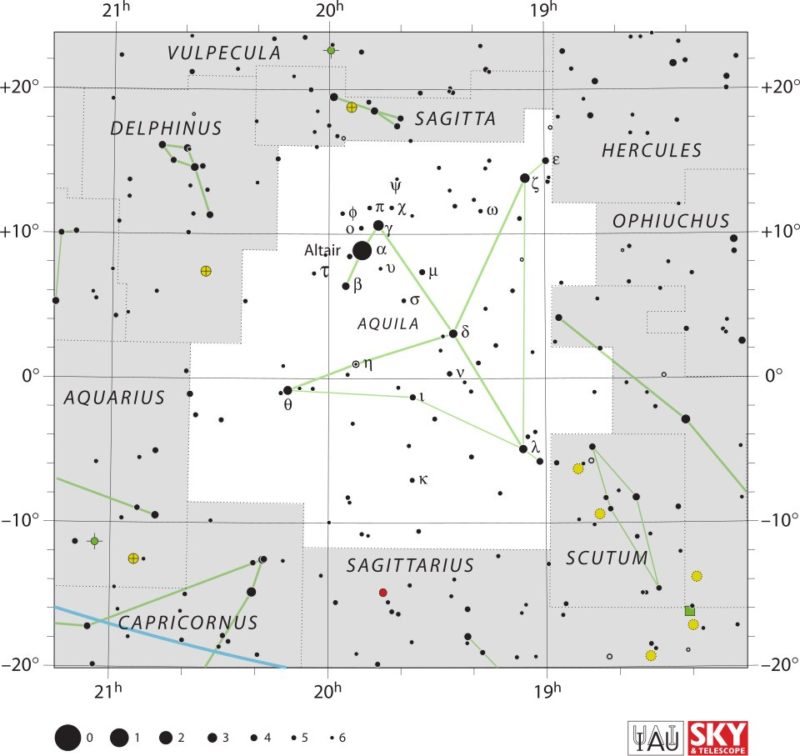
Aquila is a mid-sized equatorial constellation straddling the celestial equator, dominated by Altair, the twelfth brightest star in the night sky, and best seen from July through October across most of the inhabited world. The name is Latin for eagle. That’s the short version, and it’s accurate, but it hides how much is packed into this patch of the summer Milky Way. Ancient Babylonian observers looked at the same stars and saw something entirely different. Modern instruments have found a dormant black hole hiding there.
What Makes Aquila a Distinct Constellation?
Name and meaning
The Romans called it Aquila, though they also used Vultur volans, the flying vulture, which tells you the identification wasn’t as fixed as textbooks imply. Different Mediterranean cultures argued about what kind of bird it was. The Greeks settled on the eagle that carried Zeus’s thunderbolts. Arab and Persian names for the main stars preserve the flying-bird imagery too, which is why Altair comes from al-nasr al-ta’ir, the flying eagle.
Size and boundaries
Aquila covers roughly 652 square degrees, ranking 22nd of the 88 western IAU constellations. The official boundaries were fixed by the International Astronomical Union in the 1920s, chopping up what had been fuzzy overlapping territory for centuries. Its center sits near right ascension 19h 40m and declination +3 degrees, which is why it works for observers on both sides of the equator.
Neighboring constellations
Sagitta and Hercules sit to the north, Aquarius and Capricornus to the south, with Ophiuchus westward and Delphinus eastward. Cygnus, the swan, floats up and to the left. Two birds in the same neighborhood, which confused more than one ancient astronomer. Scutum, once part of Aquila before becoming its own designation, borders the southwest, and the official IAU boundary diagram lays this out cleanly if you want to see how tight the packing is.
Where to Find the Eagle in the Night Sky
Best months
August and September are the sweet spot. Aquila culminates around local midnight in early August, meaning it’s directly overhead for mid-northern latitudes. By late October it’s sliding into the western twilight.
Summer Triangle method
Find Vega. It’s blindingly obvious overhead in summer. Then Deneb. Then drop south to the third corner, and you’ve found Altair. That third point is Aquila’s head, and the Summer Triangle asterism serves as a reliable pointer that works even from moderately light-polluted suburbs.
Hemisphere visibility
Visible between +90 and -75 degrees latitude, which covers almost everyone. Southern hemisphere observers get it upside down, wings pointing the wrong way, but they get a better view of the Milky Way behind it.
Brightest Stars Inside Aquila
| Star | Designation | Magnitude | Distance (light-years) |
|---|---|---|---|
| Altair | Alpha Aquilae | 0.76 | 16.7 |
| Tarazed | Gamma Aquilae | 2.72 | 395 |
| Alshain | Beta Aquilae | 3.71 | 44.7 |
| Eta Aquilae | Eta Aql | 3.5–4.4 (variable) | 1,200 |
Altair
Altair spins so fast it’s visibly flattened, completing a rotation in under nine hours. Our sun takes 25 days. That rotational speed makes it oblate, wider at the equator than pole to pole, and it was the first star other than the sun to have its surface imaged directly.
Tarazed and Alshain
Tarazed is an orange giant star, far more luminous than Altair but much farther away. Alshain is the fainter flanker on the other side. Together the three form a short straight line, and that line is the single most recognizable feature of the eagle constellation.
Eta Aquilae
A classical Cepheid variable, swinging between magnitudes 3.5 and 4.4 over about seven days. You can track the change by eye against nearby comparison stars, which makes it a genuinely satisfying naked-eye project.
Deep Sky Objects Worth a Telescope
The constellation sits along a dense stretch of the Milky Way, so the field is crowded.
- NGC 6781 – A planetary nebula, often compared to the Owl Nebula, needing at least a 6-inch aperture.
- NGC 6709 – A loose open cluster, roughly 40 stars, easy in binoculars.
- Barnard’s E (B142/143) – A dark nebula silhouetted against the star fields near Tarazed.
- Gaia BH3 – The 33-solar-mass sleeping black hole Gaia scientists stumbled onto in 2024, the most massive stellar black hole found in our galaxy.
Hubble’s imaging of the colorful shroud around a stellar jet in the G35 region sits about 7,200 light-years out, and infrared surveys have counted more than 700 protostars buried in a dark cloud there. More recently, the detection of PeV particles from a pulsar in this constellation confirmed it as a cosmic-ray factory.
Mythology Behind the Eagle
Mesopotamian roots
Babylonian myth is stranger and older. The star pattern was linked to a dead man, a psychopomp bird ferrying souls to the starry heaven, and Babylonian astrologers watched it for divination. Egyptian tradition folded the same stars into the Horus and Set conflict, casting the bird as a falcon.
Greek and Roman accounts
Zeus’s eagle. It carried his thunderbolts and, in the version Hyginus preserved, abducted the beautiful youth Ganymede to Mount Olympus to serve as cupbearer. Aratus mentioned it. Ptolemy catalogued it in the Almagest. Roman mythology kept the bird as the emblem of Jupiter, and the legionary standard borrowed the symbol wholesale.
East Asian and Polynesian views
Altair is the Cowherd in the Chinese Qixi legend, separated from the Weaver Girl by the Milky Way, meeting once a year on a bridge of magpies. Polynesian navigators used the same star for wayfinding across open ocean.
How Astronomers Have Tracked Aquila Through History
Ptolemy’s catalogue included Antinous, a now-obsolete constellation carved out of Aquila’s southern stars to honor Hadrian’s lover. It survived on charts until the nineteenth century, then quietly vanished.
Observe Aquila With the Right Gear and Timing
Binoculars, 10×50, do most of the work here. For the planetary nebulae you’ll want aperture, and guidance on deep-sky instruments is worth reading before spending money. Wait until Aquila is at least 30 degrees above the horizon.
Why Aquila Rewards Beginners More Than Bigger Constellations
Because the geometry is honest. Three stars in a row, one of them brilliant. No squinting at magnitude 5 filler stars trying to imagine a water carrier. You find Altair once and you never lose it again.
FAQ
Is Aquila a zodiac constellation?
No. It borders Aquarius and Capricornus but the ecliptic doesn’t pass through it.
Can I see Aquila from the southern hemisphere?
Yes, down to about -75 degrees latitude, appearing inverted.
What is Aquila’s brightest star?
Altair, magnitude 0.76, one of the nearest bright stars at 16.7 light-years.
Conclusion
Aquila is a small commitment with an outsized payoff, and I keep coming back to it for the same reason people keep choosing the ship that simply feels right over the one that technically wins on paper. Learn the three stars. The rest unfolds from there.
Would you like to receive similar articles by email?

Paul Tomaszewski
Paul Tomaszewski is a science & tech writer as well as a programmer and entrepreneur. He is the founder and editor-in-chief of CosmoBC. He has a degree in computer science from John Abbott College, a bachelor's degree in technology from the Memorial University of Newfoundland, and completed some business and economics classes at Concordia University in Montreal. While in college he was the vice-president of the Astronomy Club. In his spare time he is an amateur astronomer and enjoys reading or watching science-fiction. You can follow him on LinkedIn and Twitter.


You May Also Like

Why Scientists Need Clear Imaging to Solve Medical Mysteries
How Did Dwarf Planet Orcus Get Its Name