Aquarius Constellation Guide
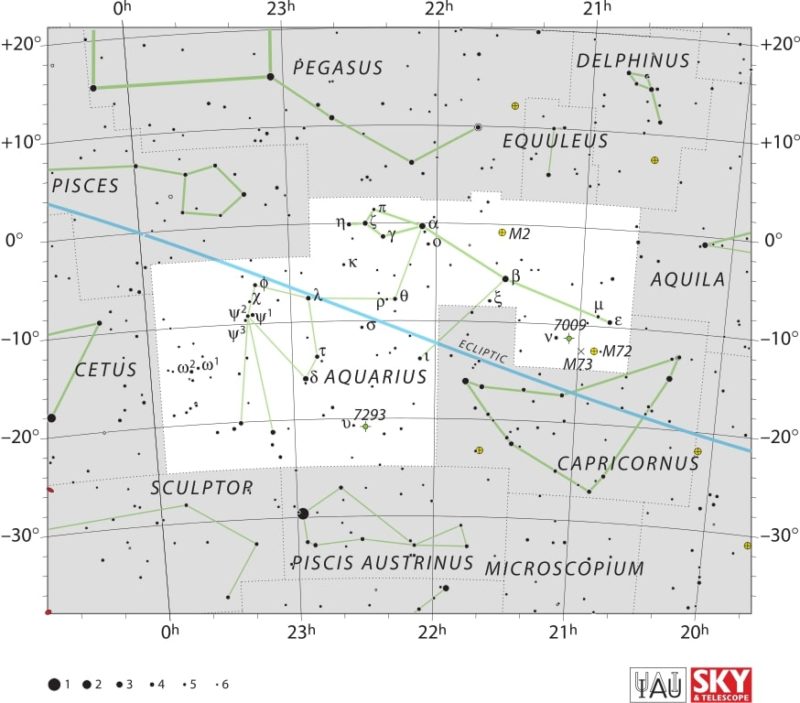
Aquarius sits in the southern sky as the tenth largest constellation, covering roughly 980 square degrees, and it belongs to that soggy stretch of sky older astronomers called “the Sea.” It’s a zodiac constellation, one of the twelve, and its stars are faint enough that most beginners walk right past it without noticing. That’s the honest starting point.
No blazing beacons here, no obvious geometry like Orion’s belt. Aquarius asks for patience, a dark site, and a willingness to connect dots that barely register at the edge of vision.
What Is Aquarius and Where Does It Sit in the Sky?
Size and rank
Big, but not bright. The International Astronomical Union’s official constellation boundaries place Aquarius among the sprawling giants of the sky, tenth by area, and yet the entire constellation offers nothing brighter than magnitude 2.9. That mismatch between size and luminosity is exactly why it frustrates people.
Boundaries and neighbors
Pisces sits to the north and east. Capricornus to the west. Aquila and Delphinus hang above, Piscis Austrinus below, and Cetus curls off toward the east. Sculptor and Equuleus fill in the remaining edges. The whole neighborhood belongs to that watery region, which includes the celestial river Eridanus a bit farther off, plus Pisces the fish and Capricornus the sea goat. Ancient sky patterns clustered water imagery together, which was less coincidence than deliberate design.
Celestial coordinates
Aquarius straddles right ascension 20h 38m to 23h 56m, declination +3° to -25°. Straddling the celestial equator like that gives it a rare advantage. Nearly everyone on Earth gets a look.
When Can You See the Water Bearer?
Northern hemisphere timing
October is your month. Aquarius climbs to its highest point around local midnight in early October, and from mid-northern latitudes it hovers moderately low in the south. September through November covers the useful window.
Southern hemisphere timing
Better view, frankly. Observers below the equator see Aquarius pass nearly overhead during spring evenings, which means less atmospheric muck between you and those faint stars. Southern latitudes get the constellation for a longer stretch each night, too.
Sky conditions needed
You need genuine darkness. Bortle 4 or better, no Moon, and eyes that have adjusted for at least twenty minutes. Suburban skies will hand you two or three stars and nothing else.
How Do You Find Aquarius Without a Star Chart?
Start from Fomalhaut
Fomalhaut, in Piscis Austrinus, is the one bright star in that entire region of sky. Find it low in the south, then sweep upward. Aquarius sits directly above.
Trace the Water Jar
Four faint stars form a small Y-shaped asterism near the constellation’s heart. That’s the Water Jar, and Zeta Aquarii marks its center.
Follow the water stream
A ragged chain of stars trails southward from the jar toward Fomalhaut, representing poured water. Don’t chase a rigid outline here. The shape is gesture, not silhouette, and I’ve always found it easier to let the surrounding stars pull your eye along the flow than to memorize a diagram.
Main Stars of the Aquarius Constellation
Sadalsuud and Sadalmelik
Beta Aquarii carries the name Sadalsuud, “luck of lucks,” and it’s the brightest star in Aquarius at magnitude 2.9. Alpha Aquarii, or Sadalmelik, sits second at 2.95. Both are rare yellow supergiants, and the detailed spectral profile of Sadalmelik shows a G-type star some 520 light-years out, burning through its fuel at a pace that dwarfs the Sun.
| Star | Magnitude | Distance (light-years) | Type |
|---|---|---|---|
| Beta Aquarii (Sadalsuud) | 2.90 | ~540 | G0 Ib supergiant |
| Alpha Aquarii (Sadalmelik) | 2.95 | ~520 | G2 Ib supergiant |
| Delta Aquarii (Skat) | 3.27 | ~113 | A3 V |
| Zeta Aquarii | 3.65 | ~92 | Binary, F3 III |
Skat and Zeta Aquarii
Delta Aquarii goes by Skat, and it anchors the southern portion of the figure. Zeta is the more rewarding target for anyone with a small telescope. The binary components of Zeta Aquarii orbit each other over roughly 540 years, splitting cleanly at moderate magnification, and the pair sits right at the center of the Water Jar.
TRAPPIST-1 and R Aquarii
Here’s where the constellation stops being a faint curiosity. TRAPPIST-1, an ultracool dwarf star hiding within these boundaries, hosts seven rocky planets, three of them in the habitable zone. NASA’s announcement of the largest batch of Earth-size habitable-zone planets around a single star put this ordinary patch of sky on every exoplanet researcher’s map. R Aquarii, meanwhile, is a symbiotic binary throwing off jets that Chandra’s X-ray imaging of Aquarius captured in striking detail.
Deep-Sky Objects Worth Tracking Down
There are 257 NGC and IC objects catalogued inside the constellation, so you’ll never run out. But four deserve priority:
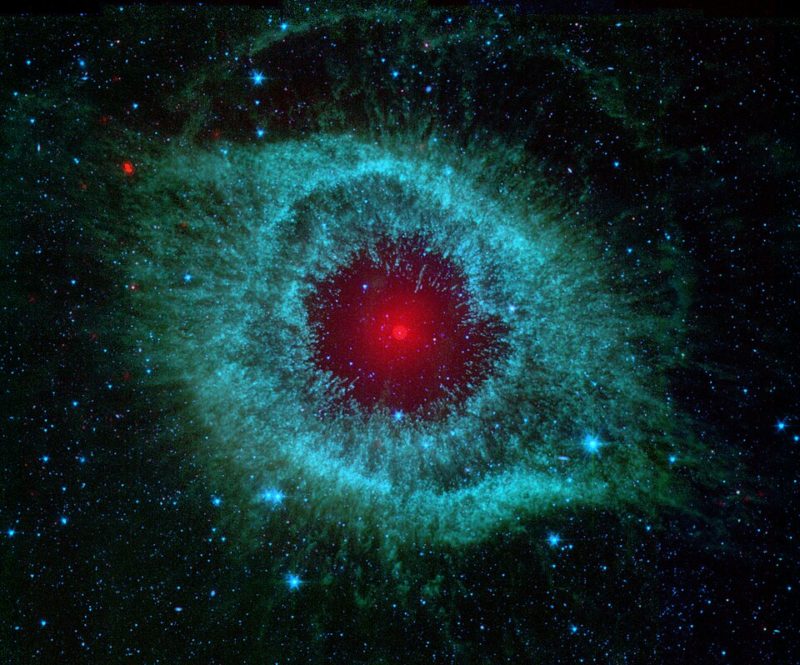
- NGC 7293, the Helix Nebula — the closest bright planetary nebula, about 650 light-years away
- NGC 7009, the Saturn Nebula — small, blue-green, with faint lateral extensions
- Messier 2 — a magnitude 6.3 globular cluster, one of the oldest in the Milky Way
- Messier 72 — fainter globular, plus the odd little asterism M 73 nearby
Helix Nebula
The famous Helix Nebula earned its nickname as the “Eye of God,” and NASA’s imagery of the Helix Nebula reveals the dying star’s shed layers spread across nearly a full lunar diameter of sky. Low surface brightness makes it tricky. Wide field, dark sky, and an OIII filter help enormously.
Saturn Nebula
NGC 7009 got its name because early observers thought its extensions resembled the ringed planet Saturn’s ring system. The high-resolution ESA/Hubble view of NGC 7009 shows a complex nested structure that no backyard scope will resolve, though the blue-green disk is obvious at magnitude 8.
Messier 2 and Messier 72
Charles Messier catalogued both. M2 is the showpiece, densely packed and roughly 13 billion years old, and this detailed profile of Messier 2 walks through its concentration class and stellar population. M72 is dimmer, more diffuse, and sits near M 73, a small cluster of four stars that may not be a cluster at all.
Mythology Behind the Water Bearer
Sumerian sky watchers saw Gula, a water god, in these stars, and the Mesopotamian roots of the water-bearer figure trace back well before Greek astronomy borrowed the imagery. Babylonian astronomers connected the constellation to seasonal flooding. Egyptians linked it to Hapi, deity of the Nile, and NOIRLab’s overview of Aquarius within the Sea region notes how consistently the pattern carried water symbolism across unrelated cultures. The Greek version involves Ganymede, and the account of Ganymede’s abduction by Zeus has the beautiful youth carried to Olympus to pour drinks for the gods.
Observation Tips Under Autumn Skies
Use a wide-field eyepiece and stop hunting for perfect shapes. Nebula filters transform both planetary nebulae. Note that the Eta Aquariids and Delta Aquariids both radiate from this region, with a northern radiant and southern radiant for the latter, and the Eta Aquariid meteor shower details put its peak in early May, well outside prime Aquarius viewing season.
FAQ
Is Aquarius visible year-round?
No. Roughly September through November for northern observers, spring for southern ones.
Can I see the Helix Nebula with binoculars?
From a truly dark site, yes, as a faint gray patch. Barely.
What’s the brightest star?
Beta Aquarii, Sadalsuud, at magnitude 2.90.
Conclusion
Aquarius rewards observers who stop expecting brightness. Faint stars, ancient symbolism, and a genuinely remarkable planetary system tucked inside its boundaries. Go find Fomalhaut, look up, and give your eyes time.
Would you like to receive similar articles by email?

Paul Tomaszewski
Paul Tomaszewski is a science & tech writer as well as a programmer and entrepreneur. He is the founder and editor-in-chief of CosmoBC. He has a degree in computer science from John Abbott College, a bachelor's degree in technology from the Memorial University of Newfoundland, and completed some business and economics classes at Concordia University in Montreal. While in college he was the vice-president of the Astronomy Club. In his spare time he is an amateur astronomer and enjoys reading or watching science-fiction. You can follow him on LinkedIn and Twitter.


You May Also Like
How To Start An Astronomy Club

Living with CRPS: Coping Strategies and Treatment Advances