Apus Constellation Guide
Tucked away near the southern celestial pole sits one of the sky’s quietest residents, a small constellation that most stargazers glance past without a second thought. Apus, the bird-of-paradise, doesn’t shout for attention. It has no dazzling stars, no ancient legends passed down from the Greek storytellers, no place in the zodiac. Yet for anyone curious enough to explore the far southern sky, this faint constellation rewards patience with a handful of surprising treasures.
This guide walks through what Apus means, where to find the constellation, and which stars and deep sky objects hide within its modest boundaries.
What Does Apus Represent and Where Did Its Name Come From?
Bird-of-Paradise Meaning
The name Apus comes from the Greek word “apous,” meaning “footless” or “without feet.” Odd, right? The reference traces back to the bird-of-paradise, a species from New Guinea whose skins reached European markets stripped of their legs. Traders and naturalists, working from these mutilated specimens, assumed the birds simply had no feet and drifted endlessly through the air. The constellation name preserves that old misunderstanding. According to Richard Hinckley Allen’s study of star names, early astronomical texts even garbled it further, labeling the region “Apis Indica,” which confused the bird with a bee.

Plancius and 1598 Origin
Apus is a relatively young invention. The Flemish astronomer Petrus Plancius introduced it on a celestial globe in 1598, drawing on observations gathered by Dutch navigators Pieter Dirkszoon Keyser and Frederick de Houtman during their voyages through the East Indies. A few years later, Johann Bayer folded Apus into his 1603 Uranometria under the name “Avis Indica.” Nicolas Louis de Lacaille tidied things up in the 1750s, assigning the Bayer letters we still use for its stars today.
Absence of Ancient Myth
Here’s what makes Apus different from constellations like Orion or Leo. There’s no mythology behind it. None. Because the southern sky remained hidden from Mediterranean and Middle Eastern observers, the region simply had no stories attached. The western IAU constellations of the deep south are almost all products of the Age of Exploration, invented by mapmakers rather than dreamed up by ancient poets. That absence of myth is part of why Apus feels so overlooked.
Where Is Apus Located in the Night Sky?
Southern Sky Position
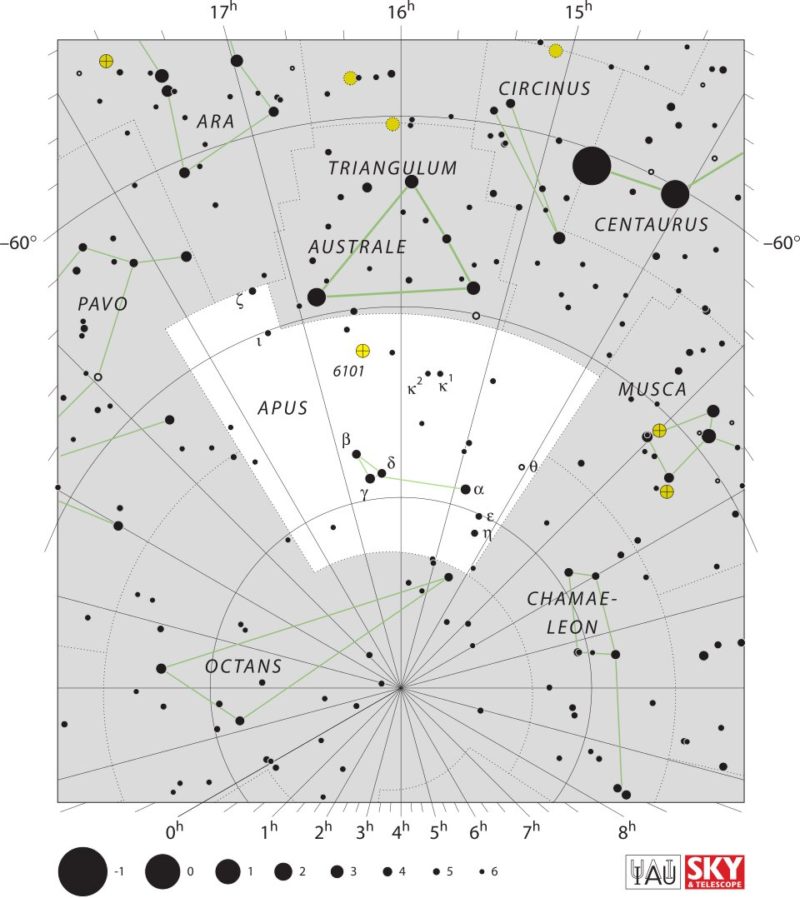
You’ll find Apus in the southern celestial hemisphere, roughly 13 degrees from the south celestial pole. It sits deep in territory that never rises for observers in the northern equatorial regions. The constellation lies within a busy neighborhood of southern sky landmarks, wedged between brighter and more famous star patterns.
Bordering Constellations
Apus shares its constellation boundaries with several neighbors worth knowing when you’re navigating that patch of sky. These include:
- Triangulum Australe and Circinus to the north
- Ara along the eastern edge
- Octans, the constellation containing the south celestial pole, to the south
- Chamaeleon and Musca to the west
Coordinates and Size
Apus is genuinely small. It ranks as the 67th largest of the 88 modern constellations, covering only about 206 square degrees. The right ascension values center roughly around 16 hours, with declination near minus 75 degrees. Eugène Delporte drew up its official boundaries for the International Astronomical Union back in 1930, giving the region its clean modern edges.
How Do You Find Apus?
Best Viewing Months
July is your best bet. During the Southern Hemisphere winter, Apus climbs high enough after dark for comfortable viewing, and the constellation sits near culmination through the middle of the year. If you’re planning an observing session, aim for a moonless night far from city glow, since these dim stars vanish fast under light pollution.
Latitude Visibility Range
Because Apus hugs the celestial pole, visibility depends heavily on where you stand. Observers south of about 7 degrees north latitude can catch at least part of it. For anyone in Australia, southern Africa, or the lower reaches of South America, the constellation stays circumpolar, meaning it never dips below the horizon.
Star-Hopping From Triangulum Australe
The easiest way to locate Apus is to start with brighter guideposts. Find the distinctive triangle of Triangulum Australe first, then hop southward toward the pole. The faint scattering of stars just below that triangle marks the head of the bird-of-paradise. A good southern sky map or a stargazing app makes the jump far simpler.
Major Stars in Apus
Alpha Apodis
The brightest star in the constellation, Alpha Apodis, glows at an apparent magnitude of only 3.83. It’s an orange giant sitting roughly 498 light-years away, having swelled to about 48 solar radii as it evolved off the main sequence. Even as the leading light of Apus, it barely qualifies as noticeable to the naked eye under ordinary conditions.
Beta and Gamma Apodis
Beta Apodis is another orange giant, shining near magnitude 4.24 at a distance of about 156 light-years. Gamma Apodis follows close behind at magnitude 3.86, making it technically competitive with Alpha for brightness. Both are evolved giant stars that have burned through their core hydrogen and expanded, a common fate for stars a few times heavier than our Sun.
Delta and Variable Stars
Delta Apodis is a wide double star, splitting into Delta1 Apodis and Delta2 Apodis, both red giants visible through binoculars. The variable star R Apodis and the semiregular fluctuations elsewhere give the region a bit of dynamic character. Kappa Apodis breaks into Kappa1 Apodis and Kappa2 Apodis, while stars like Eta Apodis, Zeta Apodis, Theta Apodis, and Iota Apodis fill out the constellation’s sparse framework. Two host stars, HD 131664 and HD 134606, carry confirmed planets, discovered through the same radial-velocity techniques that fueled early exoplanet hunts before Kepler.
Deep Sky Objects Within Apus
NGC 6101 Globular Cluster
The standout deep sky object here is NGC 6101, a globular cluster drifting about 47,600 light-years from the Sun. It’s a loose, ancient swarm of stars, best appreciated through a moderate telescope, and easily the most rewarding target the constellation offers. Researchers studying its kinematics have found it unusually rich in blue straggler stars, hinting at a dynamically active past.
IC 4499
IC 4499 is another globular cluster, looser and fainter than NGC 6101. It caught astronomers’ attention because it appears surprisingly young for a globular, throwing a small wrench into tidy models of how these ancient star systems form and age.
NGC 6392
NGC 6392 rounds out the list as a modest spiral galaxy tucked within the constellation’s borders. It won’t compete with showpiece galaxies elsewhere, but it fits the pattern of Apus, quiet objects that reward the observer willing to hunt. The gravitationally lensed Sunburst galaxy also lies in this direction, a favorite subject for professional astronomers probing distant, magnified light.
Why Apus Stays Faint and Overlooked
Frankly, Apus suffers from bad luck on two fronts. Its stars are dim, none brighter than magnitude 3.8, and it lacks the mythological weight that draws people to older patterns. There’s no bright star catalogue entry that stops you in your tracks, no story to anchor it in memory. For most casual observers scanning the night sky, it simply blends into the background near the pole.
FAQ
Is Apus visible from the Northern Hemisphere?
Only barely, and only from locations near or south of 7 degrees north latitude. For most of North America, Europe, and northern Asia, it never rises.
What is the brightest star in Apus?
Alpha Apodis is traditionally called the brightest, though Gamma Apodis runs nearly even with it at magnitude 3.86.
Does Apus contain any planets?
Yes. Two stars in the constellation, HD 131664 and HD 134606, host confirmed exoplanets.
When is the best time to see Apus?
July, during the Southern Hemisphere winter, offers the clearest and highest views of the constellation.
Conclusion
Apus won’t ever headline a stargazing guide, and that’s fine. This little southern constellation carries a strange history, a name born from a European mistake, and a scattering of orange giants and globular clusters that reward the patient observer. If you find yourself under dark southern skies some winter night, take a moment to track down the footless bird. It’s a quiet corner of the heavens, sure, but discovering the overlooked ones is half the fun of looking up.
Would you like to receive similar articles by email?

Paul Tomaszewski
Paul Tomaszewski is a science & tech writer as well as a programmer and entrepreneur. He is the founder and editor-in-chief of CosmoBC. He has a degree in computer science from John Abbott College, a bachelor's degree in technology from the Memorial University of Newfoundland, and completed some business and economics classes at Concordia University in Montreal. While in college he was the vice-president of the Astronomy Club. In his spare time he is an amateur astronomer and enjoys reading or watching science-fiction. You can follow him on LinkedIn and Twitter.


You May Also Like
NGC 2336: A Unique Barred Spiral Galaxy
How Did Venus Get Its Name?