Antlia Constellation Guide
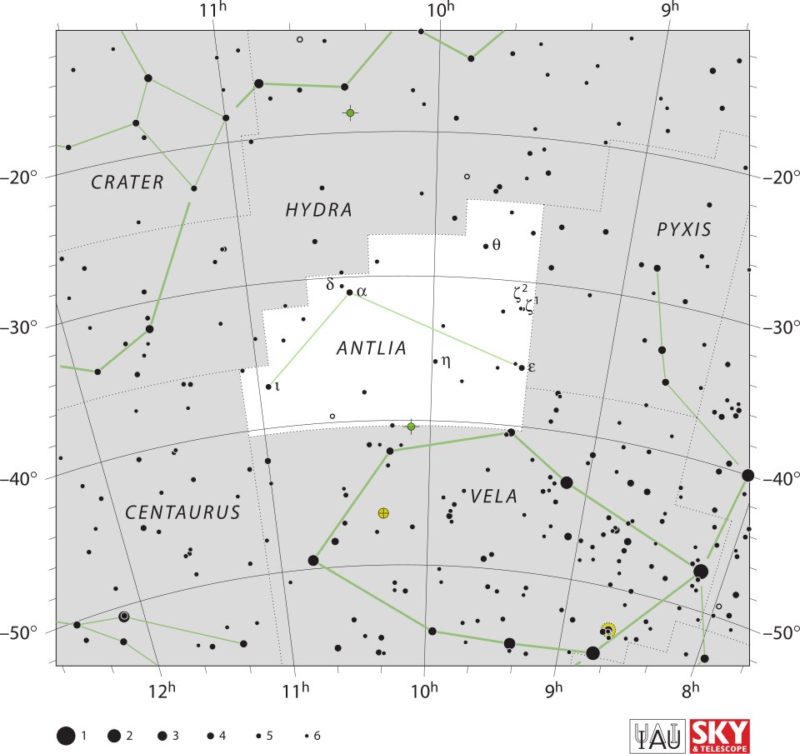
If you go looking for Antlia in the night sky expecting something grand, you’ll be disappointed. This is a faint constellation, one of those dim southern patches most casual stargazers glide right past without noticing. But that quietness is exactly what makes it worth a second look. Antlia, the Air Pump, is a modern southern constellation created not from ancient myth but from Enlightenment-era science.
This guide walks through what it is, who invented it, where to find it, and why a constellation with no stars brighter than 4th magnitude still deserves your attention.
What Is the Antlia Constellation?
Antlia is a small constellation in the southern celestial hemisphere, representing an old-fashioned air pump. No heroes, no gods, no sprawling backstory. Just a piece of laboratory equipment immortalized against the stars.
Air Pump Symbol
The name itself is Latin for “air pump,” a nod to the vacuum machine invented in the 17th century. When the French astronomer who created it first sketched these stars, he was honoring the tinkering spirit of experimental physics, not the drama of classical mythology. The device traces back to work by French physicist Denis Papin and the earlier German experiments of Otto von Guericke.
Modern Origin
Unlike Orion or the constellations Ptolemy catalogued thousands of years ago, Antlia is a newcomer. It doesn’t appear in any ancient star chart. It’s one of the modern constellations invented during the scientific revolution, which is oddly fitting for a group of stars named after a machine.
Faint Profile
Here’s the catch with Antlia. It’s genuinely dim. The whole region is sparse, structurally thin, and easy to lose against the surrounding dark. The brightest star barely scrapes past 4th magnitude, so you won’t be dazzled. You’ll be squinting.
Who Created Antlia and Why?
The credit goes to the French astronomer Nicolas-Louis de Lacaille, who mapped much of the southern sky in the 1750s.
Lacaille’s Vision
Working from an observatory at the Cape of Good Hope, Lacaille charted stars that European astronomers up north simply couldn’t see. He filled the gaps between older constellations with symbols of the Enlightenment. He named this one la machine pneumatique, later Latinized to Antlia Pneumatica.
Enlightenment Science
Lacaille wasn’t sentimental about the past. He was celebrating the tools of reason. Think about it, while ancient sky-mappers honored bulls and hunters, this French astronomer chose telescopes, easels, chemical furnaces, and an air pump. The southern celestial hemisphere became, in his hands, a museum of scientific instruments.
Name Shortened
The original Antlia Pneumatica felt clunky. It was John Herschel who recommended trimming it down, and the shorter name Antlia stuck through general adoption. A small edit, but one that stuck for good.
Where Is Antlia Located in the Sky?
Antlia sits south of the celestial equator, wedged between brighter neighbors. Its coordinates put it firmly in southern territory.
Right Ascension
The constellation spans a right ascension of roughly 9h 27m to 11h, placing it near the boundary with the vast winding constellation Hydra.
Declination
Its declination runs from about -24° to -40°, deep enough south that northern observers get a poor deal. If you live in the far north, Antlia hugs your horizon or never rises at all.
Bordering Constellations
Antlia shares its constellation boundaries with several regions. Hydra curls along its northern edge, while Vela, Pyxis, and Centaurus frame the rest. To help orient yourself, here’s a quick reference:
| Direction | Bordering Constellation |
|---|---|
| North | Hydra |
| West | Pyxis |
| South | Vela |
| Southeast | Centaurus |
When and Where Can You See Antlia?
Timing and location matter more with faint constellations than showy ones.
Best Viewing Months
April evenings are your window. That’s when Antlia climbs highest and stays visible for a decent stretch after dark, according to guides like EarthSky’s breakdown of when to spot the Air Pump.
Ideal Latitudes
You’ll have the best luck south of the equator, though observers as far north as around +45° can still catch it low on the horizon. Anywhere in the Southern Hemisphere gives you a clean, high view.
Meridian Timing
The constellation crosses the meridian, its highest point in the sky, during April nights. Catch it then and you’re seeing it at its clearest, well above the atmospheric murk near the horizon.
Which Stars Define Antlia?
None of the Antlia stars will stop you in your tracks. But a few reward patience.
Alpha Antliae
The brightest of the bunch, Alpha Antliae, is an orange giant star sitting about 320 light-years away. Prof. Jim Kaler’s stellar analysis classifies it as an orange giant, a star that swelled up after burning through its hydrogen core.
Epsilon Antliae
Epsilon Antliae is another orange giant, fainter but similar in character. Nearby you’ll also find Iota Antliae and Theta Antliae, quiet stars that fill out the constellation’s thin frame.
Variable Stars
Antlia holds a couple of intriguing variable stars. U Antliae is a carbon star whose brightness wobbles over time. Then there’s S Antliae, a contact binary star where two suns orbit so close they nearly touch, listed in the NASA Exoplanet Archive as a genuine oddity. Zeta Antliae, meanwhile, is a wide double star worth splitting with binoculars.
What Deep Sky Objects Live in Antlia?
This is where Antlia earns its keep. The faint stars hide some serious deep sky objects.
Antlia Dwarf Galaxy
The Antlia Dwarf is one of those objects that reminds you how much sits just beyond easy reach. It’s part of our own galactic neighborhood, yet so faint that it went unnoticed for decades.
Spiral Galaxy NGC 2997
The unbarred spiral galaxy NGC 2997 is the showpiece. Tilted almost perfectly face-on, its arms unwind in a clean spiral, making it a favorite target for astrophotographers with patient shutters.
Antlia Cluster
The Antlia Cluster is a dense knot of galaxies dominated by NGC 3258 and NGC 3268. A DECam deep view from NOIRLab revealed hundreds of galaxies swarming in this compact region, a favorite among professional astronomers studying how clusters assemble.
Observe Antlia With the Right Equipment
Naked-eye stargazing won’t get you far here. You’ll need help. A modest telescope pulls in Alpha Antliae and the brighter doubles easily, but the galaxies demand more aperture, dark skies far from city glow, and a decent star chart or an Antlia constellation map to guide you. NGC 2997 becomes a smudge in small telescopes and a genuine spiral in larger ones. Keep a red flashlight handy to protect your night vision, and let your eyes fully adjust before hunting the dwarf galaxy.
Why Antlia Matters Despite Its Faintness
I’ll be honest, I find something charming about a constellation named after a lab tool. It’s a snapshot of a moment when humanity decided the machines of science deserved a spot among the stars. Antlia isn’t flashy. It won’t win over anyone chasing bright showpieces. But it carries the fingerprints of early science, and its hidden galaxy cluster keeps astronomers busy to this day. Faint doesn’t mean unimportant.
FAQ
Is Antlia visible from the Northern Hemisphere?
Partly. Observers up to around +45° latitude can glimpse it low on the horizon during April, though Southern Hemisphere viewers get the better show.
What does Antlia represent?
An air pump, specifically the vacuum machine of early experimental physics, chosen by Lacaille to honor the science of his era rather than classical myth.
Are there any planets in Antlia?
Yes. Several exoplanets have been detected orbiting stars within the constellation’s boundaries, some ranging up to dozens of Jupiter masses.
Conclusion
Antlia rewards the observer willing to slow down. A faint smear of southern stars named for a pump, it holds a dwarf galaxy, a stunning spiral, and one of the richest clusters in the Virgo Supercluster. Wait for a dark April night, aim your telescope south, and go explore what most people never bother to find.
Would you like to receive similar articles by email?

Paul Tomaszewski
Paul Tomaszewski is a science & tech writer as well as a programmer and entrepreneur. He is the founder and editor-in-chief of CosmoBC. He has a degree in computer science from John Abbott College, a bachelor's degree in technology from the Memorial University of Newfoundland, and completed some business and economics classes at Concordia University in Montreal. While in college he was the vice-president of the Astronomy Club. In his spare time he is an amateur astronomer and enjoys reading or watching science-fiction. You can follow him on LinkedIn and Twitter.


You May Also Like
How to Use a Skin Stapler
Asteroid 2 Pallas – Overview, Characteristics & Exploration