Andromeda Constellation Guide
Look up on a clear autumn night, away from city glow, and you’ll eventually land on a faint smudge of light that doesn’t quite look like a star. That smudge is the Andromeda Galaxy, and the constellation wrapped around it, Andromeda, has been guiding stargazers and storytellers for roughly two thousand years. It’s one of the 48 constellations cataloged by Claudius Ptolemy in the second century, and it remains one of 88 modern constellations recognized today by the International Astronomical Union.
What makes Andromeda worth learning isn’t just the mythology, though that’s a good story. It’s that this one patch of sky hands you a direct line of sight to the nearest major spiral galaxy to our own Milky Way, visible without a telescope if your skies are dark enough.
How Do You Find Andromeda in the Night Sky?
Finding Andromeda starts with a shape most people already half-recognize without knowing its name.
Locate the Great Square of Pegasus first
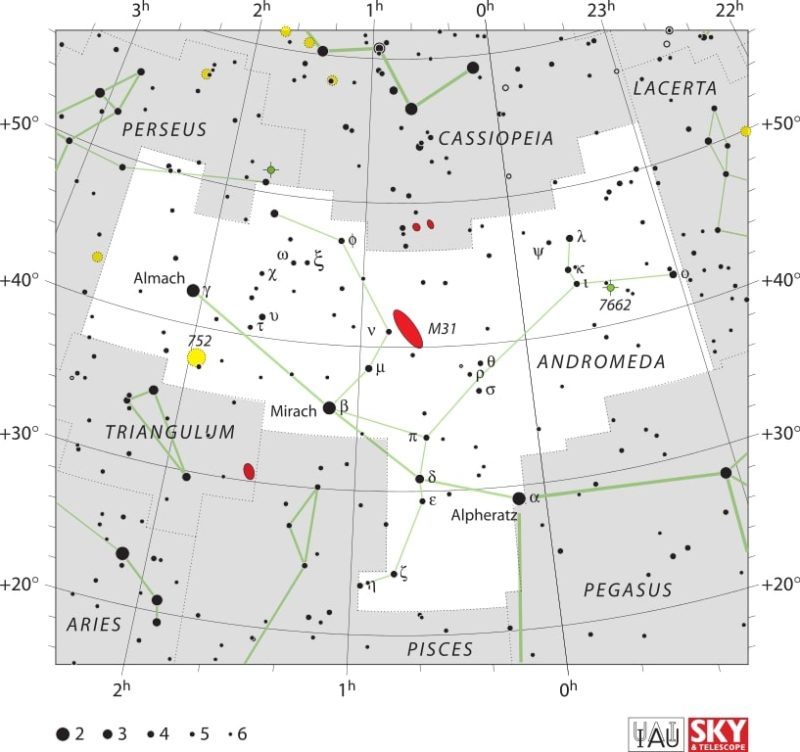
The Great Square of Pegasus is your anchor point, four stars forming a near-perfect square that dominates the autumn sky in the northern hemisphere. Oddly enough, the star marking the square’s northeastern corner doesn’t actually belong to Pegasus anymore. That star is Alpheratz, and it’s shared history, once counted as part of the constellation Pegasus, now officially reassigned to Andromeda. Astronomers sometimes still call it Alpha Andromedae to avoid confusion, since the naming reshuffle happened centuries after Ptolemy’s original catalog.
Trace the star chains from Alpheratz
From Alpheratz, two curving chains of stars stretch outward like a pair of loose ropes hanging off the corner of Pegasus. Follow the brighter chain and you’ll hit Mirach, then Almach, each one roughly evenly spaced and easy to pick out even under moderate light pollution. This is where things get genuinely useful for the practical stargazer: extend a line from Mirach north and slightly west, and you’ll land almost exactly on the fuzzy patch that is the Andromeda Galaxy.
Use Cassiopeia as a pointer guide
If the Great Square feels too vague on a hazy night, Cassiopeia offers backup. This W-shaped (or M-shaped, depending on the season) constellation sits almost directly across from Andromeda, and its distinctive points act like a signpost aimed at the galaxy’s general location. Cassiopeia constellation points, when extended downward, roughly bisect the space where Andromeda’s brightest deep-sky object sits. Sailors along the Mediterranean coast used exactly this kind of star-hopping technique long before anyone had a name for celestial navigation.
When Is the Best Time to View Andromeda?
Ideal hemisphere and latitude conditions
Northern hemisphere observers get the better deal here, frankly. Andromeda’s declination places it far enough north that viewers in the mid-latitudes, think most of the continental United States, see it ride high across the sky for months. Southern hemisphere observers below about 40 degrees south latitude will find it hugging the north horizon or missing entirely, a quirk of the equatorial coordinate system that governs how we map right ascension and declination onto the celestial sphere.
Dark-sky requirements for the galaxy
Spotting the constellation’s stars is forgiving. Spotting the galaxy itself is not. You need genuinely dark skies, ideally somewhere with minimal light pollution, to see the Andromeda Galaxy as anything more than a ghost of a smudge with the naked eye. Binoculars help enormously here, and even modest small telescopes will start resolving its oval core and hint at the disk extending beyond it.
What Is the Mythology Behind Andromeda?
The Greek princess and Cetus the sea monster
The myth goes like this. Queen Cassiopeia bragged that her daughter Andromeda, or in some tellings herself, was more beautiful than the sea nymphs known as the Nereids. That kind of boast never goes unpunished in Greek mythology. The sea god Poseidon, insulted on behalf of the nymphs (some versions swap in the sea goddess Thetis as the offended party), sent a sea monster, Cetus, to ravage the coastline. An oracle declared the only fix was to chain Princess Andromeda to a rock as an offering to the beast.
Perseus and the rescue that named the stars
Enter Perseus, fresh off beheading Medusa, flying home on winged sandals gifted partly through the goddess Athena’s favor. He spots Andromeda chained to the rock, falls for her immediately, and strikes a deal with her father: kill the monster, marry the princess. He does exactly that, using either Medusa’s severed head to turn Cetus to stone or a sword, depending on which ancient source you trust. Zeus later honored the whole cast by placing them among the stars, which is why the sky preserves this entire family drama in one neighborhood.
How Andromeda connects to neighboring constellations
This is why Andromeda doesn’t sit alone. Perseus, Cassiopeia, Cetus, and even Pegasus, the winged horse tied to Perseus’s exploits in some versions, cluster together in the same region of sky. It’s essentially a mythological family reunion mapped onto the heavens, and recognizing one constellation in this group makes the others far easier to locate by association.
What Are the Key Stars in Andromeda?
| Star | Designation | Notable Feature |
|---|---|---|
| Alpheratz | Alpha Andromedae | Shared border star, once part of Pegasus |
| Mirach | Beta Andromedae | Points toward the Andromeda Galaxy |
| Almach | Gamma Andromedae | Colorful double star, gold and blue components |
Alpheratz, the shared border star
Alpheratz remains the brightest star in the constellation and, despite its odd history of belonging to two constellations at once, is now firmly cataloged under Andromeda. It’s a blue-white subgiant, considerably more massive and luminous than our sun.
Mirach and its galaxy-marking role
Mirach earns its keep as a navigational tool more than anything else. Its practical value, pointing observers toward Messier 31, arguably outweighs its own modest astrophysical claim to fame.
Almach, a colorful double star
Almach rewards anyone who bothers to point even a small telescope at it. Split into two components, you’ll see a striking contrast between a golden-orange primary and a fainter blue-green companion. Not seen by modest telescopes are two more smaller stars orbiting the blue-green companion.
What Deep-Sky Objects Does Andromeda Contain?
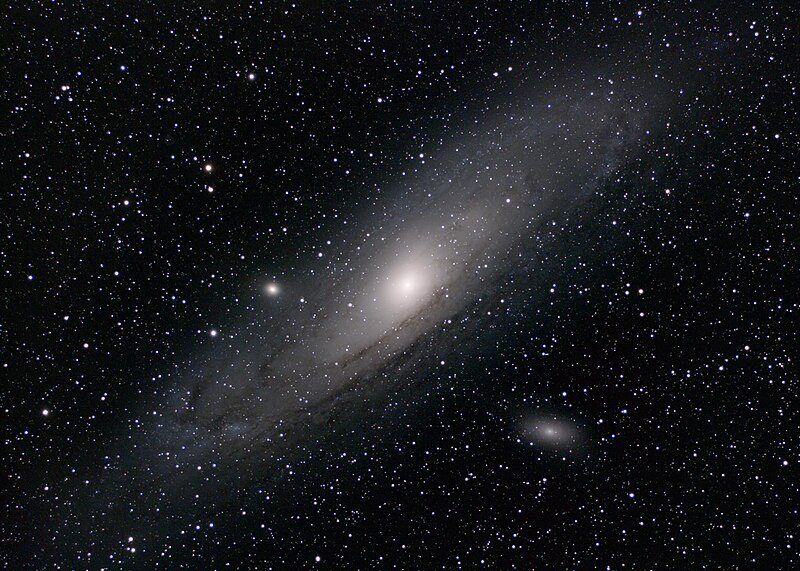
The Andromeda Galaxy (Messier 31)
This is the headline act. Messier 31, roughly 2.5 million light-years distant, is the largest galaxy in what’s called the Local Group, edging out even the Milky Way in terms of sheer stellar population.
Companion galaxies M32 and M110
M31 doesn’t travel alone. Two dwarf spheroidal galaxies, M32 and M110, orbit it closely and appear as small, dim companions in wide-field images or larger amateur telescopes. Both are thought to have been distorted, possibly stripped of gas, through gravitational interaction with their much larger neighbor.
NGC 752 and other lesser-known clusters
Beyond the galaxy trio, Andromeda hides some lower-profile targets worth hunting. NGC 752 is a loose open star cluster, pleasant in binoculars on a clear night. NGC 7662, nicknamed the Blue Snowball, is a planetary nebula, the glowing shell cast off by a dying star, visible as a small blue disk through moderate telescopes.
What Causes the Andromedids Meteor Shower?
The Andromedids meteor shower is tied to debris left behind by Biela’s Comet, a comet that famously broke apart in the 1800s. When Earth’s orbit crosses the scattered trail of that comet’s remnants, the resulting meteor shower radiates from a point within the Andromeda constellation, though activity has been weak and unpredictable in recent decades compared to its dramatic outbursts in the 19th century.
FAQ
Is Andromeda visible without a telescope?
Yes, under dark skies, the galaxy appears as a faint smudge to the naked eye, though binoculars or small telescopes reveal considerably more detail.
What’s the best month to see Andromeda?
October offers the best combination of high sky position and reasonable evening hours across the northern hemisphere.
Why is Alpheratz associated with two constellations?
Historical star charts placed it within Pegasus before modern astronomical conventions formally reassigned it to Andromeda.
Conclusion
Andromeda rewards the patient observer twice over, once with a genuinely good story about chained princesses and slain monsters, and again with a real, physical galaxy sitting quietly in the same patch of sky, waiting for anyone willing to step outside on a dark, clear night and look.
Would you like to receive similar articles by email?

Paul Tomaszewski
Paul Tomaszewski is a science & tech writer as well as a programmer and entrepreneur. He is the founder and editor-in-chief of CosmoBC. He has a degree in computer science from John Abbott College, a bachelor's degree in technology from the Memorial University of Newfoundland, and completed some business and economics classes at Concordia University in Montreal. While in college he was the vice-president of the Astronomy Club. In his spare time he is an amateur astronomer and enjoys reading or watching science-fiction. You can follow him on LinkedIn and Twitter.


You May Also Like
Hydra Constellation Guide

Dental Implants vs. Dentures: Long-Term Benefits Compared